Engineers rarely take to writing for the public. What could be the reason for such reticence? Are they not confident of literary prowess? Do they think that their engagement with designs and drawings, plants and machinery, roads, buildings and irrigation dams is too prosaic for public interest? Or both? But they all deal with human beings and work for human welfare. Since a fair share of the country’s best talent works in the fields of engineering and technology, it is a pity that more accounts are not emanating from the pen of engineers.
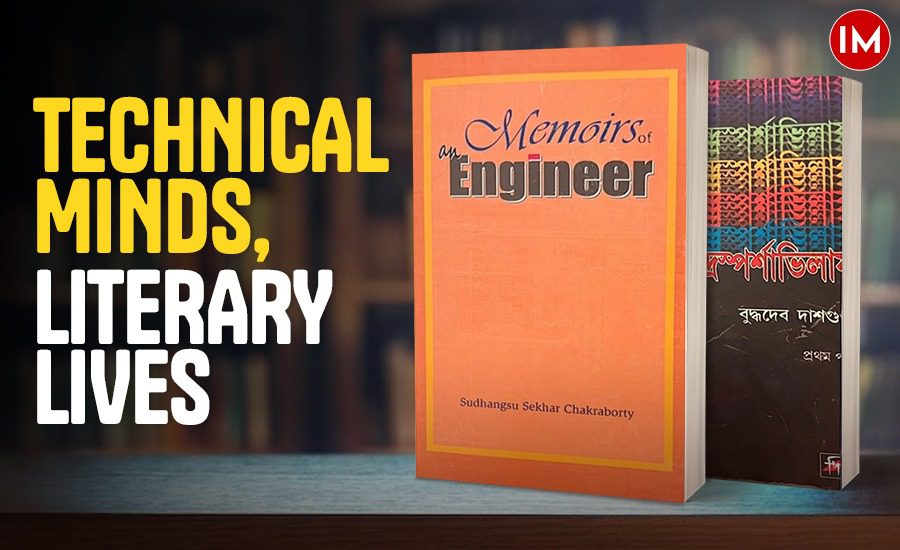
These thoughts crossed my mind when I just finished reading three books. Two in Bengali and one in English, authored in the last two decades by three of our most illustrious engineers. The first one is titled Bamaner Chandrasparshavilas (The Desire of a Dwarf to Touch the Moon) by the engineer-sarodist Buddhadev Dasgupta (Disha Sahitya, Part I first published in 2004, and Part II in 2010); the second one is titled Memoirs of an Engineer by the engineer-entrepreneur Sudhangsu Sekhar Chakraborty (ORIOLE Publication, 2019); and the third one by the engineer-researcher-teacher-academic administrator Amitabha Ghosh is interestingly named Mouja Gangarampur (Abhisikta Publications, 2016). Although the style, context and content vary wildly, these are all autobiographical in nature. Coincidentally, all of them were products of the Bengal Engineering College (now, the Indian Institute of Engineering Science and Technology), Shibpur, West Bengal. Not very surprising, though, if one keeps in mind that this institution has produced celebrated literary figures like Badal Sarkar and Narayan Sanyal and poets like Jatindranath Sengupta and Binoy Majumdar.
Judged by literary merits alone, Bamaner Chandrasparshavilas has few equals. The book moves on two strands, often converging and often diverging, almost seamlessly. Dasgupta’s fame as an instrumentalist of pan-India fame often eclipses his accomplishments as a student (who stood second in the matriculation examination of 1948) and as a practising engineer in the private sector. His public image also submerges his writing skill that sparkles with wit and humour. The way the two volumes chronicle his life from childhood and how it was influenced by his guru, Radhika Mohan Maitra, the noted sarodist, and by the legendary teachers at Shibpur, like Professors S.R. Sengupt, A.C. Roy and R.G.P.S. Fairbairn, makes a compelling narrative. He weaves magic by mixing lively anecdotes with hard facts about stalwarts like Allauddin Khan, Bade Ghulam Ali Khan, Ali Akbar Khan, Ravi Shankar, Vilayat Khan, Jnan Prakash Ghosh and Ajoy Chakraborty from the world of music and towering figures in the field of engineering – always maintaining a low profile himself.
Here is an example from his college days. After designing a four-stroke diesel engine as a part of project work, he enquired from Professor Fairbairn whether the engine would work in real life. After some thought, the professor replied, ‘Yes, your engine will run… but after some time… it will run into the Ganges… you forgot to provide the locking nuts on your foundation bolts!!’
No wonder the book was received with huge popularity and critical acclaim.
It is a pity I never met Dasgupta (1933-2018), though we had spoken on the phone a few times. He seemed a little upset with the manner in which his association with the Rajya Sangeet Akademi was severed but was gracious enough to appreciate the merit of his successor, whom the government had chosen. He told me, ‘Stabdha hoye jabar aage…’ (Before becoming silent…), he was planning to complete the final part of his memoir. But he passed away sometime thereafter. I wonder if his death came in the way. If so, this unique genre of writing stands impoverished.
Like Dasgupta, Chakraborty (1937–) was also a brilliant product of B.E. College, obtaining a first-class degree in engineering in 1957, when a first-class degree from Shibpur used to mean a real first-class product by any standard. And a rarity too. Chakraborty’s story is very different but interesting nonetheless. A victim of Bengal’s partition, his prosperous family lost almost everything. Nevertheless, the steadfastness of the young man ensured that the formidable difficulties of life were eventually overcome. He rose to be among the founder-directors of the well-known company Consulting Engineering Services (CES), which, at its peak, employed about 2,500 people, mostly engineers. The company spread globally and, in the fields of roads and bridges in particular, acquired international fame, largely owing to the efforts of a few outstanding engineers. This slim volume faithfully records the process of this rise, as also of how providence played a crucial role in changing his life’s contours. Time and again, he had taken bold decisions, often against the advice of his well-wishers. This capacity for risk-taking at appropriate junctures, coupled with a genuine love for nation-building as an engineer-entrepreneur and innate leadership qualities, distinguishes him from other equally eminent engineers. Unlike many others, he credits his colleagues and team members so profusely and keeps his own profile so moderate that the story, which in lesser hands would have turned into a drab one, becomes so engrossing. The same generosity of spirit becomes evident when he remembers his father-in-law, Pramatha Nath Bishi, or donates ten crore rupees to set up a Centre for Sustainable Infrastructure Development at his alma mater.
As a brilliant teacher-researcher and an astute educationist-administrator, Amitabha Ghosh (1941–) has few parallels. As students of mechanical engineering, we used to be mesmerised by his teaching of difficult subjects like the Theory of Machines. Later, he moved to IIT, Kanpur, as a professor and eventually retired as one of IIT Kharagpur’s most celebrated directors. At one time, he was hailed as India’s best authority on robotics. But a man of his calibre and technical expertise never retires. They give back to society, often selflessly, far more than they received from it. This book, Mouja Gangarampur, has distinct characteristics. It does not cover what he is best known for – as one of India’s finest engineering minds. Autobiographical by implication, it traces the life of Sandipan, mostly in the rural setting of the Rahr region of Bengal in newly independent India, from childhood to early adulthood. The book ends with the protagonist appearing for the school final examination.
What makes this book a reader’s delight is the way the curiosity and wonderment of a growing boy, like Bibhutibhushan’s Apu, is captured with accuracy and empathy. A particular event, chance access to two books—Euclid’s Elements and another Bengali one on trigonometry—made him discover a new world and marked his ascent from a boy, considered average by every standard, to one deeply interested in studies. This was an epiphanic moment! The way every small detail of the boy’s life and interactions with his friends and surroundings has been captured adds enormous charm and richness to this slim volume.
These three books, authored by engineers who scaled high peaks in their lives, also display certain common characteristics. As professional engineers, their observations of life are clearly expressed in a language that is precise and devoid of verbosity and jargon. Everyone is careful not project themselves unnecessarily. Besides, all these writings radiate fun, happiness and hope – something they might have imbibed from fellow students and teachers during their years of stay in the hostels of the old college standing by the side of the Ganges.
Although Dasgupta had received the Padma Bhushan primarily as a sarodist, Chakraborty and Ghosh have not received any such national award. Not even one by the state government. If society values primarily the popular entertainers and not its real achievers, who should one blame?
The books will interest engineers, engineering aspirants and discerning readers, making them wonder why the engineers are not writing more.
(Amitabha Bhattacharya retired from the IAS as a Principal Adviser in the Planning Commission, New Delhi. He had also worked with UNDP and in the private sector. He writes on issues of public interest.)