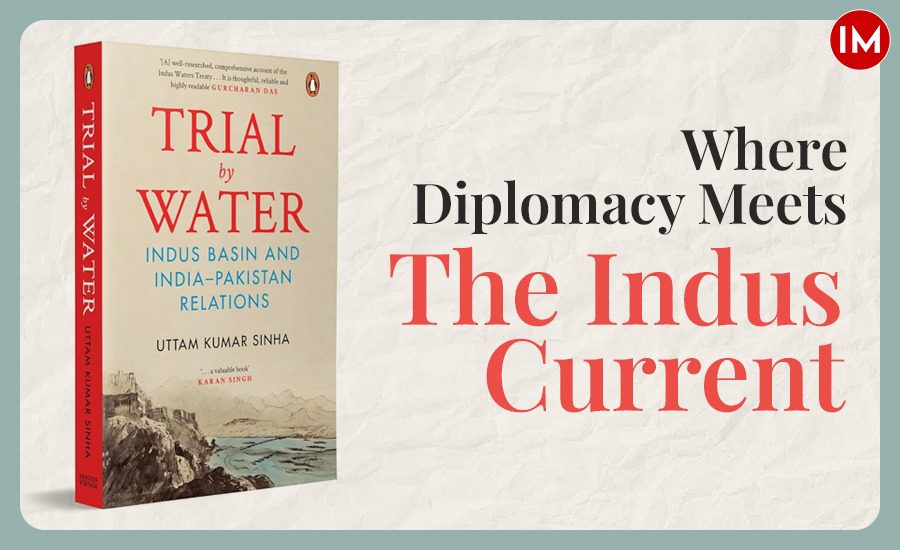
Uttam Kumar Sinha’s scholarly treatise, Trial by Water: Indus Basin and India-Pakistan Relations, could not have come at a more opportune time. Two days after the bloodshed in picturesque Pahalgam—when Pakistan-sponsored terrorists killed twenty-six tourists on July 22nd—Debashree Mukherjee, Secretary of the Water Resources (Jal Shakti) ministry, informed her Pakistani counterpart, Syed Murtaza, of India’s decision to keep ‘the Indus Waters Treaty (IWT) of 1960 in abeyance with immediate effect.’ A year earlier, in August 2024, India had issued a formal notice to Pakistan under Article XII (3) seeking a review of the treaty signed on September 19, 1960, between the democratically elected prime minister of India, Jawaharlal Nehru, and the chief martial law administrator of Pakistan, Field Marshall Ayub Khan, at the then-capital of Pakistan in Karachi.
Crescat e Fluviis
Brokered by the World Bank, this agreement was the result of contentious negotiations, exceeding those of Radcliffe’s boundary division. There were three key differences. First, Mountbatten was in complete control. Second, Radcliffe had a deadline—the 15th of August—and thirdly, the census data of 1941 was a general indicator for assigning Muslim majority districts to Pakistan and the Hindu-Sikh majority districts to India.
Assigning rivers and canals was far more complex. The Indus basin, with its extensive network of thirteen canals and nineteen headworks, irrigated a total of 36.5 million acres as the largest contiguous integrated irrigation system on a single river. No wonder then that the motto of the British Punjab was the Latin expression Crescat e Fluviis, “Let it grow from the rivers.” And as Sinha tells us, the irrigation network of canals could girdle the circumference of the earth twice over, thereby making Punjab the granary of the Empire and its most prosperous province.
However, the Partition was accompanied by unprecedented violence and mayhem. Between 500,000 and 800,000 deaths, displacement of around ten million people, grievous injuries, and sexual assault on at least a hundred thousand women. Tensions ran high, and bitter discussions on Indus were characterised by conflicting claims and a pervasive atmosphere of distrust. In East Punjab, everyone from political leaders to the press and bureaucrats to irrigation engineers was most reluctant to spare even an extra drop of water. In fact, to Nehru’s ‘liberal and generous approach towards a peaceful settlement based on reciprocity,’ a perplexed parliamentarian commented, ‘I have a feeling, rightly or wrongly, that the Prime Minister has a tendency, whenever our country is involved in some sort of a dispute, be it a border dispute or any other dispute with a neighboring country, Pakistan or China, to conduct himself in the manner of an umpire in a cricket match rather than as one of a country that is involved in the dispute over whose destiny he has the honour to preside.’ But to be fair, even the hawks in Pakistan, led by Fatima Jinnah, were extremely critical of Ayub Khan for having conceded the Eastern rivers to India. Dawn, the newspaper founded by her famous brother, had quipped that ‘Ayub had won, Pakistan had lost.’
The Abdullahs on the Indus Waters
Meanwhile, the distribution of water between India and Pakistan faced opposition from another quarter. When Sheikh Abdullah, the ‘frenemy’ of Nehru, was finally released in 1964, he held that the people of the state had been deprived of ‘their natural share’ at the expense of both India and Pakistan. Sinha points out that the first resolution in favour of abrogation of the treaty actually came from the unanimous resolution of the J&K Assembly in 2002 and again in 2016. Thus, all three Abdullahs – Sheikh Mohammed, Farooq and Omar – have argued that India’s position on IWT was restrictive towards J&K. Incidentally, this perception was shared even by the Congress leadership of East Punjab!
The Nehru who shines in Uttam’s book is the economist and civil servant BK, who later became our Ambassador to the USA during the critical sixties. It was he who insisted that the Indian negotiating team be led by the distinguished irrigation engineer, Gulhati. He also asked his cousin to temper his strident anti-Americanism if he wanted American aid. It must be acknowledged that while Pakistan under Ayub was saying all the right things at the White House, Nehru was still stuck in his ideological time warp.
As the subtitle of the book clearly states, Sinha’s book is also about India-Pakistan relations, and therefore, the state of J&K has to be part of the discussion. Everything that has been written about Riyasat e Jammu wa Kashmir wa Ladhak wa Tibet Ha – the official name of the state from 1846 to 1947 – is combative. There were four principal actors: Maharaja Hari Singh, the twenty-one-gun-salute ruler who wanted to assert the state’s independence after the lapse of British paramountcy; Sheikh Mohammad Abdullah, the Aligarh-educated mass leader with Bolshevik leanings who converted the Muslim Conference into the National Conference; Prime Minister Jawahar Lal Nehru, whose family traced its ancestry to the state; and Mohammed Ali Jinnah, who ‘offered the moon’ to Hari Singh and his prime minister, Ram Chandra Kak, if the state joined the Dominion of Pakistan. Within the valley (though not in Jammu or Ladakh or the frontier areas abutting Tibet), the Muslim League was pressing the Maharaja to join Pakistan, while Sheikh Abdullah was vociferous in his support for accession to India. Be that as it may, by the third week of October, when the tribal raiders backed by the Pakistan army regulars were almost near the airfield of Srinagar, Maharaja Hari Singh sought the assistance of the Indian army to push back the invaders. However, Nehru insisted that the Maharaja first sign the instrument of accession in favour of India, which was finally done on October 26. The very next day, Indian troops landed in Srinagar and were well on their way to capturing Muzaffarabad when India suggested a ceasefire, which was immediately accepted by Pakistan since the raiding parties had disintegrated. From the Indian point of view, it was a strategic blunder. But Mountbatten and the British commanders-in-chief—General Roy Bucher of India and General Douglas Gracey of Pakistan—were keen that troops that had faced action together in the Second World War should not be training guns at each other. In a supreme irony of sorts, Sheikh Mohammad Abdullah from India and Sir Zarfarullah Khan from Pakistan, as the two eloquent spokespersons for both sides at the UNSC debates on the ceasefire, were soon to become ‘persona non grata’ for their respective countries.
The second part of the book is called ‘Diplomacy and War.’ This year also marks six decades of the 1965 war in which Shastri’s India proved much more resilient than Ayub’s Pakistan. Ayub had grossly underestimated the new prime minister, as well as his firm resolve and determination, as well as the reforms initiated by Defence Minister YB Chavan. In his imagination, Ayub thought that ‘they would seize the bridge on the Beas River on the GT Road on September 7, Ludhiana on September 9, have a stroll to Delhi by September 10, and enjoy a banquet in the Red Fort in Shah Jehan’s palace on September 11.’ Alas, that was not to be. For, as Shastri quipped, ‘Ayub is a big man. Why give him all the trouble? I will walk up to Lahore to greet him.
The chapter ‘Rivers, Regimes, and the 1965 War’ brings many interesting nuggets to the fore about the follies and foibles of both the armies, theirs more than ours. Just as the Pakistan army was priming its attack, Major General Akbar Hussian Malik was relieved of his command, for he was an Ahmadiyya; the charge was given instead to Gen. Yahya Khan, who was a Pathan Shia like the army chief, Musa Khan. On the Indian side, we had a very conservative chief whose suggestion of withdrawing up to the Beas was rejected both by the field commanders and the political leadership. There was no way in which the Golden Temple would have been left undefended. The former CM of Punjab, Captain Amarinder Singh, who was then the ADC to Gen. Harbaksh Singh, has recorded that the GoC stood his ground when the army chief suggested a strategic withdrawal from the Amritsar sector.
When the UN-mediated ceasefire was announced, it was ‘like rain interrupting a test match hanging in the balance, with both sides believing their objective was within reach. However, the momentum favoured India.’ In any case, the political objectives of Pakistan—of seizing Kashmir by force, driving a communal wedge in the country, and getting global support in its favor—were all negated.
Let me end on a personal note. Twenty-five years ago, I was a guest scholar at the Brookings Institution under the tutelage of the legendary Stephen Cohen. The Senior Resident Fellow from Pakistan was General Jehangir Karamat. Cohen reiterated his assessment, much to my joy and Karamat’s discomfiture, that the Pakistan Army had ‘acquired an exaggerated view of the weakness of both India and the Indian military … the 1965 war was a shock.’
For all this, and much more, this is the book to read this season. Its anecdotal recall, empirical detail, and sound perspective make it a valuable lesson for the present—and likely future.