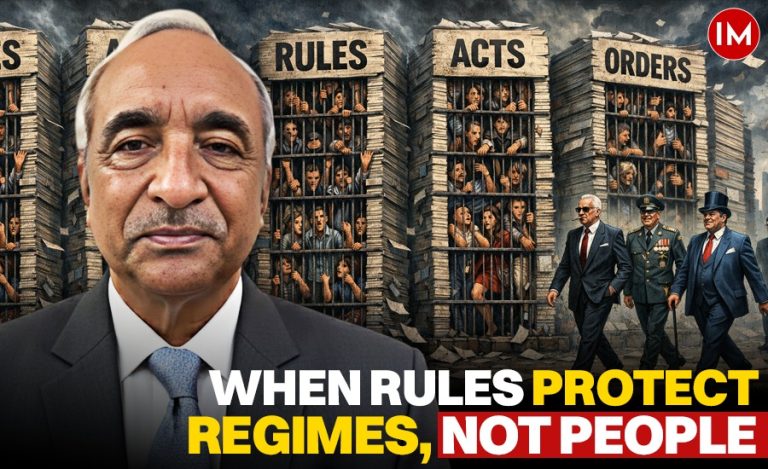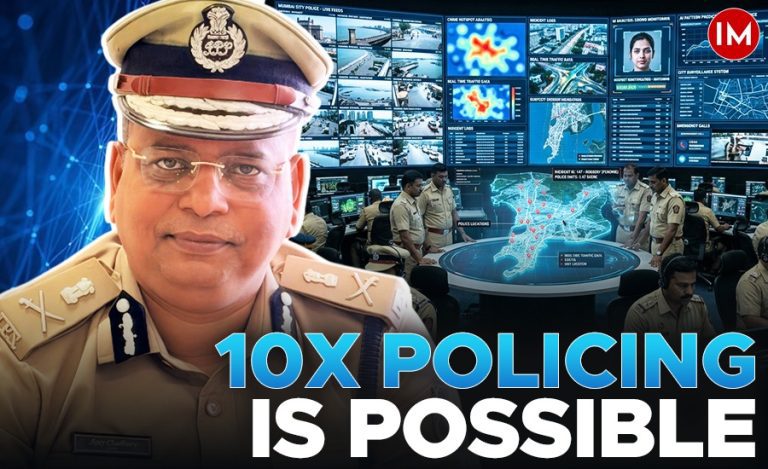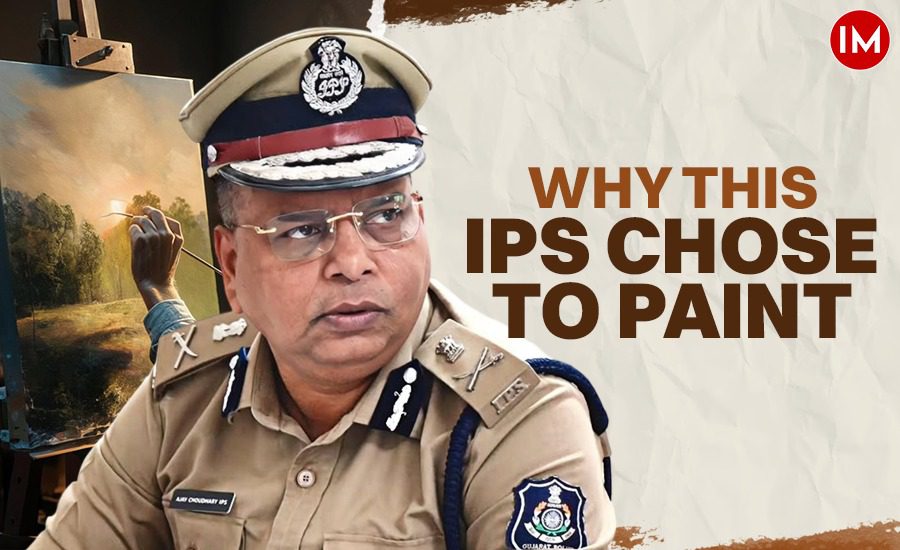
In a system where authority often defines identity, there are a few who quietly redraw the lines. For Ajay Chaudhary, a 1999-batch IPS officer of the Gujarat cadre currently serving as ADGP, policing is not just about enforcing the law—it is about understanding people. And painting, for him, is not just an art form—it is a way of seeing.
“Painting is like a mirror—you see yourself in it,” he told Indian Masterminds.
That one line perhaps explains a life that moves effortlessly between the discipline of policing and the depth of artistic introspection.
FROM BOKARO TO THE IPS
Born in Jharkhand’s Palamu district and raised in Bokaro Steel City, Chaudhary’s journey reflects the classic arc of aspiration—education, perseverance, and public service. After completing his B.Tech in Civil Engineering from IIT Delhi, he entered the civil services, choosing a path that would place him at the intersection of power and responsibility.
But even early on, his thinking refused to stay confined. His upbringing in an industrial township and exposure to premier institutions gave him both structure and curiosity. When he entered the Gujarat cadre, the contrast was striking.
“Gujarat gives you space to experiment and innovate,” he shared with Indian Masterminds, describing it as a cosmopolitan and forward-looking environment.
REDEFINING POLICING: FROM AUTHORITY TO EMPATHY
In a country where policing is often associated with fear, Chaudhary advocates a shift—towards what he calls empathetic policing.
For him, the distinction is simple yet powerful:
- Lawbreakers require firmness.
- Citizens deserve approachability.
“People don’t just expect authority anymore—they expect solutions, empathy, and professionalism,” he told Indian Masterminds.
His approach challenges the colonial legacy of policing and pushes towards a service-oriented model—one where a police officer is not just an enforcer, but a problem-solver, much like a doctor.
He believes leadership must be demonstrated, not declared. Whether it is stepping forward to personally listen to a differently-abled complainant or setting standards for his force, he leads by example.
Watch the Interview here :
THE ARTIST BEHIND THE UNIFORM
Away from the uniform lies a deeply reflective artist.
What began as a childhood hobby—encouraged by his parents—has evolved into a serious artistic pursuit spanning over two decades. His abstract works have been exhibited in India and internationally, earning recognition in reputed art circles.
For Chaudhary, art is not separate from his profession—it complements it.
“Art gives you perspective. It brings balance and clarity in thinking,” he said in his conversation with Indian Masterminds.
He draws inspiration from masters like V. S. Gaitonde, S. H. Raza, and Nasreen Mohamedi—artists known for their philosophical depth and minimalist expression.
For him, abstraction mirrors life itself—constantly evolving, gaining clarity with time.
BEYOND ROLES: A MULTI-DIMENSIONAL LIFE
Police officer. Painter. Reader. Thinker.
Chaudhary refuses to be defined by a single identity. Each role feeds into the other, creating a more balanced and insightful personality.
“Life is limited—we should live it fully and meaningfully,” he reflected while speaking to Indian Masterminds.
He believes that exposure to diverse fields enhances decision-making and broadens perspective—an essential quality in complex administrative roles.
READING, THINKING, AND GROWING
At the core of his philosophy lies a simple but powerful belief: your thinking shapes your life.
He strongly advocates reading as a means to expand one’s mental horizons. Books, according to him, are gateways into the minds of great thinkers.
He recommends works like Think and Grow Rich by Napoleon Hill, along with spiritual literature that nurtures inner clarity.
“Your mind has no size. The bigger your thoughts, the bigger your self-concept—and that defines your goals,” he told Indian Masterminds.
In an age of shrinking attention spans, he emphasizes deep reading as a tool for clarity, communication, and growth.
SPIRITUALITY AND INNER BALANCE
For Chaudhary, external effectiveness is rooted in internal stability.
Meditation, spiritual reading, and reflection are integral to his daily life. These practices help him remain calm and composed in high-pressure situations.
“A police officer should be like an ocean—calm, deep, and steady,” he said during the interview.
This mindset allows him to approach problems objectively—solving them without becoming emotionally entangled.
A MESSAGE FOR ASPIRANTS
For young civil service aspirants, his advice is grounded in realism and purpose:
- Be service-oriented
- Stay positive
- Practice empathy
- Remain calm
- Keep learning
“Real life is far more complex than academic life. You need the right mindset, not just knowledge,” he told Indian Masterminds.
BEYOND THE UNIFORM
Ajay Chaudhary’s story is not just about policing or art—it is about integration.
It is about blending logic with creativity, authority with empathy, and action with reflection.
He represents a new generation of civil servants—those who understand that governance is ultimately about people, not just systems.
And perhaps his most powerful lesson is this:
To grow in life, you must first expand your thinking.