“Our police station would flood every time it rained — the water had nowhere to go and was completely wasted.”
— Parveen Kumar, Head Constable, Palam Vihar Police Station, Gurugram
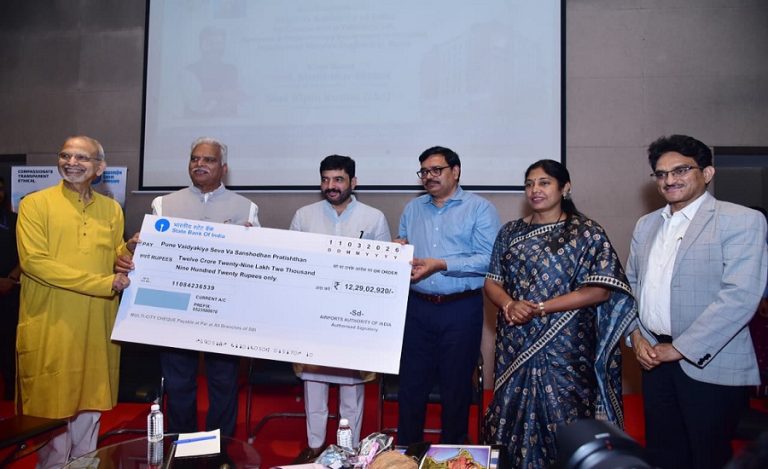
Navjyoti Foundation was one of the proud recipients of Nexus of Good Annual Awards, 2025 that were given away on 16th of November at a glittering function at PHDCCI, New Delhi by Mr B K Chaturvedi, former Cabinet Secretary, Government of India. The model that this Foundation has evolved is a wonderful example of Nexus of Good. It can be replicated right through the country through public-private partnership.
In Haryana, rain often means chaos. Every downpour at a police station would bring flooded compounds, overflowing drains, and days of inconvenience for police personnel and the public alike. This story was not unique to one location; it echoed across the state, especially in Gurugram, Faridabad and Sonipat. Police stations, essential public institutions where people come seeking help, were facing a serious challenge.
Ironically, while the earth was drying up below, water-logging was worsening above. According to the Central Groundwater Board, the groundwater situation in these districts had reached alarming levels, with extraction ranging between 104% and 212%. Rapid urbanisation, over-extraction, and changing rainfall patterns had left the land parched and unstable. The same rain that failed to percolate into the soil was pooling in compounds, roads, and open spaces. The crisis was twofold: groundwater depletion and urban flooding.
To address this growing challenge, Navjyoti India Foundation, founded in 1988 by Dr. Kiran Bedi and fifteen like-minded police officers, took an innovative step under the Ministry of Jal Shakti’s “Catch the Rain Where It Falls” campaign. Launched in November 2022, the initiative set out with a clear mission: to turn rainwater from a recurring problem into a lasting resource.
Navjyoti India Foundation identified 48 police stations across Gurugram, Faridabad, and Sonipat, chosen for their institutional ownership, public visibility, and accessibility. Each site was carefully studied using scientific and community-based methods. Rainwater harvesting systems were designed according to the contours of each compound, combining traditional recharge wells with modern filtration and drainage techniques. The focus was not on building expensive infrastructure, but on creating sustainable, low-cost models that could be replicated anywhere: schools, offices, or homes.
“This has been a collaborative initiative addressing water scarcity by enhancing groundwater recharge and urban water security. We hope this serves as an inspiration for scaling similar initiatives and reinforcing institutional commitment to water sustainability” – Dr. Chandni Bedi, Coordinating Director, Navjyoti India Foundation.
Each structure is made of gully traps, filtration wells, and recharge pits, carrying a lifespan of up to 15 years. Together, they enable an annual recharge of 44.4 million litres of groundwater while preventing waterlogging across 1,62,728 sq. m. The team itself was inclusive, with 50% of women’s participation, ensuring that the spirit of sustainability was also one of equality.
In a matter of months, change became visible, not dramatic but deeply felt. Where water once stagnated, it now seeped quietly into the soil. The project has benefited over 2.8 lakh people, including police personnel and local residents.
Even the cost of the initiative, roughly ₹0.033 per litre of water recharged, showed how affordable environmental responsibility could be when rooted in community effort and practical design.
Moreover, police officials and staff members were trained to take ownership of the systems, ensuring routine maintenance and cleanliness.
‘All the police stations and government offices in Gurugram should have a rainwater harvesting structure. It should spread to other cities in Haryana, as well as India” – Shri G. Asok Kumar, Retd. Director General for the National Mission for Clean Ganga, Ministry of Jal Shakti, said during the launch event of “Catch The Rain Where it Falls” in Gurugram.
An independent evaluation conducted by external experts later confirmed what was already visible on the ground. An outcome study conducted on 40 police stations across Gurugram recorded that 82% of respondents had adopted improved water use practices, and 75% had started discussions in their own communities about rainwater harvesting. Scorecards capturing environmental, social, and financial dimensions were prepared for each police station, revealing an average score of 72% across eight assessed aspects spanning sustainability, community impact, and fiscal performance. The practice was found effective with a best practice score of 80-100% in 19 police stations.
These figures spoke of something much larger than infrastructure; they reflected a shift in understanding. Police officers, families, and visitors began to see the link between their immediate surroundings and the invisible aquifers beneath. Moreover, during the launch of the outcome study, Sh. Vikas Arora, Police Commissioner, Gurugram, announced that performance appraisals would be based on the structures maintained by the SHOs.
The results of the initiative are visible not just on the surface but beneath it. The compounds that once flooded after every shower now stay clear. The water that used to run off into drains is now guided carefully back into the ground.
“With this initiative, not only have the waterlogging issues been reduced, but we’ve also started to see improvements in the groundwater level. The rainwater that used to flood the compound earlier now flows directly into the recharge well” – Inspector Suman, SHO, Sector 51, Gurugram (2023).
Through Catch the Rain Where It Falls, Navjyoti India Foundation has shown that environmental recovery begins with local action and shared accountability.
Each police compound that now absorbs rainfall tells a story, A story of collaboration between citizens and institutions, of science meeting simplicity, and of how leadership can come from the most unexpected places.
The model put in place by Navjyoti Foundation can be adopted not merely by police stations but by many others. A beginning has been made. It has the potential to take a care of serious problem that confronts all of us.