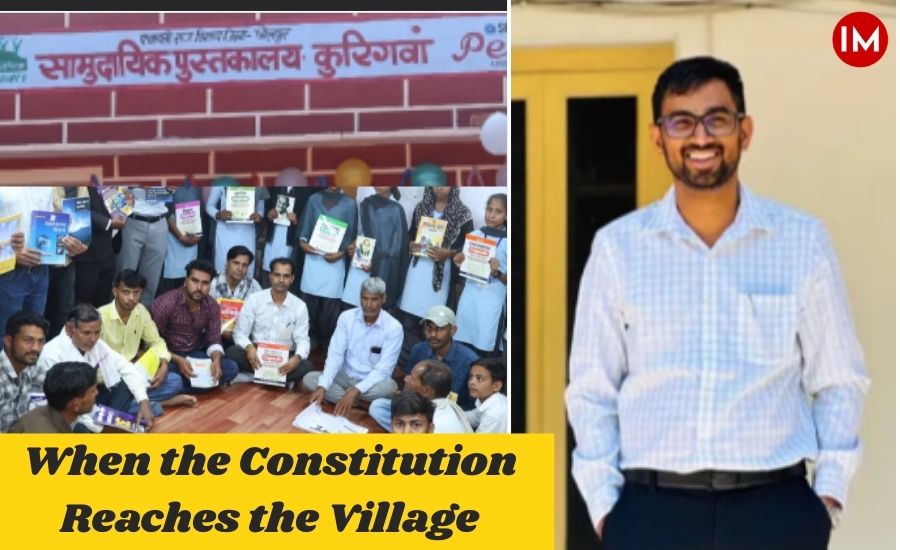
In many Indian villages, government buildings often stand silent — freshly painted once, inaugurated once, and then quietly forgotten. Their doors remain locked. Their purpose fades. Dust gathers faster than people.
In Rajasthan’s Dholpur, that silence has been broken.
Rooms that once stored unused furniture now echo with the Preamble of the Constitution. Children read aloud. Women sit in circles discussing rights and duties. Young aspirants scroll through online study material. Elders pause to ask questions about governance.
These are not ordinary libraries. They are Digital Samvidhan Ghars, established under the ChandraJyoti Abhiyan — an initiative that is slowly transforming citizenship at the grassroots.
Read More: The ‘Spectrum Man’ Who Revived a Dead Station with ₹2.59 Lakh
Leading this quiet transformation is Nivrutti Avhad Somnath (IAS), a 2021 batch IAS officer of the Rajasthan cadre, currently serving as the CEO of Zilla Parishad, Dholpur. Speaking to Indian Masterminds, he explains that the initiative is not about infrastructure — it is about culture.
THE IDEA: TAKING THE CONSTITUTION TO THE LAST MILE
The foundation of ChandraJyoti Abhiyan rests on a simple belief — democracy must be understood before it can be strengthened.
Rather than restricting constitutional awareness to ceremonial days or textbooks, the district administration decided to create permanent community spaces where citizens could regularly engage with constitutional values.
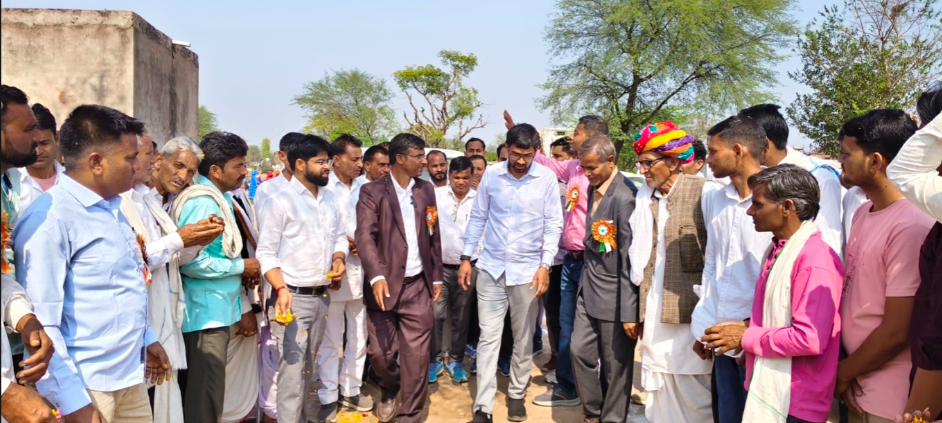
“If democracy has to be strong, its roots must reach the village. Constitutional literacy should not remain confined to textbooks,” Somnath told Indian Masterminds.
Each Digital Samvidhan Ghar is equipped with curated reading material, digital access points, and structured civic content. The idea is not merely to promote reading, but to foster informed participation.
The initiative encourages collective reading of the Preamble under the “Kitab Ka Pehla Panna” campaign. The Constitution becomes the first book a citizen encounters in the space — symbolically and practically.
FROM UNUSED BUILDINGS TO LIVING SPACES
One of the most innovative aspects of the initiative is its use of existing infrastructure.
Instead of constructing new buildings, vacant Panchayat rooms and underutilised government spaces were converted into vibrant civic hubs. This significantly reduced costs and ensured faster rollout.
“We did not want a scheme dependent on heavy funding. We wanted a model that districts can replicate using what they already have,” Somnath explains.
The approach reflects a deeper administrative philosophy — governance is often about activating dormant assets rather than building parallel structures.
But what truly distinguishes these libraries is who runs them.
SAMVIDHAN SAKHI: WOMEN AT THE CENTER
The Digital Samvidhan Ghars will be run by Self-Help Group (SHG) women, designated as Samvidhan Sakhis.
This is not incidental. It is intentional.
By placing women at the center of operations, the initiative ensures community ownership and sustainability. The Samvidhan Sakhis will manage the libraries, facilitate discussions, coordinate school visits, and maintain digital access systems.
This transforms the space into more than a reading room — it becomes a community-led institution.
“Any initiative must belong to the community. Administration can initiate, but sustainability comes from local ownership,” says Somnath.
Through this model, the administration strengthens both constitutional awareness and women-led grassroots governance.
CSR-LED, COMMUNITY-DRIVEN
ChandraJyoti Abhiyan is also a CSR-led initiative, ensuring that it does not become financially burdensome on the district administration.
The district plans to establish 50 libraries with support from IIFCL under CSR funding. The first 28 libraries are being supported by SBI Card.
This public-private-community partnership makes the initiative scalable and financially sustainable.
Importantly, the libraries are not restricted to passive reading. National programs, educational broadcasts, and awareness sessions will be streamed in these spaces. Schools will regularly bring students to the Samvidhan Ghars, integrating civic engagement into routine learning.
The digital infrastructure ensures that these are future-ready institutions — combining constitutional literacy with technology access.
FROM DELIVERY TO DIALOGUE
Traditional governance models often focus on delivering schemes and infrastructure. While essential, they sometimes leave little room for civic dialogue.
ChandraJyoti Abhiyan attempts to bridge that gap.
By creating structured spaces for interaction, the administration shifts the model from service delivery to participatory engagement.
“Development is not only about infrastructure. It is also about awareness and empowerment,” Somnath told Indian Masterminds.
Villagers conduct group readings. Youth volunteers assist elders in navigating digital platforms. Discussions around rights, duties, and local governance are becoming more common.
The district administration’s role gradually becomes facilitative rather than directive.
BUILDING A CULTURE, NOT JUST A LIBRARY
What makes this initiative unique is its long-term vision.
The focus is not on inaugurations or short-term metrics. It is on creating a culture of informed citizenship.
“We are not organizing a one-day event. We are building institutions that will continue to function long after transfers happen,” Somnath emphasizes.
That institutional thinking is crucial. The initiative embeds itself within Panchayati Raj structures, ensuring continuity beyond individual officers.
The cultural shift is already visible. Students see the Constitution as relevant. Women lead discussions. Youth view governance as participatory.
In a district often stereotyped for its ravines and difficult terrain, a different narrative is emerging — one of civic awakening.
REDEFINING DHOLPUR’S IDENTITY
Dholpur has long carried a narrow public perception. But initiatives like ChandraJyoti Abhiyan are reshaping its image.
By prioritizing constitutional literacy, digital inclusion, and women-led management, the district positions itself as a laboratory of grassroots democratic innovation.
These Digital Samvidhan Ghars are not just libraries. They are platforms of dialogue. They are centers of digital empowerment. They are training grounds for informed citizenship.
Most importantly, they are building a culture — where democracy is not abstract, but practiced.
Locked rooms have turned into living classrooms.
In the villages of Dholpur, democracy is no longer a distant concept. It is being read aloud, debated, accessed online, and understood.
And in that quiet act of collective reading, a district is rediscovering its voice — one page at a time.
Read More: From Allocation to Action: How Vadodara’s ₹7,609-Crore Budget Redefines Urban Governance