In a region long associated with parched fields and deep borewells, a quiet transformation has rewritten the development narrative. Annamayya district, once ranked 25th in groundwater availability in Andhra Pradesh, now stands at 2nd place in the state. Within just months, average groundwater levels rose by 8.7 metres—more than double the Rayalaseema regional average of 3.6 meters during the same period.
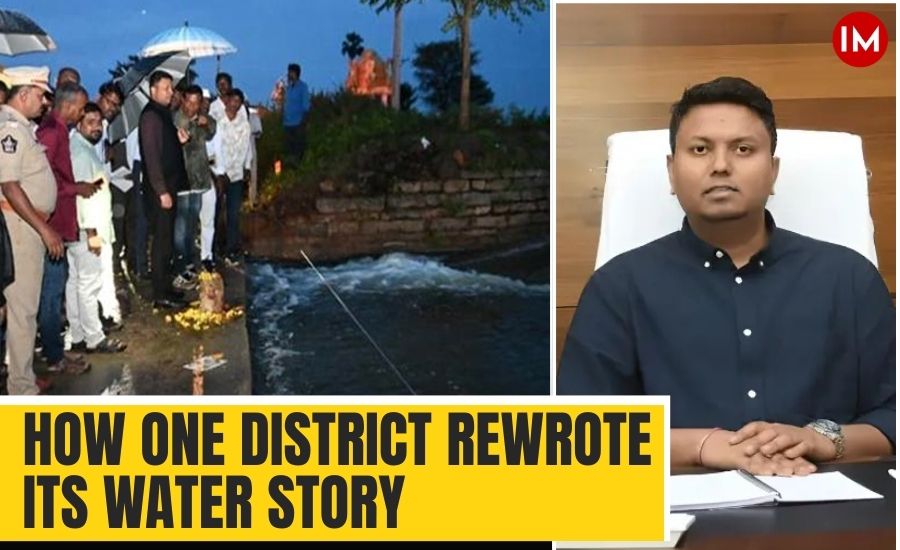
This dramatic shift is the result of a district-led initiative called Project Jaladhara, designed and executed under the leadership of District Collector Nishant Kumar (2014 batch, Andhra Pradesh cadre). The project focuses not on building new mega irrigation structures but on restoring, reconnecting, and optimally using existing water bodies.
“Jaladhara is not just restoring tanks — it is restoring faith, livelihoods, and life across Annamayya District,” IAS Nishant Kumar told Indian Masterminds, describing the broader impact of the programme.
A DISTRICT ONCE DEFINED BY WATER SCARCITY
For years, farmers in Annamayya worried about falling groundwater tables, failing borewells, and uncertain crop cycles. Entire mandals depended heavily on deep groundwater extraction. Surface storage structures—tanks, feeder channels, and streams—had gradually become defunct due to neglect and siltation.
Despite limited rainfall, large volumes of runoff water flowed unutilised each monsoon. The district administration decided to change this pattern by ensuring that every drop of rainfall was scientifically captured and redistributed.
Guided by the vision of Andhra Pradesh Chief Minister N. Chandrababu Naidu under the Swarna Andhra Vision–2047 framework, the district adopted a sub-basin-based water planning approach. Instead of waiting for state-level river interlinking projects, officials asked a simple question: could surplus water within the district itself be diverted to deficit areas?
SUB-BASIN PLANNING AND TANK INTERLINKING
Project Jaladhara is based on interlinking surplus and deficit basins within the district. The administration mapped sub-basins, identified water flow patterns, and revived cascades of interconnected tanks.
Particular attention was given to the Cheyyeru sub-basin of the Pennar river system and other minor basins. Surplus water was diverted to deficit mandals, including Rayachoty, Madanapalle, Thambalapalle, Rajampet, Lakkireddi Palle, and Nandalur.
Nearly 3.9 TMC of surplus water was redirected to dry tanks such as Tallapaka, Nandalur, Lebaka, and Korlakunta. Tanks like Pullampet Tank and Konamma Cheruvu received water after nearly four to five decades, leading to visible celebrations in surrounding villages.
Importantly, this was achieved without constructing any new large irrigation projects. Instead, existing infrastructure was revived and reconnected.
MASSIVE RESTORATION THROUGH CONVERGENCE
The scale of implementation was extensive and largely driven through convergence of departments and effective use of employment guarantee schemes.
Key achievements include:
- 4,000 out of 6,000 defunct feeder channels restored
- 1,700 feeder channels currently under progress
- 310 new feeder channels excavated
- 214 farm ponds constructed
- 102 trenches developed
- 532 local streams rejuvenated
- 3,089 tanks restored under conservation measures
- 962 mini irrigation tanks filled to full capacity
Machinery was deployed at 163 critical locations to clear major blockages. Traditional knowledge from local communities was integrated with modern mapping and satellite analysis.
Rainfall from the Montha and Dithva cyclones was scientifically captured and redirected into restored tanks and recharge systems. The approach ensured minimal runoff loss.
RECORD GROWTH IN WATER STORAGE
The numbers reflect the scale of change.
Subsurface water storage increased from 13.15 TMC in August 2025 to 48.86 TMC by December 2025—a rise of 35.71 TMC in just six months.
Groundwater levels also improved significantly. In November 2024, average groundwater depth stood at 12.97 meters. It deepened to 14.45 meters by August 2025. By December 2025, the average depth reduced to 5.85 meters, with water now available at just 3–8 meters depth across nearly 90 percent of the district.
Within five months alone, groundwater levels improved by 8.59 meters, reviving over 20,000 borewells that had previously gone dry.
Compared to the Rayalaseema regional average improvement of 3.6 meters between May and December 2025, Annamayya recorded a remarkable 8.7-meter increase.
The district that once ranked 25th in groundwater availability now ranks 2nd in the state.
VISIBLE ECOLOGICAL CHANGE
Satellite imagery from the Andhra Pradesh Space Applications Centre indicates clear ecological improvement.
According to NDVI (Normalised Difference Vegetation Index) data:
- Moderate vegetation increased by 5.12 lakh acres
- The water body area expanded by 3,927 acres
- Dense vegetation, including forest area, increased by 400 acres
These changes occurred without introducing any new irrigation projects—only through restoration and optimal utilisation of existing tanks.
REDUCED POWER CONSUMPTION AND FISCAL SAVINGS
Improved groundwater availability significantly reduced the energy required for irrigation.
With water accessible at shallower depths, agricultural borewell electricity consumption fell by 30–40 percent. Around 12.54 lakh units of electricity are being saved daily from approximately 1.25 lakh pump sets.
Between August and November 2025, this translated into estimated savings of ₹95.71 crore for the state exchequer.
Notably, this reduction occurred even though agricultural electrical connections increased from 1.16 lakh to 1.48 lakh during the same period. The data indicates that farmers are pumping water from shallower levels, requiring less power per unit of irrigation.
BOOST TO HORTICULTURE AND LIVELIHOODS
Water security has directly influenced agricultural expansion and diversification.
Horticulture cultivation expanded to 85,760 hectares—an increase of 20,000 hectares compared to the previous year. Typically, annual expansion ranges between 7,000 to 8,000 hectares, making this year’s growth exceptional.
By December 2025, horticulture contributed an additional Gross Value Added (GVA) of ₹1,634 crore.
Under the livelihood component of Project Jaladhara, 10,000 milch animals were distributed to farmers through various schemes. These animals were sourced from other districts and states. The initiative increased milk production by approximately one lakh litres per day and is expected to contribute an additional ₹100–120 crore annually to the district economy.
When factoring in horticulture growth, animal husbandry, fisheries activity, and power savings, the district estimates an overall economic boost of ₹1,100–1,170 crore this year.
RECOGNITION AT THE STATE LEVEL
The success story was recently presented to Chief Minister N. Chandrababu Naidu, outlining how scientific planning and coordinated execution converted a drought-prone district into a water-secure region.
The Chief Minister also recognised the Indian Masterminds post highlighting the initiative on his Instagram.
Responding to the recognition, Collector Nishant Kumar said, “Indeed a proud moment for the district, always known for being dry and backward.”
Project Jaladhara demonstrates that effective water governance does not always require new mega projects. By interlinking tanks, restoring feeder channels, mapping sub-basins, and capturing seasonal rainfall efficiently, Annamayya has created a scalable model for semi-arid districts.
Nearly 90 percent of the district has benefited, barring a few rain shadow regions. The administration is now better prepared for summer, with strengthened storage and recharge systems in place.
What makes this initiative notable is its integrated impact—improved groundwater, reduced energy consumption, expanded agriculture, ecological recovery, and measurable economic gains.
From a district once defined by water scarcity to one ranked second in groundwater availability, Annamayya’s journey under Project Jaladhara offers a practical blueprint for sustainable rural development in water-stressed regions of Andhra Pradesh and beyond.