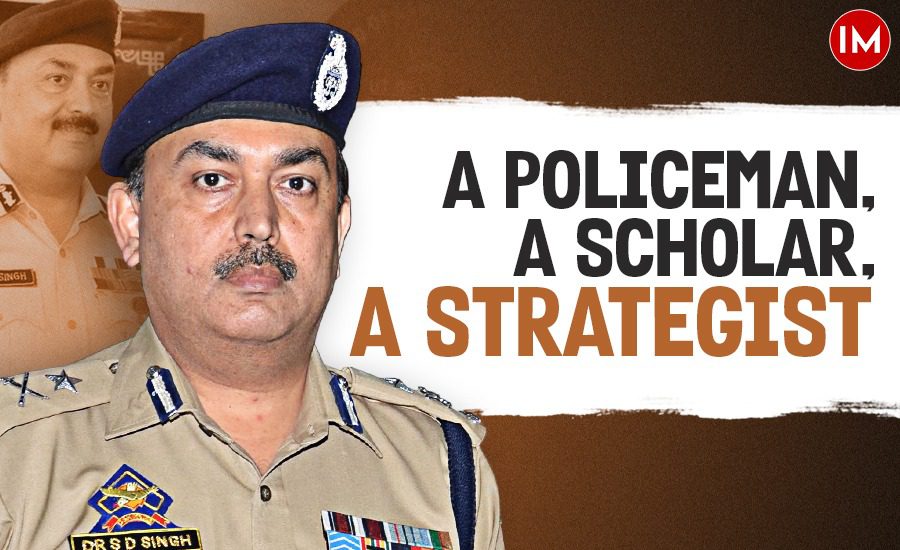
When Dr Shiv Darshan Singh Jamwal assumed charge as the Director General of Police of Arunachal Pradesh, it marked more than a routine administrative transfer. It signalled the arrival of an officer whose career blends frontline policing, border management, academic scholarship and strategic thinking—qualities that are increasingly vital for one of India’s most sensitive and strategically located states.
A 1995-batch IPS officer of the AGMUT cadre, Dr Jamwal succeeds Anand Mohan, who has been transferred to Delhi. For Arunachal Pradesh—bordering China, Myanmar and Bhutan—his appointment brings in an administrator shaped by decades of experience in conflict-prone regions, high-altitude terrains and national security institutions.
Born on May 3, 1969, in Purani Mandi, Jammu, Dr Jamwal is the son of Hukam Singh Jamwal. Over the years, he has earned a rare reputation in Indian policing—as a “scholar cop”, equally comfortable commanding forces on the ground and contributing to national policy through research and writing.
ROOTS IN CONFLICT ZONES
Dr Jamwal’s policing journey has largely unfolded in regions where governance is tested daily. His early and mid-career postings across Jammu & Kashmir placed him at the heart of counter-insurgency operations during some of the most volatile phases in the region.
As Inspector General of Police of the Jammu Range and later as Additional Director General of Police in Jammu & Kashmir, he oversaw law and order, coordinated counter-terrorism operations, and worked closely on police welfare measures—often under intense operational pressure. His tenure was marked by a focus on balancing security imperatives with institutional discipline and personnel morale.
These years shaped his reputation as an officer who understood that policing in sensitive regions requires both firmness and restraint.
LADAKH AND THE BORDER CHALLENGE
In 2023, Dr Jamwal was appointed the Head of Police and later Director General of Police of the Union Territory of Ladakh—one of the most strategically significant and logistically challenging regions in the country. The role demanded oversight of security in high-altitude border areas, coordination with multiple central agencies, and the task of strengthening a relatively new police force following Ladakh’s bifurcation from Jammu & Kashmir.
His familiarity with the region was not new. Having earlier served as SSP Leh, Dr Jamwal returned to Ladakh not as an outsider, but as someone deeply connected to its people, geography and culture. During his tenure as DGP Ladakh from 2023 to 2026, he focused on infrastructure development, capacity building, and adapting policing practices to the region’s unique terrain and security requirements.
It was a posting that reinforced his credentials as a specialist in border and high-altitude security management.
ACADEMIC MIND IN UNIFORM
What sets Dr Jamwal apart from many of his contemporaries is his deep engagement with academic research. He holds a Ph.D. in bio-weapons and biological disaster management and has been associated with the National Disaster Management Authority since 2007. His work has contributed to India’s national guidelines on Chemical, Biological, Radiological and Nuclear (CBRN) preparedness—a critical but often understated dimension of internal security.
At a time when security threats are evolving beyond conventional domains, his expertise in CBRN disaster management adds a strategic layer to his policing profile.
THE WRITER AND THE THINKER
Dr Jamwal’s intellectual pursuits extend well beyond operational research. He is the author of Ladakh: Travel–History–Culture, one of the most comprehensive books on the region’s heritage, art, architecture and social life. The work reflects not just academic rigour, but also a deep affection for the land and its people.
He has written extensively on security studies, strategic affairs and regional culture, producing papers and monographs that are widely read within policy and academic circles. This rare blend of scholarship and field experience has earned him respect across institutions, reinforcing the “scholar cop” tag that follows him.
CENTRAL DEPUTATION AND NATIONAL ROLE
Beyond state policing, Dr Jamwal has served on central deputation, including as Additional Director General in the Indo-Tibetan Border Police. He was also part of key national institutions earlier in his career, gaining exposure to border management and inter-agency coordination at the national level.
He is a recipient of the President’s Police Medal for Distinguished Service and the Police Medal for Meritorious Service—recognitions that underscore both his operational competence and sustained contributions to policing.
ARUNACHAL PRADESH AND THE ROAD AHEAD
As he takes charge in Arunachal Pradesh, Dr Jamwal steps into a state that presents its own complex challenges—border security, policing in remote and difficult terrain, infrastructure gaps, and the need for modernisation without disturbing social harmony.
While no official statement has outlined his immediate priorities, officials indicate that his experience in Ladakh and Jammu & Kashmir will be invaluable in strengthening law enforcement, enhancing coordination with central forces, and upgrading police capabilities.
With his background, observers expect a leadership style that combines strategic foresight, operational discipline and attention to personnel welfare.
A LEADER SHAPED BY EXPERIENCE
Dr Shiv Darshan Singh Jamwal’s journey—from the streets of Jammu to the high passes of Ladakh and now to the eastern frontiers of Arunachal Pradesh—reflects a career forged in India’s most demanding security environments. His appointment as DGP of Arunachal Pradesh brings with it not just experience, but perspective—one shaped equally by boots on the ground and books on the desk.
In a state where geography and geopolitics intersect daily, that combination may prove decisive.