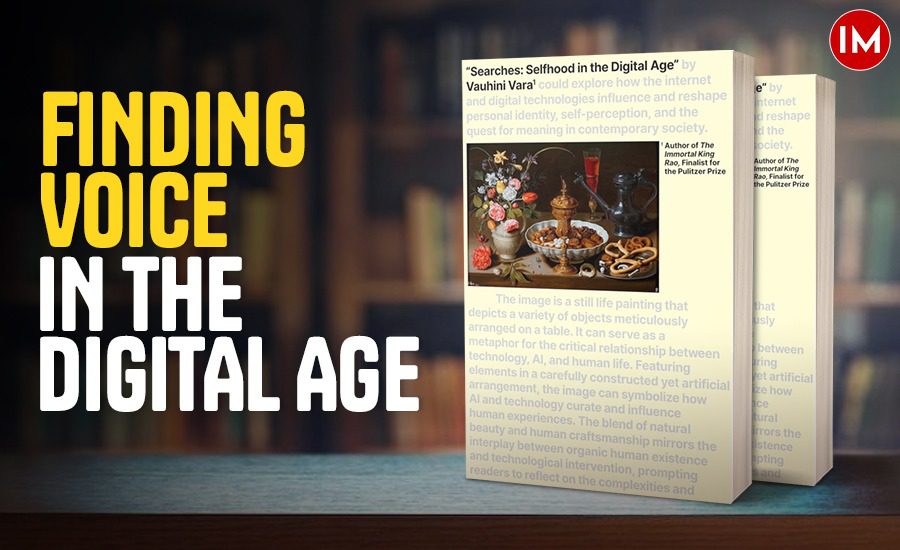
“It’s hard for a lot of us to imagine not searching on Google, buying on Amazon, scrolling on X and Instagram, and conversing with ChatGPT, because these services, all the problems with them notwithstanding, are convenient and entertaining enough for us to keep using them. I even allow the optional surveillance that comes with these services, in some cases, because it makes the services more convenient and entertaining.” Thus writes Vauhini Vara in one of the last chapters of her often surprising and always original book about discovering the self within society and socialization and social media. This chapter is titled “The Master’s Tools”; it includes the threads of an imagined conversation with Audre Lorde, and it wonders – without any totalizing impulse to find definitive answers – about our imagined futures within and outside the Master’s House.
The author’s Google searches (in alphabetical order), Amazon orders, early Instagram posts, and ChatGPT editorial feedback feature through the course of the book. Essays are written with an unflinching, piercing candour which contrast sharply against the inherently self-contained and sanitized summaries of Large Language Machines which follow. Sometimes the interspersed LLM responses are brutally at odds with the human prose which precedes them, but at another time the author and the machine have collaborated to produce work which is heightened by the very fact of their mutuality. The story “Ghosts”, presented as a co-writing exercise between Vauhini and an early edition of ChatGPT, was first published online in early 2021 and went viral soon after. It is a text that would have played out differently had there been human responses to the author’s prompts – about the early loss of her sister to cancer – at the very least, human responses would have adapted into certain physical markers of their Indian-Canadian-American identity more easily. ChatGPT’s narratives offered sentimental tropes; Vara honed her ability to write about grief in countering those clichés: “The machine-generated falsehoods compelled me to assert my own consciousness by writing against the falsehoods.”
As a tech journalist (who was the first to cover a dedicated Facebook beat for The Wall Street Journal), Vara’s interactions with Mark Zuckerberg and Sam Altman inform the text. As a fiction writer (whose Pulitzer Prize finalist novel The Immortal King Rao draws from aspects of ancestral history), conversations with her parents alter the rhythm of the book as well. There is a very real reckoning with the psychology and political economy of how technocracy has come to be under tech titans and their thinking machines, alongside the author’s own creative process of meaning-making without the sacrifice of honesty or relative optimism.
Selfhood in the digital age is entangled with what we share and shape. Sometimes this is smoothed out or knotted further by deliberate experimentation. “I am Hungry to Talk” is a chapter which features two columns on each page: one written in Spanish (a language Vara learned while on a year-long sabbatical in Spain), and one with its corresponding Google English translation. As Vara practices her Spanish, she observes how these efforts are perceived by native Spanish-speakers around her: “I was suddenly reminded of the way white people saw my mom when I was a child. She had told me a story many times about how she had applied for a job in the United States as a therapist at a shelter for domestic violence survivors, and was told that they couldn’t hire her because her accent was too strong. The language we use doesn’t exist in a vacuum, but the recipients of our speech and writing link it with other signals they receive before interpreting the meaning.”
From the Spanish original, I can identify at least one word per sentence: “pronto”, “terapeuta”, “significado.” Before some long-ago diffusion in history, we all shared the same roots of language. Since then, our branches have sharpened into specificity and bias which have now infected the internet and Artificial Intelligence. Predictive algorithms in technological capitalism can and are successfully rewiring our biological brain chemistry. To different degrees, we have no option but to surrender to this surveillance in exchange for services.
So how does one come to know oneself in this fragmented time? We are complicit creatures constructed by generations before us – inheritances that we can only partially visualise or understand in full – and by the perspectives of those who live in the same current space as us.
The title of the first chapter is “Your Whole Life Will Be Searchable”. The title of the last chapter is “What Is It Like to Be Alive?” There are anonymous crowd-sourced responses from other women, and a meditation by the author herself on what this indescribable sensation could be explained as within the limitations of language: “I will define it in my writing—this writing—in which I feel myself stretching a hand—this hand!—across space and time toward you who are reading this elsewhere, later.” Life is still inexplicable (even though Google’s automatic ad tracking demographics can be shockingly accurate) and much of it is beyond what technology can currently track. The words we write and read can be dismissed precisely because of that same stubborn human subjectivity which also allows for moments of incandescent understanding. The searchability of our aliveness can provide clues to a larger picture, but not the full portrait itself.
“Each of us is here now because in one way or another we share a commitment to language and to the power of language, and to the reclaiming of that language which has been made to work against us,” is the quote from Audre Lorde (“The Transformation of Silence into Language and Action, 1977) which opens this book. When I enter the title of the book along with the author’s name into a new ChatGPT prompt on my phone, and then refine this generic input into a more pointed question about the influence of Audre Lorde, it replies that both authors resist narrative closure: “Where Lorde allowed herself righteous heat, Vara cools anger into a kind of forensic calm.” I don’t know if I agree with the particular inflections of this analysis. But there is certain truth to it, as there is to all the other contradictory complicated perspectives in our intertwined, interdependent collective. Searches doesn’t end on what is found — it invites the reader to recognize, and in turn discover, or dare to imagine, the speculations of our own worlds.