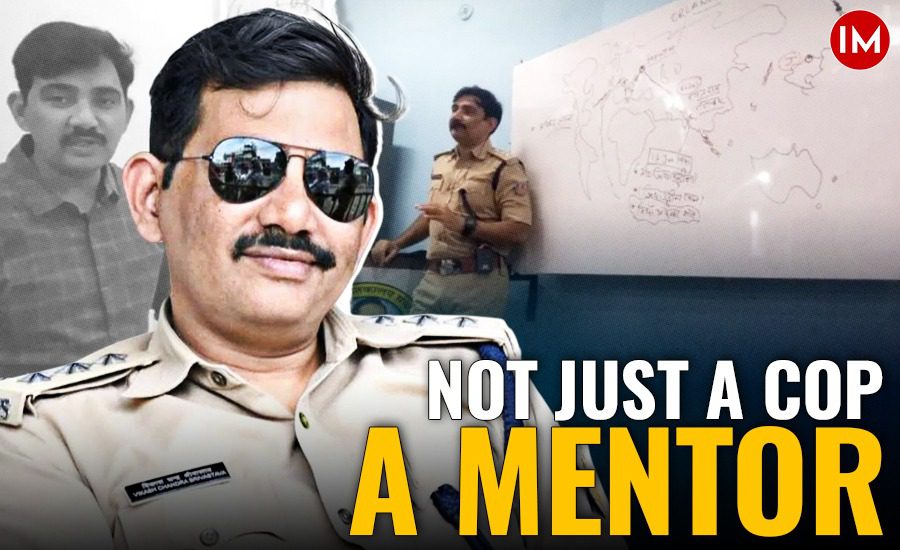
In July 2021, a YouTube channel quietly began streaming general studies classes for Jharkhand aspirants. The man behind the laptop camera was not a full-time educator or coaching entrepreneur. He was a serving police officer — DSP Vikas Chandra Srivastava.
Today, DSP Ki Paathshala has grown into a large online learning community with more than 1,000 videos and over 1.65 lakh subscribers. Across Telegram and WhatsApp groups, nearly 60,000 students stay connected for guidance on JPSC and other competitive exams. But the journey did not begin online. It started much earlier — in libraries, hostels, and even remote village schools.
FROM DEOGHAR LIBRARY TO A STATEWIDE MOVEMENT
The idea of DSP Ki Paathshala took shape during Mr Srivastava’s posting in Deoghar. Behind his residence was a 24/7 public library where he often went to study whenever time permitted.
“Whenever I got time, I would go there to study. If someone came along or work got held up offline, I used to stop and teach,” DSP Vikas Srivastava shared in an exclusive interview with Indian Masterminds.
Gradually, he began thinking about how to teach students more systematically. He started using maps and visual explanations to simplify general studies topics. That informal teaching evolved into a structured effort. After his transfer to Ranchi and the disruption caused by COVID-19, he decided to formalise his outreach.
“In July 2021, the DSP Ki Paathshala channel was properly formed,” he says. “But before that, I was already taking offline classes wherever I was posted.”
Even today, he does not treat it as a brand-building exercise. For him, it is an extension of something that began in childhood.
A CHILDHOOD SHAPED BY TEACHING
Vikas Chandra Srivastava belongs to Hazaribagh, Jharkhand. His father was a science teacher, and his mother a homemaker. Growing up, he often watched his father teach children from economically weaker families, sometimes providing books and clothes free of cost.
“Teaching has been a passion since the beginning, not just a hobby,” he says. “Sometimes when my father fell ill, I used to teach Class 10 students.”
After schooling at DAV in Hazaribagh, he completed his graduation from Nizam College in Hyderabad. Although his father hoped he would become an engineer, Mr Srivastava had different plans.
“I wanted to become a civil servant,” he says. “So after graduation, I went to Delhi on my own and prepared in Mukherjee Nagar.”
He prepared for two to three years around 1999–2000, but selection did not happen. He returned to Hazaribagh and began teaching neighbourhood students at the 10+2 level. While guiding them, he noticed a gap in their general studies preparation.
“I saw there was no improvement in their scores. That made me think — how could that be? They were junior to me by six or seven years,” he explains. “So I started teaching them GS properly.”
What began as casual mentoring slowly turned into something more structured. Even while preparing for civil services himself, he was teaching district-level students.
BALANCING A 24/7 POLICE JOB AND TEACHING
Currently posted in Ranchi as Senior Deputy Superintendent of Police at the Investigation Training School, Mr Srivastava oversees advanced investigation training for police personnel as per Supreme Court guidelines issued in 2016.
Police work is demanding and unpredictable. Yet he finds time for classes.
“Police jobs are 24/7, right? But if you have the challenge and the passion, time will automatically come out,” he says. “It’s not correct to say, ‘I’m very busy, no time.’”
Most of his classes are online and usually conducted at night. He does not fix rigid schedules. Through his Telegram group of more than 44,000 JPSC aspirants, he simply posts: What should I teach today? Students respond instantly.
As soon as he reaches the office and finds a window of time, he streams.
There are also spontaneous moments. “Many times I’m out on duty, doing investigation, and I spot a school in a remote village. I go there and tell the children for 10 minutes how to study properly — mapping and all,” he says. “They get very motivated seeing that.”
This approach also improves public perception of policing. Students who have never interacted with a police officer in such a setting begin to see a different side of the uniform.
MENTORSHIP BEYOND SYLLABUS
While online classes focus on JPSC prelims and mains, Mr Srivastava believes mentorship is just as important as subject knowledge.
“Many children suffer from anxiety. Many call and start crying — ‘Sir, it feels like I won’t be able to make it,’” he says.
He makes it a point to speak to them personally. For interview preparation, he prefers offline sessions. With the help of friends who offer their offices as venues, he organises 10-day mock interview sessions in Ranchi. Bureaucrats and senior officers volunteer their time free of cost.
“For those far away — in Mumbai or Delhi — we sometimes conduct mock interviews online,” he adds.
The entire initiative runs without charging fees.
“This became my mission — payback to society. If society has given you something, you should return it,” he says.
SUCCESS STORIES THAT MATTER
Over the years, DSP Ki Paathshala has produced significant results in Jharkhand Public Service Commission (JPSC) exams.
In one JPSC final result, out of 342 successful candidates, more than 140 were associated with his classes. Many of them visited him after the results, touching his feet in gratitude.
“Senior officers were surprised seeing what was happening,” he recalls with a smile.
One story remains especially close to him. Babita Pahadiya, from the Pahadiya tribe — a primitive tribal group in the Santhal region — became the first officer from her community. In her interview, she credited DSP Ki Paathshala and showed the flowcharts and mind maps she had studied.
“I saw her notes — it was exactly the same flowcharts I teach. I felt very happy,” he says. “It’s going in the right direction.”
From blurry laptop-camera recordings in 2021 to a digital library of over 1,000 videos today, the growth has been organic.
“It’s no longer just Vikash Srivastava alone,” he says. “Many people joined, and it became a big family, a big movement.”
Click here for his YouTube channel.
A MESSAGE TO ASPIRANTS
DSP Vikas Srivastava’s advice to competitive exam aspirants is direct and grounded in reality.
“See where you are right now,” he says. “Many children are studying in much worse conditions than you. Consider yourself better off.”
He describes students attending live classes while cooking, sharing a single mobile phone among siblings, or studying despite visual impairment.
“Think about that and stay motivated — never get demotivated,” he tells them.
He also has a message for fellow officers and professionals.
“Ekla chalo re won’t work,” he says. “It’s great that some people are doing this. But apart from salary, what are you doing for society?”
He believes even small efforts can multiply.
“Stand up anywhere — even on Sunday, at a railway station among four children. If those four get motivated, it can turn into four hundred, four thousand,” he says.
MORE THAN A YOUTUBE CHANNEL
DSP Ki Paathshala is not positioned as a commercial coaching brand. It operates as a community-driven platform focused on accessible education for Jharkhand aspirants.
For DSP Vikas Chandra Srivastava, the uniform and the classroom are not separate worlds. One represents law enforcement; the other represents guidance. Both, in his view, are forms of public service.
As he continues to train police personnel by day and mentor civil service aspirants by night, his core idea remains simple: give back, whenever and wherever possible.
And for thousands of students across Jharkhand preparing for JPSC and other exams, that idea has already made a difference.