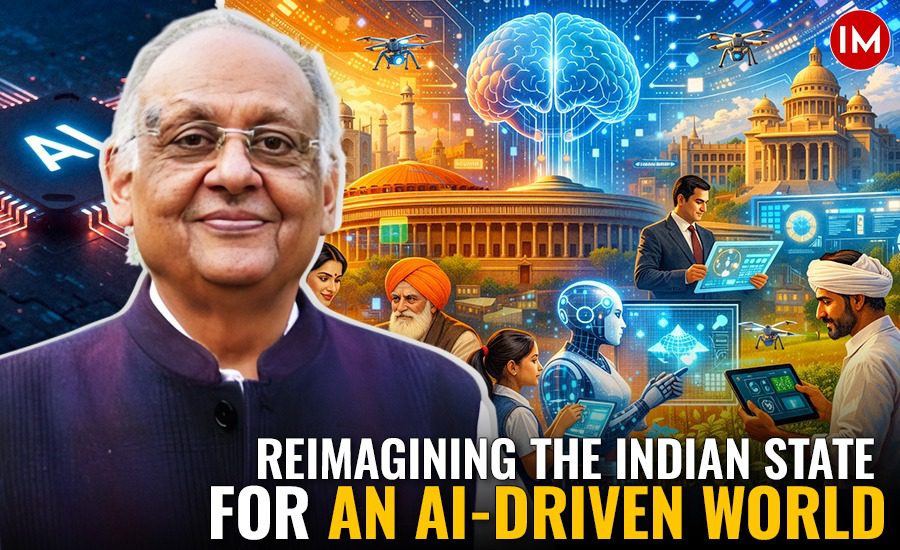
We are living in the second most momentous period in the history of earth, the first being 4 billion years ago when organic life appeared as amoeba, says Harari. AI’s exponential growth is causing unprecedented disruption, a precursor to transformation at a scale and pace almost beyond human understanding. This casts an incredible responsibility on governments, to guide and shape the disruption and the future, by taking governance where no one has gone before. Are we ready?
FUTURE-READY GOVERNANCE (FRG)
Future-Ready Governance must go beyond solving today’s problems—it must visualize the future, anticipate disruptions, and institutionalize mechanisms to harness the power of exponential technologies, especially Artificial Intelligence. Given the kind of legacy and environmental uncertainties governments face today, we need to experiment, learn, unlearn, relearn.
We can begin by reconstructing the concept of “Creative Destruction” (defined by Joseph Schumpeter as the process by which innovation destroys old systems and creates new ones) into “AI-driven Systemic Disruption”, and consciously develop and operate a disruption-based strategy. We can set up a chain of “Centres of Excellence for Disruption” to deliberately catalyze disruption as a policy tool. We can encourage setting up of “governance startups” across the governmental systems, integrated synergistically with the excellent innovation ecosystems already in place. These CoEs and governance startups will gene-edit the DNA of our 20th century systems, transforming them into “AI- Powered Future Ready” genomes.
NORTH STAR
Our quest must begin with a
North Star that aligns personal
and organizational goals, where individual dreams coalesce into a shared collective dream for society. As former President Dr. A.P.J. Abdul
Kalam wrote in Ignited Minds, dreams transform into thoughts, thoughts into actions, and actions into transformation. Ethics must provide the foundation for these dreams, and technology the driving force. As observed by Prime Minister Modi in his Address at BRICS Summit on August 23, 2023: “…to make BRICS a future-ready organization, we will need to make our respective societies also future-ready, and technology will play an important role in this”. We have to remember that we have “One Earth, One Family, One Future”, and that “We don’t inherit the Earth from our ancestors, we borrow it from our children.”
PRINCIPLES
The FRG framework may rest on four foundational principles:
i) Future-Driven: Visualizing future scenarios, anticipating challenges and opportunities, and building agile, rapid- response systems.
ii) Technology-Powered:
Leveraging AI, data, and blockchain to achieve quantum gains in efficiency, transparency, and service delivery.
iii)People-Centric: Governance centered on people—
both citizens and public functionaries—ensuring fairness, ease of access,
and dignity across all socio- economic groups.
iv) Sustainability-Conscious:
Integrating environmental, social, and economic sustainability into all decisions, supported by real- time monitoring of natural resources and climate risks.
EXPONENTIAL SDGs
The UN Sustainable Development Goals (2016–2030) are now embedded in governance systems. An additional layer may be added on top of the existing SDGs, to significantly improve the quality & speed of implementation of selected higher priority areas within the SDGs, through application of exponential technologies broadly for two purposes:
- i) More effective implementation, leading to higher quality, speed & savings.
- ii) Reinventing internal systems and processes to make them highly effective, and empower/ enable functionaries to deliver more with less effort, also leading to higher motivation & job-satisfaction.
INSTITUTIONAL INFRASTRUCTURE
Institutional infrastructure may be redesigned suitably for supporting the initiative, as illustrated below:-
i) Stewardship: NITI Aayog may lead and guide the initiative, as part of its policy and innovation leadership. It may consider setting up the suggested
CoEs for Disruption, launch
a major Governance startup program, and take up suitable pilot projects, under the Atal Innovation Mission.
ii) Indian Institute of Foresight & New Age Technology: IIFNAT may be set up to provide the required world class knowledge/ expertise in the areas of Foresight/ Futures-Thinking and New Age Science/ Technologies.
iii) Evolving Organizations: The ever accelerating pace of change is fast exceeding the limits of change humans and organizations can absorb. We need to develop a new framework for organizations capable of supporting FRG effectively. This may focus on primacy of purpose
and people, and shift from structure-based functioning to process-driven operations.
REIMAGE, REDESIGN, RECREATE
The FRG initiative will need to be led by people with a futuristic and moonshot mindset, knowledge of exponential technologies, and excellent inter-personal skills. They would need to understand the anatomy of disruption, and Reimagine every institution and sector. The existing institutions and systems will then need to be Redesigned to cater to the future Reimagined scenarios, followed by effective strategies and pragmatic action plans to Recreate them. A series of skillfully designed pilot projects within this framework will help develop prototypes and PoCs, which may be replicated and scaled to evolve a holistic, flexible strategic architecture.
The change strategy would need to specifically address challenges arising from sabotage by vested interests and resistance due to insecurity/ ignorance, as also AI introduction related issues like bias in data labeling/ training, algorithms generating fake content, and legal issues about responsibility and liability.
The journey may begin with a series of pilot projects. Encouraging States to experiment with the above suggested ideas, and take up “Viksitstate(name)@2047: AI- Powered Future Ready Governance Projects”, “Exponential SDGs”,and “Reimagining District Administration” initiatives, may be a good way to begin. Other pilots could include setting up virtual/ hybrid universities, transforming schools, reimagining healthcare (shifting from sickness-focus to holistic wellness) etc.