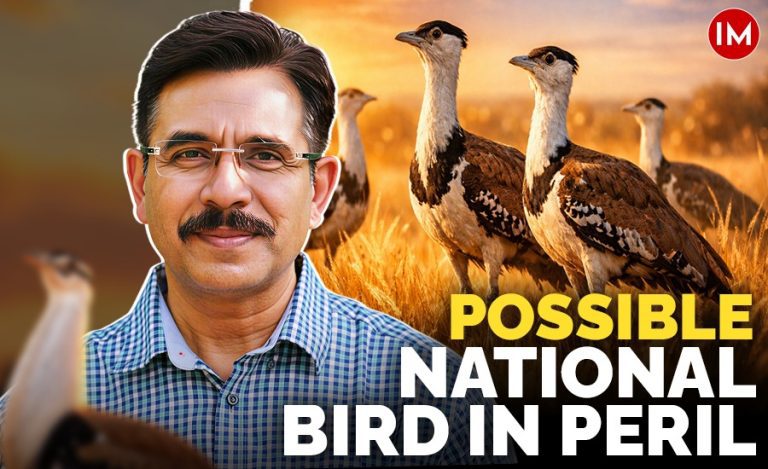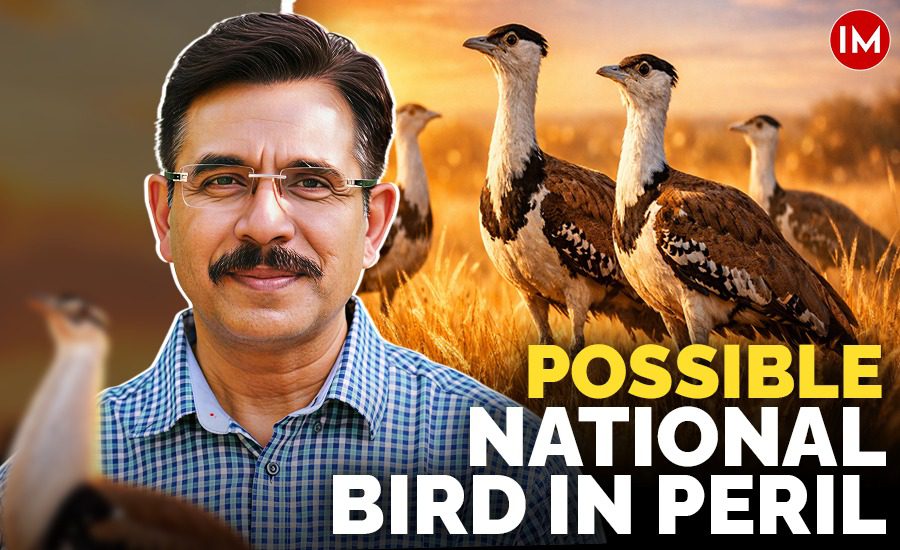
Did you know there was a bird that could have been India’s national bird instead of the peacock—and is now close to extinction? It’s called the Great Indian Bustard. Only about 120 of them remain in the entire world, and 117 of those are in Rajasthan, where it is also the state bird.
After Independence, the Great Indian Bustard—locally known as Godawan—was seriously considered for the status of national bird. But in the end, the peacock’s beauty won the day. Dr. Y. V. Jhala, who served for many years as the Dean of the Wildlife Institute of India in Dehradun, points out an unusual reason too: in English, a distorted form of the bird’s name sounds like a swear word. That, reportedly, nudged policymakers to choose the peacock over the bustard.
Kindly watch the video interview for full story by clicking here…..
The bird has also suffered because its meat is considered a delicacy, leading to widespread hunting. It is among the heaviest flying birds in the world—males can weigh up to 15–16 kilograms. With wings fully spread, it can stretch 7 to 8 feet across.
But hunting and neglect have taken a devastating toll. Today, only around 120 Great Indian Bustards survive globally—117 in Rajasthan and just three in Gujarat.
Tragic Problem
There’s another tragic problem. Because its eyes are positioned on the sides of its head, the bird can see left and right while flying, but not clearly straight ahead. Add to that its heavy body, which makes quick turns difficult. In the deserts of Rajasthan, crisscrossed by high-tension power lines, many bustards collide with these wires mid-flight and die.
The Supreme Court, in 2021 and again in 2025, directed that these power lines be laid underground. But given the enormous cost, implementation has yet to begin in earnest.
Conservation Underway
Meanwhile, conservation efforts are underway in Rajasthan and Gujarat. In places like Sam and Ramdevra near Jaisalmer, scientists are trying to breed and protect the birds in controlled conditions. Recently, a chick was successfully hatched through artificial means in Gujarat. But unless the threat of overhead power lines is removed, their survival remains uncertain.
Dr. Jhala also warns that it’s not just the bustard—many other birds like flamingos and pelicans fall victim to these high-tension wires.
A study suggests that in the Thar Desert alone, around 150,000 birds die every year due to power line collisions and electrocution. Migratory birds flying at night are especially vulnerable, as they simply cannot see the wires.
The Supreme Court has now stepped in again, ordering that these cables be taken underground instead of running overhead.
So why does the Great Indian Bustard matter so much to India? Why are crores being spent on its conservation? The issue is still caught between the courts and the government. And in the meantime, with every passing month, more birds are being lost.
We need to wake up—and soon. Otherwise, the Great Indian Bustard will join the long list of species that once existed, and are now gone forever.
Who knows—had it been declared India’s national bird, its fate might have been very different. Like the tiger, it too could have become a proud symbol of the nation, protected and celebrated.