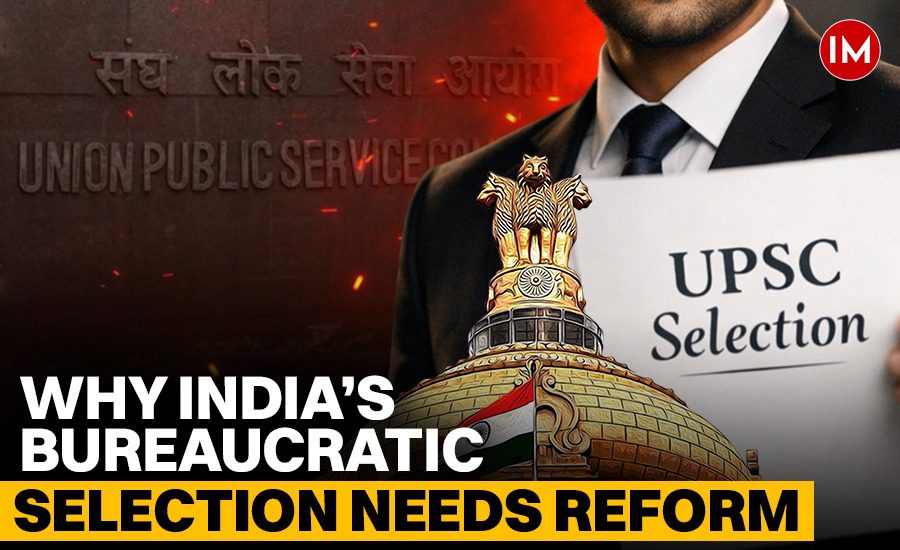
The integrity of recruitment into India’s higher bureaucracy is facing renewed scrutiny as a series of controversies involving caste, income, and disability certificates expose weaknesses in the selection ecosystem overseen by the Union Public Service Commission.
Recent controversies- from high-ranking candidates to serving officers-have revived a long-standing legal question: can procedural compliance substitute for substantive justice?
Ashtha Jain and the EWS question: When legality meets ethical scrutiny
The latest debate has been triggered by Ashtha Jain, who secured All India Rank 9 in the Civil Services Examination 2025. Her case has drawn attention due to her earlier induction into the Indian Police Service through the general category, followed by a subsequent selection into the Indian Administrative Service using an Economically Weaker Sections (EWS) certificate.
At present, there is no judicial finding establishing wrongdoing. Legally, the EWS framework- introduced through the 103rd Constitutional Amendment- bases eligibility on current income and asset criteria. This means a candidate can, in principle, qualify for EWS in one attempt even if they did not in a previous one.
Yet, the controversy lies in what administrative law scholars describe as “category migration without demonstrable socio-economic change.” The law recognizes income thresholds, but does not require longitudinal verification of financial status. This creates a situation where a candidate may remain within the letter of the law while raising concerns about its spirit.
Former civil servants have suggested that such cases may fall within the broader doctrine of “fraud on statute”-where legal provisions are technically complied with but used in a manner that defeats their underlying intent. While courts have not yet adjudicated on such transitions, the debate signals a growing discomfort with purely document-based validation of socio-economic status.
The Pooja Khedkar Case: A legal watershed
If the Ashtha Jain case raises ethical questions, the case of Pooja Khedkar marks a clear legal turning point. Her candidature was cancelled after discrepancies were found in her claims related to OBC status, disability certification, and age-based relaxations. Subsequent proceedings brought the matter before the Supreme Court of India, while the Delhi High Court made strongly worded observations, describing the case as a fraud not only on a constitutional body but on society itself.
The legal implications of such cases are well established. Under the BNS, offences such as cheating and forgery are attracted when false documents are used to obtain public employment. In addition, service law principles apply: once fraud is established, the appointment is liable to be cancelled irrespective of the time elapsed.
The jurisprudential foundation lies in the judgment in Chairman & MD, FCI vs Jagdish Balaram Bahira, where the Supreme Court held that appointments secured through false caste certificates are void ab initio. The Court made it clear that equity cannot be invoked to protect beneficiaries of fraud, as doing so would undermine the purpose of reservation itself.
The Khedkar case has also drawn attention to the possibility of organized networks facilitating the procurement of fraudulent certificates-though such allegations remain subject to investigation. Nonetheless, it has become emblematic of how systemic gaps can be exploited at scale.
PwBD certification and the problem of medical subjectivity
Parallel to caste and income-related disputes, controversies around disability certification–particularly under the Persons with Benchmark Disabilities (PwBD) category-have exposed a different set of institutional weaknesses.
Cases such as those involving Shubham Agarwal (recommended in CSE 2024 under the PwBD category) and other officers have raised questions about the consistency of medical assessments across states, scientific robustness of disability evaluation and also distinction between certified disability and functional capability.
Under existing rules, a minimum of 40% disability is required to qualify for reservation benefits. However, certification is conducted by state-level medical boards, often with varying standards and limited inter-operability of records.
The Supreme Court’s judgment in Vikash Kumar vs UPSC-while primarily focused on reasonable accommodation-commented on the need for standardized and evidence-based disability assessment. The Court recognized that disability is not merely a medical condition but also a question of access and fairness, thereby placing a higher burden on institutions to ensure accuracy and consistency.
Experts in medical jurisprudence caution that the absence of a centralized verification mechanism enables what is informally termed “certificate shopping”, where individuals may obtain differing assessments from multiple authorities. This creates a fragile legal environment in which disputes often arise only after selection, rather than being prevented at the entry stage.
OBC-NCL and the debate on ‘Invisible Wealth’
The controversy surrounding Poorva Chaudhary, who secured a rank in the Civil Services Examination 2024, under the OBC Non-Creamy Layer (NCL) category, has reignited debate on the adequacy of income-based criteria for determining backwardness.
Her case attracted public attention due to her familial background and perceived affluence, leading to questions about whether the existing framework accurately captures socio-economic disadvantage. Legally, however, the criteria are clear: eligibility is determined by income thresholds and specific exclusion rules laid down by the Department of Personnel and Training.
One such rule provides that children of parents who entered Group A services after a certain age may still be eligible for OBC-NCL status. This highlights a critical gap between legal eligibility and perceived privilege.
Courts have, in various contexts, acknowledged this limitation. Income certificates do not account for accumulated wealth, social capital, or lifestyle indicators. As a result, individuals who are technically eligible may not align with the intended beneficiaries of reservation policies.
A similar tension was visible in the case of Navneet Kaur Rana, who clinched the reserved Amravati parliamentary seat in Maharashtra as an independent candidate in 2019. In this case, judicial proceedings revolved around the validity of caste certification and the extent to which courts should examine substantive socio-cultural identity beyond documentation.
Functional Ability vs Certified Disability: The Praful Desai debate
Another dimension of the controversy has emerged from cases like that of Praful Desai, an IAS officer from the 2019 batch who secured a 532nd rank in the economically weaker section (EWS) and orthopedically handicapped category. Praful Desai came under public scrutiny following images of physical activity on the social media platforms. While no judicial finding has invalidated his status, the debate raised an important question: does visible physical capability contradict certified disability?
Courts have generally rejected such simplistic interpretations. Disability, in legal terms, does not imply total incapacity. However, they have also emphasized that certification must be consistent, credible, and medically defensible. The burden, therefore, lies on institutions to ensure that certification processes are rigorous enough to withstand both legal and public scrutiny.
A Pattern across decades: Courts have been consistent
Historical precedents reinforce the judiciary’s firm stance on fraudulent certification. Cases involving officers such as Sanjay Bhatia (1986-batch IPS officer, fired in 2010 over fake caste certificate) and IAS officer Asif K. Yusuf, who entered service using a forged OBC certificate, demonstrate that courts have consistently upheld the principle that fraudulent entry into public office cannot be regularized.
The long-running caste verification dispute involving Ajit Jogi further illustrates how such issues can persist across decades, ultimately requiring judicial intervention to resolve questions of identity and eligibility.
The Core Problem: Procedure vs Due Process
At the heart of these controversies lies a fundamental institutional limitation. The Union Public Service Commission primarily verifies whether a certificate- is issued by a competent authority, conforms to the prescribed format and falls within the validity period
It does not, however, verify the substantive truth of the claims contained within those documents.
This creates a paradox. Entry into public service is granted on the basis of procedural compliance, while substantive verification, if it happens at all, occurs only after disputes arise. By then, the candidate may already be in service, complicating both administrative and legal remedies.
Reform Imperatives: From documentation to verification
The Second Administrative Reforms Commission had, years ago, flagged the need for robust beneficiary identification systems. Its recommendations have gained renewed relevance in light of recent controversies.
Experts now advocate a shift from a system based on “procedure established by law” to one grounded in substantive due process. This would involve integration of income data with tax records, centralized medical certification, digitized caste verification through scrutiny committees and real-time, Aadhaar-linked verification platforms.
Beyond legality, towards legitimacy
The fake certificate controversy is no longer confined to legal technicalities. It has evolved into a broader question about the legitimacy of State institutions and the fairness of access to public employment.
Courts have repeatedly affirmed that reservation is a tool of social justice, not a mechanism to be manipulated. Yet, as long as verification remains procedural rather than substantive, the system will remain vulnerable to exploitation.
The challenge, therefore, is not merely to detect fraud, but to redesign institutions in a way that makes such fraud structurally difficult. Until then, the gap between merit and manipulation, and between legality and legitimacy will continue to test the credibility of the Civil Services in India.