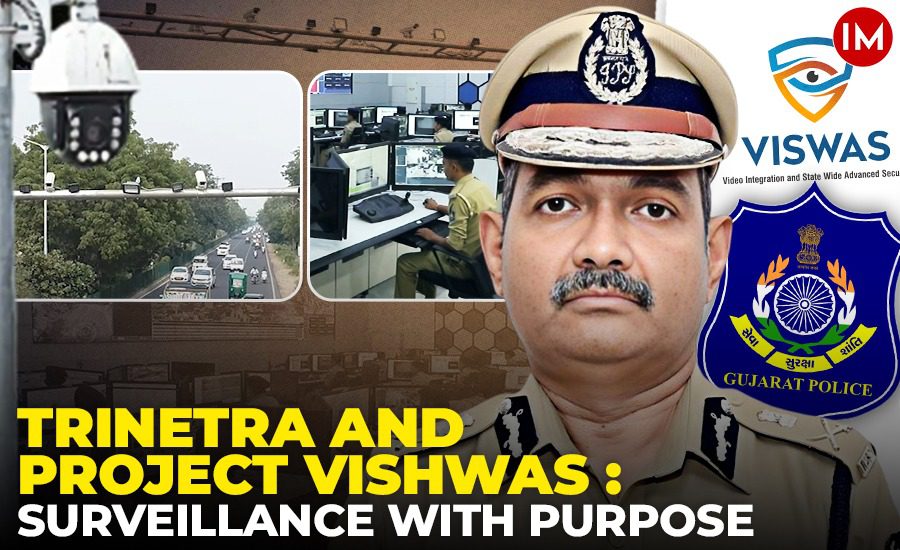
When policing meets technology at scale, the results can redefine public safety. In Gujarat, this transformation has taken shape through Project Vishwas, with its technological nerve centre – TRINETRA, the Integrated Command and Control Centre (i3C). Designed as the “third eye of the police,” TRINETRA integrates thousands of cameras, drones, data analytics, and human intelligence into a single, unified system that is reshaping how law and order is maintained across the state.
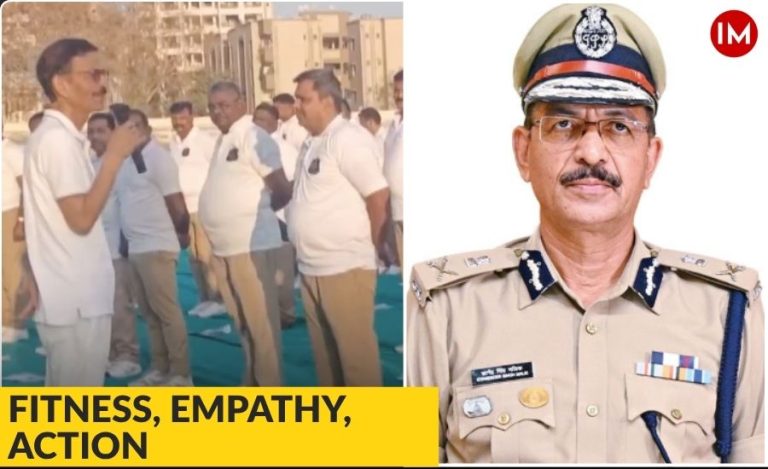
Presented under the Law & Order: Police Command Centre category, TRINETRA is not just a surveillance project—it is a force multiplier. The initiative was spearheaded and presented by Mr. Narasimha Komar, IPS, a 1996-batch officer of the Gujarat cadre of DGP rank now Working as Police Commissioner of Vadodara.
THE CONCEPT OF TRINETRA: A FORCE MULTIPLIER
TRINETRA functions as the Integrated Command and Control Centre (i3C) for over 7,000 CCTV cameras, 10,000+ body-worn cameras, and 21 drone-based cameras deployed across Gujarat. Cameras mounted on poles, worn on police uniforms, and flying in the sky together form a seamless surveillance grid.
This three-tiered vision—ground, body, and aerial—has given Gujarat Police unprecedented situational awareness. The system is supported by video analytics, trained engineers, and district-level command centres, enabling real-time monitoring as well as post-incident investigations.
“Trinetra is not just about watching—it is about understanding, anticipating, and responding. When technology and policing work together, it leads to better decision-making and safer outcomes,” told Mr. Narasimha Komar during a conversation with Indian Masterminds.
SCALE AND INFRASTRUCTURE: COVERING THE ENTIRE STATE
Under Project Vishwas, Gujarat Police initially deployed 7,000+ CCTV cameras across 41 cities, including all district headquarters and key religious and tourist destinations such as Somnath, Dwarka, Ambaji, Palitana, Dakor, Pavagadh, and the Statue of Unity. The project has since expanded to nearly 100 cities, covering even Tier-2 towns and smaller urban centres.
The surveillance backbone includes 34 District Command and Control Centres (NETRAMs), massive video walls, data centres, secure networks, and integrated platforms such as ITMS (Integrated Traffic Management System) and VIMS (Video Incident Management System).
BODY-WORN CAMERAS: TRANSPARENCY ON THE UNIFORM
One of the most transformative elements of Project Vishwas has been the rollout of 10,000 body-worn cameras (BWCs). Of these, 1,000 cameras support live streaming, while 9,000 function as standalone devices. With features like multi-mic audio, low-light capability, GPS-based live maps, and 12-hour battery life, these cameras have fundamentally changed police-public interactions.
Docking stations have been installed in 622 police stations, supported by an Evidence Management System (EMS) that ensures secure storage and retrieval of footage.
“Body-worn cameras have brought transparency, accountability, and trust. They protect citizens from excesses and police personnel from false allegations,” Mr. Komar notes.
DRONES AND VIDEO ANALYTICS: EYES IN THE SKY
The drone-based camera system under TRINETRA uses micro UAVs equipped with thermal and daylight vision, capable of operating up to 200 metres altitude with an endurance of 90 minutes. These drones are extensively used during VIP movements, festivals, disaster management, and large public gatherings.
Advanced video analytics further enhance capabilities—detecting wrong-way driving, crowd density, unattended objects, camera tampering, intrusions, and even behavioural patterns. Automatic Number Plate Recognition (ANPR) enables vehicle tracking across jurisdictions, aiding in criminal investigations and hit-and-run cases.
TRAFFIC MANAGEMENT AND ROAD SAFETY
Project Vishwas also powers Gujarat’s Integrated Traffic Management System (ITMS). Traffic violations are detected electronically, e-challans are generated automatically, and citizens receive notifications via SMS and email. This shift from manual enforcement to technology-led monitoring has improved compliance and reduced road accidents.
Between 2018 and 2020, road accidents fell by nearly 29 percent, highlighting the system’s impact on mobility and safety.
GOVERNANCE, TRAINING, AND RESULTS
The project is backed by a robust governance model involving police, state IT agencies, and private system integrators. More than 300,000 police personnel have undergone role-based training, supported by over 250 technical staff and outsourced engineers.
The results are tangible: over 6,200 criminal cases detected, recovery of ₹13.99 crore worth of stolen property, and the creation of a data-driven decision support system for policing.
A NATIONAL MODEL FOR SMART POLICING
Recognised with the National e-Governance Gold Award and several other honours, Project Vishwas and TRINETRA together represent a new paradigm in Indian policing—where technology enhances human judgement rather than replacing it.
As Gujarat moves into the next phase with greater AI and machine learning integration, TRINETRA stands as a powerful example of how a “third eye” can make policing smarter, fairer, and more citizen-centric.