When citizens lose faith in complaint systems, governance begins to drift away from the people it serves. In Punjab’s Jalandhar, that drift had become visible—vacant plots were turning into garbage dumps, stray cattle roamed busy roads, unsafe cable clusters hung dangerously overhead, and residents had no reliable way to report problems without physically visiting multiple offices.
In July 2025, the district administration changed that equation.
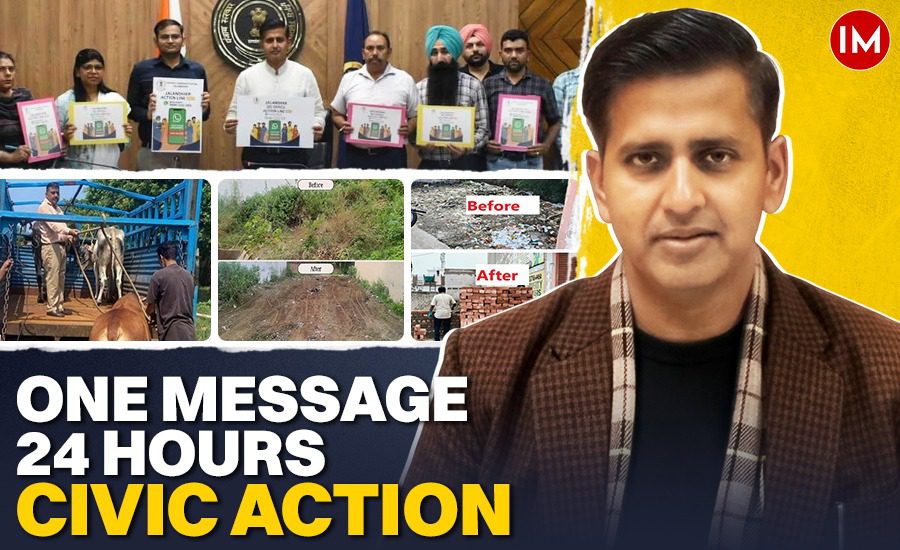
Under the leadership of Himanshu Aggarwal, Deputy Commissioner of Jalandhar (2014 batch, Punjab Cadre), the district launched Jalandhar Action Line 24/7—a WhatsApp-based, real-time grievance redressal platform designed to re-engineer urban governance at the district level.
Within four months, the initiative received 959 complaints. More importantly, it restored something that had steadily eroded: citizen trust.
WHY JALANDHAR NEEDED A SYSTEM RESET
Before the launch of Jalandhar Action Line 24/7, civic grievances were recorded manually in registers. There was no centralised tracking, no uniform follow-up mechanism, and no clarity on timelines. Departments operated in silos—the Municipal Corporation, Revenue Department, Animal Management teams, and PSPCL functioned independently, often leading to delays and accountability gaps.
Citizens were forced to make repeated visits to government offices, spend money on travel, and follow up endlessly without assurance of resolution.
“The biggest gap was not intent—it was process,” IAS Himanshu Aggarwal told Indian Masterminds.
“We realised that unless we redesigned the system itself, complaints would continue to move slowly and citizens would continue to feel unheard.”
Emergencies made the shortcomings even more visible. During floods or urgent public safety issues, the absence of a centralised, real-time communication platform delayed coordination and response.
The need was clear: governance had to become faster, transparent, and citizen-driven.
A WHATSAPP-BASED GOVERNANCE MODEL
Instead of building a complex portal that might discourage adoption, the district administration chose a simple and accessible tool — WhatsApp.
“At the district level, innovation must be practical,” Mr Aggarwal explains.
“If you want citizens to participate, you cannot ask them to learn a new system. You must go where they already are.”
Through a dedicated WhatsApp number, citizens can instantly report civic issues by sending photos, videos, and location details. Complaints range from:
- Garbage accumulation in vacant plots
- Illegal electricity and cable clustering
- Stray animal issues
- Road maintenance problems
- Flood-related public concerns
Each complaint is digitally captured and routed in real time to a multi-department District Committee comprising officials from the Municipal Corporation, Revenue Department, Animal Management teams, PSPCL, and other relevant agencies.
Complaints now move through defined digital stages:
- Received
- Assigned
- Verified
- Action Taken
- Closed
Every stage is time-stamped and visible to supervisory authorities.
“Transparency is not about announcements. It is about digital trails. Once every action is recorded, accountability becomes automatic,” the officer said.
24-HOUR RESPONSE WINDOW AND LEGAL ENFORCEMENT
One of the most important features of the system is its structured 24-hour response window.
Field teams are assigned for on-ground verification, and evidence — photographs and reports — is uploaded directly into the system. If violations are confirmed, legally backed notices are issued with defined compliance timelines.
For example, in cases of garbage-filled vacant plots:
- Owners are given 14 days to clean the site.
- If they fail to comply, the Municipal Corporation undertakes cleaning.
- Penalties are imposed.
- Red entries are made in the jamabandi (land records), linking enforcement directly with property documentation.
“We did not want this to be just a complaint platform. We wanted enforcement to be structured, lawful, and visible,” Mr Aggarwal states.
Weekly reviews are conducted by officials of the Municipal Corporation, while fortnightly and monthly meetings chaired by the Deputy Commissioner ensure performance monitoring and bottleneck resolution.
MEASURABLE IMPACT
The initiative originally began with a focused goal — making the city stray cattle free.
“Road safety and animal welfare were both concerns. We realised that a helpline dedicated to stray cattle could also evolve into a broader civic platform,” Mr Aggarwal recalled.
Using the helpline, more than 250 stray cattle were relocated to cattle pounds (gaushalas), where they are properly cared for. This significantly improved road safety and reduced accident risks.
As public trust grew, more categories were added — cleanliness violations, garbage reporting, unsafe cables, and public issues during floods.
Within four months:
- 959 complaints were registered
- Over 200 stray animals were relocated
- Multiple unsafe cable clusters were addressed
- Vacant plots were cleaned
- Road hazards were resolved
“The number of complaints is not a negative statistic. It reflects confidence. Citizens are engaging because they know action will follow,” the officer clarifies.
TIME AND COST SAVINGS FOR CITIZENS
The shift from manual registers to a digital workflow has dramatically reduced both time and cost for residents.
1. No More Physical Visits
Citizens no longer need to travel to multiple offices. Complaints can be filed instantly through WhatsApp, saving transport expenses and working hours.
2. Faster Resolution
Digitally routed complaints replaced slow manual follow-ups. The 24-hour response window ensures early verification and timely action.
3. Defined Accountability
Real-time tracking eliminates ambiguity. Citizens no longer have to repeatedly check status updates in person.
“Earlier, a citizen might lose two days just following up. Now the system follows up on behalf of the citizen,” Mr Aggarwal told Indian Masterminds.
The administrative effort has also become more efficient. With structured digital workflows, departments avoid duplication and confusion.
OVERCOMING IMPLEMENTATION CHALLENGES
Introducing any digital governance reform brings challenges.
Inter-Departmental Coordination
Earlier, departmental silos slowed action. To address this, a single district-level committee was created with defined roles and digital routing mechanisms.
“Coordination cannot depend on phone calls. It must be embedded into the system.”
Fragmented Manual Records
Manual registers lacked traceability. A centralised digital system with time stamps ensured structured documentation.
Technology Adoption
Instead of introducing a complex portal, the administration leveraged WhatsApp — already familiar across socio-economic groups. “Accessibility determines adoption. If the system is simple, participation increases automatically.”
Ensuring Compliance
Delays and non-compliance were tackled through digital evidence uploads, legal notices, and integration with land records. “Enforcement must have consequences. Otherwise, systems lose credibility.”
A REPLICABLE GOVERNANCE MODEL
The most striking aspect of Jalandhar Action Line 24/7 is its simplicity. It does not require heavy infrastructure or large budgets. The model relies primarily on:
- A dedicated WhatsApp number
- A basic digital complaint-tracking system
- Internet-enabled devices for officials
- Clearly defined Standard Operating Procedures (SOPs)
- Regular review mechanisms
“This is not about expensive technology. It is about process re-engineering.”
Because it leverages existing staff and administrative frameworks, the initiative can be replicated in other districts with minimal setup.
REBUILDING TRUST THROUGH PROCESS DESIGN
Urban governance often struggles not because problems are unsolvable, but because systems are slow and fragmented.
By integrating real-time communication, structured workflows, legal enforcement, and routine reviews, Jalandhar has demonstrated that district-level innovation can deliver tangible results without large-scale infrastructure investment.
“Governance must feel responsive. When a citizen sends a complaint at 10 pm and sees action begin the next morning, that changes perception,” IAS Himanshu Aggarwal stated.
The Jalandhar Action Line 24/7 stands as a practical example of how digital tools, when combined with administrative clarity and accountability, can reshape public service delivery.
As cities across India search for scalable urban governance solutions, this district-level initiative offers a blueprint: simple technology, defined processes, and continuous monitoring.
And at its core, a straightforward principle:
“If citizens trust the system, they will use it. And when they use it, governance improves,” Mr Aggarwal concludes.