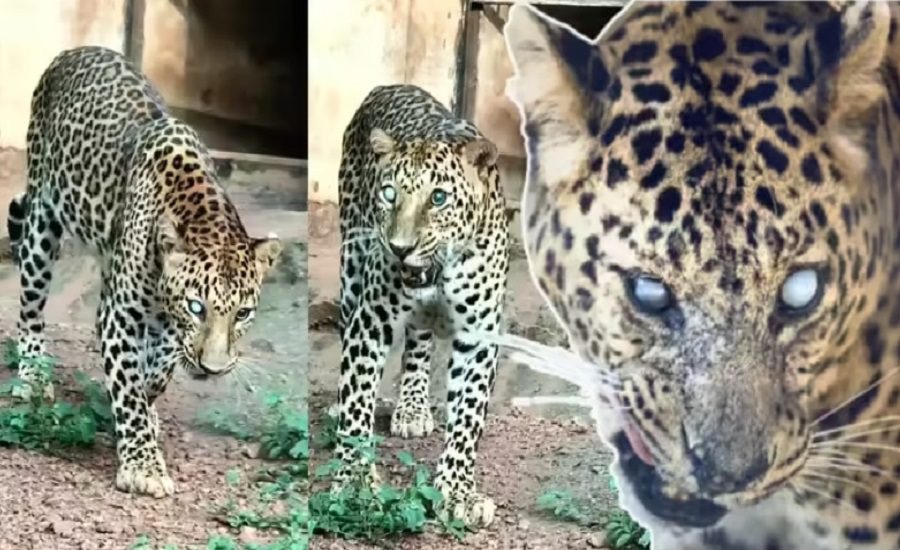
In 2020, a leopard was found near Indore in a condition so horrifying that survival seemed impossible. His skull was riddled with gun pellets, his body was weak and bleeding, and both his eyes had lost vision forever. Terrified of every sound, he lay curled up in a corner, refusing to move. It wasn’t just his eyesight that had been taken away – his confidence, trust, and spirit were shattered too.
Most believed he would not survive. Many quietly assumed death was only a matter of time. But what followed was nothing short of a miracle – born from the unbreakable will of the Forest Department and the quiet, stubborn resilience of the leopard himself. This is the story of Inder.
Indian Masterminds spoke with IFS Vijay Kumar, Director, National Park and Zoo, and senior veterinarian Dr. Atul Gupta, who treated and cared for Inder, to understand his remarkable survival and his condition today.
A Distress Call from Nayapura
In July 2020, forest officials received information about a wounded leopard in the Nayapura forest area (Compartment No. 222) of the Indore forest range. Initially, the injuries were believed to be the result of a territorial fight among wild animals. But days passed, wounds failed to heal, and concern deepened.
When the leopard was taken for a CT scan on September 21, 2020, the truth shocked everyone. Embedded deep inside his skull were 35–42 gun pellets, lodged dangerously close to vital areas of the brain. His body was bleeding, his strength nearly gone, and his eyesight had been completely destroyed.
Wildlife experts feared the worst.
Surgery Was Too Risky, Hope Was Almost Gone
Doctors examined the scans carefully. Removing the pellets would require invasive surgery – one wrong move could damage the brain and end the leopard’s life instantly. The decision was agonizing but clear: surgery was not an option.
Senior veterinarian Dr. Atul Gupta, who treated Inder, recalled the severity of the situation, “When he was brought here, his condition was extremely critical. A CT scan revealed around thirty-six pellets lodged in his head. Surgery wasn’t possible because the pellets were very close to sensitive areas of the brain. Both optic nerves were damaged, so he had completely lost his vision.”
The leopard was depressed, traumatized, and described by doctors as being “on the verge of death.”
A New Name, A New Beginning at Van Vihar
The injured leopard was shifted to Van Vihar National Park, Bhopal, where he was named Inder. Former Director Kamalika Maholtra and senior veterinarian Dr. Atul Gupta made a crucial decision—to focus not just on physical survival, but mental healing.
Inder was kept in strict isolation. His enclosure was quiet. Human presence was minimized. Soothing music was played to calm his distressed mind. Food was placed at different locations to stimulate his sense of smell – the one sense he could still rely on.
At first, nothing worked.
Inder refused to eat. He sat huddled in a corner, trembling at unfamiliar sounds. Every small noise triggered fear.
But the team did not give up.
Fighting Depression Before Healing the Body
According to Ashok Kumar Jain, Assistant Director, Forest Department, Inder’s biggest battle was psychological.
“When Inder was brought to Bhopal, he was seriously injured and deeply frightened. Due to depression, he didn’t come out of his cage for a long time and remained inactive. Everyone worked tirelessly to help him overcome this phase.”
To help Inder regain confidence, his enclosure was redesigned to resemble a forest. Instead of placing food in one fixed spot, it was scattered across the enclosure. Elevated platforms were added, respecting the leopard’s natural instinct to climb and observe from heights.
Slowly – very slowly – Inder began to respond.
Teaching a Blind Leopard to ‘See’ Again
Blindness posed the biggest challenge. Inder could not see his surroundings, so the team focused on helping him feel and understand his world.
Food locations were changed daily. Paths were left open so he could walk freely and independently. His sense of smell became his guide.
Caretakers Sharmanand Gere and Dilip Batham took complete responsibility for his daily care, ensuring consistency and patience.
Within two months, Inder had memorized the layout of his enclosure through scent alone.
Six months later, he was no longer afraid.
“It’s Nothing Short of a Miracle”
IFS Vijay calls Inder’s recovery extraordinary.
“It’s nothing short of a miracle. We worked very hard to revive Inder, and our keepers played a crucial role. Today, he is perfectly fine and surviving comfortably.”
Once written off as a lost cause, Inder began leaping, walking confidently, and responding to sounds from outside his enclosure – just like any other leopard.
Life After Darkness
Today, Inder moves confidently across his enclosure at Van Vihar. He recognizes space not through sight, but through scent and sound. He sits proudly on high platforms, listens to the world around him, and lives with a calm strength that inspires everyone who sees him.
Dr. Atul Gupta confirms – “He eats on his own, walks around comfortably, and performs all natural activities. He is not on medication anymore, only supplements like vitamins and calcium. His brain is intact, and his condition is stable.”
A Living Symbol of Compassion and Persistence
Everyone once believed Inder would die. But care, discipline, patience, and teamwork gave him a new life.
Blind, yet undefeated – Inder stands today as living proof that with the right treatment, compassion, and unwavering effort, even animals on the brink of death can be brought back.
He may never see the forest again, but he lives it every day – through courage.
This is Inder’s story. And it is one the forest will never forget.