“Dreams do not come true because they are easy; they come true because someone refuses to give up until they do.”
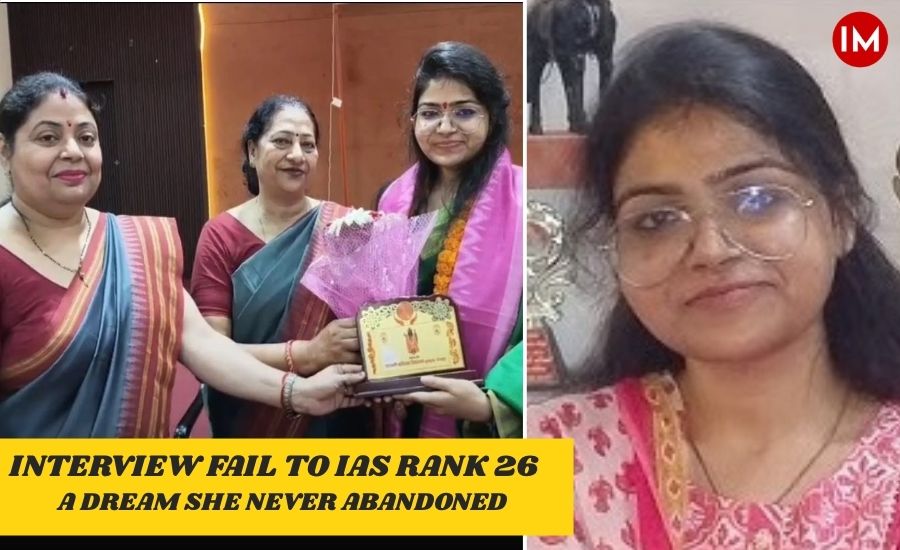
There are success stories, and then there are journeys that quietly redefine what perseverance truly means. For Ishita Sharma, the road to the Civil Services was not paved with immediate victories, but with repeated disappointments, self-doubt, discipline, and a determination so steady that even failure could not shake it. A young woman from Gorakhpur, who once declared after topping Class 12 that she would one day become an IAS officer, has now transformed that childhood promise into reality by securing All India Rank 26 in the UPSC Civil Services Examination 2025.
Her achievement carries a deeper emotional weight because it came in her fourth attempt, after failing to clear the Preliminary examination twice and narrowly missing final selection by just 14 marks after reaching the interview stage in her third attempt. Where many aspirants might have stepped back, Ishita chose to rework, rebuild, and return stronger.
Her story is not merely about rank – it is about clarity of purpose, family support, and the quiet courage required to continue when results repeatedly say “not yet.”
Journey So Far: A Dream That Began Early and Never Changed
For Ishita, the aspiration to join the civil services did not emerge during college or after graduation. It had lived within her for years.
She recalls that ever since she became aware of the world around her, she had only one dream—to become an IAS officer. Even when she topped her Class 12 board examinations, and people asked what she wanted to become, her answer was immediate and unwavering: “I will become an IAS officer.”
That statement was not youthful enthusiasm alone; it became the foundation of every academic and career decision she made afterward.
Her UPSC path, however, tested her resolve repeatedly –
- First Attempt: Could not clear the Preliminary examination
- Second Attempt: Again failed to qualify Prelims
- Third Attempt: Reached the interview stage but missed final selection by only 14 marks
- Fourth Attempt: Secured AIR 26 in UPSC 2025
The first two failures were especially difficult because they raised a painful internal question – whether the examination was beyond her capability. Yet, she did not allow temporary defeat to become permanent belief.
When the third attempt ended with such a narrow miss, the disappointment was sharper because success had come within touching distance. But rather than seeing that result as defeat, she treated it as proof that she belonged in the competition.
That final breakthrough came because she chose improvement over discouragement.
Her Background: A Strong Academic Foundation Rooted in Simplicity
Ishita Sharma comes from a grounded middle-class family in Gorakhpur.
Her father, D.K. Sharma, works as a bank manager, while her mother, Archana Sharma, is a homemaker. In countless civil services journeys, family support often appears as a quiet force behind success, and Ishita’s story is no different.
Her parents did not merely encourage her—they embraced her ambition as their own. Through years of uncertainty, repeated attempts, and emotional highs and lows, they stood by her without wavering.
She completed her schooling at Saraswati Balika Vidyalaya, where she had already established herself as an academically bright student.
Later, she pursued higher education at University of Delhi, completing both –
- Bachelor of Commerce (B.Com)
- Master of Commerce (M.Com)
Her academic discipline remained consistent throughout, and commerce eventually became both her academic strength and UPSC optional advantage.
Educated at Delhi University, But Preparation Stayed Rooted at Home
Although she studied at University of Delhi, Ishita did not relocate to a major coaching hub for UPSC preparation.
Instead, she prepared primarily from her home in Gorakhpur.
This decision reflects a growing pattern among successful candidates who rely more on strategic self-study than on conventional coaching ecosystems.
She combined:
- disciplined self-study
- limited online guidance
- repeated revision
- conceptual understanding over rote coverage
Her approach was not to study mechanically for long hours simply to satisfy a timetable. Instead, she focused on understanding each topic thoroughly before moving ahead.
This quality-over-quantity mindset became one of her strongest assets.
Cleared NET-JRF in First Attempt: Proof of Academic Precision
Before achieving success in UPSC, Ishita had already demonstrated her academic excellence by clearing the NET-JRF examination in her very first attempt.
Commerce was not merely a subject she studied—it became an area in which she built serious conceptual command.
Clearing NET-JRF early gave her confidence that she possessed both analytical ability and consistency required for competitive examinations.
It also reinforced her decision to continue with Commerce as her UPSC optional subject.
The Biggest Struggle: Learning to Continue After Repeated Failure
The emotional difficulty of UPSC is often harder than the academic difficulty.
For Ishita, the first two failures were painful because she could not even clear the Preliminary stage.
At that point, self-doubt naturally entered.
She openly admits that she began wondering whether civil services might be beyond her capacity.
That phase is often where many aspirants permanently withdraw—not because they lack ability, but because repeated failure disturbs belief.
What changed her trajectory was support from home.
Her family continuously reminded her that one examination result does not define potential.
That emotional support gave her enough strength to attempt again.
The third attempt was simultaneously encouraging and heartbreaking: she reached the interview stage but missed the final list by just 14 marks.
A near miss often hurts more than a clear failure because success feels visible but incomplete.
Instead of allowing frustration to dominate, she carefully identified weak areas and rebuilt her preparation strategy.
That decision changed everything.
Her Preparation Strategy: What Worked in the Fourth Attempt
Ishita repeatedly emphasizes that success in UPSC is not about random hard work—it is about directed hard work.
Core Elements of Her Strategy
- Consistency over irregular intensity
- Strong optional subject alignment with academic background
- Deep conceptual clarity instead of superficial reading
- Self-study as the primary preparation mode
- Selective use of online classes
- Focused revision after every failure
Why Commerce Became Her Strength
She chose Commerce as her optional subject because it directly matched her graduation and postgraduation background.
This gave her three advantages:
- familiarity with syllabus
- conceptual depth
- answer-writing confidence
She strongly advises aspirants not to choose optional subjects based on trends, popularity, or what others are taking.
Instead, optional selection should come from one’s own academic comfort and long-term retention ability.
Interview Stage: Questions That Tested Knowledge and Administrative Thinking
During the UPSC 2025 personality test, Ishita’s board reportedly explored a wide range of topics connected to her academic profile, hometown, and governance perspective.
Key Interview Areas Covered
- Commerce and Finance: Banking sector challenges, GST implementation, and structural financial reforms
- Education Policy: Questions related to National Education Policy 2020 and literacy delivery at grassroots level
- Regional Understanding: Historical and industrial significance of Gorakhpur and eastern Uttar Pradesh
- Ethics and Leadership: Handling political pressure while ensuring transparency in administration
Her interview reflected a common UPSC pattern: boards often test not only knowledge but also administrative temperament, balance, and clarity under pressure.
Given her stated interest in public education, education policy became a particularly relevant area.
Why Family Became Her Emotional Anchor
Every long UPSC journey requires a psychological support system.
For Ishita, that strength came from home.
Her father’s disciplined professional background as a bank manager and her mother’s constant emotional support helped her maintain equilibrium through four demanding years.
She also gives significant credit to her elder brother, acknowledging his role in her preparation and motivation.
Remaining connected to family while preparing from home in Gorakhpur helped her avoid the emotional isolation many aspirants experience.
That grounding became an invisible advantage.
Her Vision as an Officer: Why Education Matters Most to Her
Unlike many candidates who speak broadly about administration, Ishita has already identified a sector she wants to work on deeply—education.
She believes educational reform creates long-term social transformation.
Her own journey—from a school topper to a postgraduate scholar to AIR 26—has convinced her that education changes confidence, choices, and independence.
She has expressed a desire to work toward improving educational systems once she enters service.
Message for Aspirants: Lessons from Four Attempts
Her message carries special credibility because it comes after repeated setbacks.
Her Advice to Future UPSC Candidates
- Treat UPSC as a marathon, not a sprint
- Failure is feedback, not final judgment
- Study regularly rather than in emotional bursts
- Choose optional based on strength, not popularity
- Stay mentally connected to people who keep you grounded
- Every attempt should correct something specific
One of her most powerful lessons is simple: failure teaches what not to repeat.
That mindset helped her convert disappointment into rank.
A Strong Message for Young Women: Become Financially Independent
Beyond exam advice, Ishita speaks strongly about self-reliance for women.
She believes every young woman must aim for financial independence because real decision-making power begins when one can stand independently.
According to her, talent and skills must be actively used—not hidden.
This makes her success story larger than rank; it becomes a message of agency.
From a Class 12 Declaration to AIR 26: A Promise Kept
Years ago, a school topper confidently said she would become an IAS officer.
That statement could easily have remained a childhood ambition.
Instead, through four attempts, two prelim failures, one painful interview miss, and relentless correction, Ishita Sharmamade sure it became truth.
Her story proves that in examinations like UPSC, brilliance matters—but endurance matters more.
And sometimes, the dream belongs most deeply to those who refuse to abandon it after hearing “no” three times before finally receiving their “yes.”