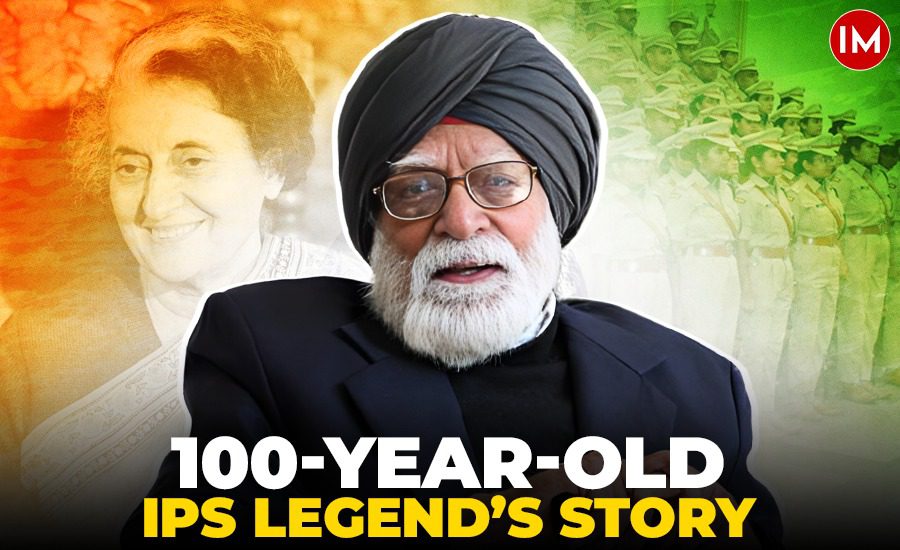
At 100, Jagjit Singh Bawa does not merely look back at life; he remembers it with striking clarity.
His memories are not ordinary recollections. They are scenes from some of India’s most defining moments: Partition, political upheaval, insurgency, and the inner workings of power. His journey runs parallel to the story of modern India itself.
Even today, in Chandigarh’s Sector 18, he lives actively, meeting friends, playing bridge five times a week, and spending time at the Golf Club. Age, for him, has slowed the body, not the mind.
BORN IN UNDIVIDED INDIA, SHAPED BY PARTITION
Bawa was born on February 21, 1926, in Multan, in undivided Punjab.
His early years carried the promise of a stable life. He studied at the prestigious Government College, Lahore, graduating with honours in History in 1945… his name still etched in its Academic Roll of Honour. He went on to pursue law at Lahore’s Law College.
Then came 1947.
Partition did not just redraw borders; it tore through lives. Bawa’s family was among the first to migrate to India. His father, a PCS officer who had served as Deputy Commissioner in several districts, moved the family to safety.
But safety came with scars.
Bawa witnessed vehicles filled with bodies. His home in Amritsar became a refuge for relatives and displaced families. Those days left an imprint that never faded.
He rebuilt his path, completing his law degree with first-class marks from Panjab University’s Law College in Shimla in 1949.
1951: ENTERING A SERVICE STILL FINDING ITS FEET
In 1951, Bawa joined the Indian Police Service.
India was young. Its institutions were still evolving. For officers like him, there was no established system to inherit. They had to shape it themselves.
He began as an Assistant Superintendent of Police, rising through the ranks as Superintendent of Police and later Senior Superintendent of Police in Ferozepur. He served as district police chief across several regions, learning policing from the ground up. Handling people, crises, and complexities that could not be taught in classrooms.
RISING THROUGH PUNJAB POLICE
Bawa’s career steadily moved upward.
He headed the Punjab CID as Deputy Inspector General, was promoted to Inspector General in 1971, and earned the highest police distinctions during his 34-year career.
These roles placed him at the centre of decision-making during a time when Punjab, as a border state, required sharp administrative judgment and constant vigilance.
His approach was simple, firm, fair, and rooted in human understanding.
THE CBI YEARS
In 1977, Bawa was called to the Centre and appointed Joint Director of the Central Bureau of Investigation (CBI). By 1980, he rose to become its Director, a position he would hold until 1985, making him one of the longest-serving chiefs of the agency.
He also represented India at Interpol conferences across Europe and the UK, placing him on the global stage of policing.
But his most defining moments came not in conferences, but in rooms where power, pressure, and principle collided.
THE DAY HE REFUSED TO DISBAND THE CBI
Soon after Indira Gandhi returned to power in 1980, Bawa had his first meeting with her as CBI Director.
Her first instruction was direct:
“Disband the CBI.”
The room must have felt heavy. But Bawa did not respond impulsively. He asked for a day. The next day, he returned with a detailed note.
He explained that the CBI had been created with the consent of all states, under the vision of Jawaharlal Nehru. Dismantling it, he warned, would be easy, but rebuilding it later would be nearly impossible.
He suggested reform instead.
The discussions stretched over days. The Prime Minister was upset with how the agency had functioned during the previous government, believing it had targeted her party and her son, Sanjay Gandhi.
But Bawa held his ground. Eventually, the decision changed. The CBI was not disbanded.
SAVING OFFICERS FROM DISMISSAL
The matter did not end there.
Indira Gandhi handed him a list of officers she believed had acted against Congress leaders. Her instruction was clear: “dismiss them”.
Again, Bawa resisted.
He warned that mass dismissals without solid grounds would create unrest and damage the institution. After persistent persuasion, he managed to shift the decision, from dismissal to transfers.
Even then, the situation was tense.
Bawa personally called the affected officers. He offered them postings of their choice outside the CBI, explaining the situation honestly, that dismissal had been the original order.
That honesty worked.
The tension eased. Officers moved on. The crisis settled.
ADVICE THAT WENT UNHEARD
As CBI Director, Bawa was also in office during Operation Bluestar in 1984. Though not directly involved, he was part of critical discussions.
He repeatedly advised against sending the Army or police into the Golden Temple.
“Do whatever you want… impose curfew, stop supplies… but don’t send forces inside,” he shared his conversation with the former Prime Minister in an interview with the media.
He believed the operation could have been avoided. But decisions took a different course.
1984: WALKING INTO A CITY ON EDGE
Then came October 1984: the assassination of Indira Gandhi.
Bawa remembers that day clearly.
He and Home Secretary MMK Wali were attending a CRPF passing-out parade when they received calls. They rushed back as Delhi began to erupt.
That evening, as he tried to return home, roads were blocked. Khan Market, Lodhi Road, areas near the Prime Minister’s residence… all closed. He was diverted repeatedly before finally reaching a friend’s house. Late at night, the Police Commissioner sent an escort to take him home.
For three to four days, he stayed indoors on police advice. But grief overpowered caution. He decided to go to her residence to pay his last respects, even as the city echoed with violent slogans.
When the Cabinet Secretary saw him there, he remarked,
“Brave of you to come here.”
The moment spread quickly. Sikh colleagues called him, asking whether they should come too.
His response was simple:
“They could come at their own risk.”
LIFE AFTER UNIFORM
After retiring in 1985, Bawa chose a quieter life in Chandigarh. But retirement did not mean withdrawal.
He served on the UT Administrator’s Advisory Council and has been associated with Guru Nanak Public School since 1995, currently heading its governing council.
His days are still full: friends, conversations, cards, and community.
THE MAN BEHIND THE RANK
Ask him the secret to his long life, and his answer is not complicated.
He credits faith, simple food, regular exercise, and good relationships, along with a guiding line from Guru Gobind Singh:
“Deh Shiva Bar Mohe Eha, Shubh Karman Te Kabhu Na Taron”
— a prayer to always walk the right path.
A LIFE THAT STILL SPEAKS
Jagjit Singh Bawa’s story does not rely on dramatic declarations.
It lives in moments:
- A young man crossing borders during Partition
- An officer shaping policing in a new nation
- A director standing his ground before the Prime Minister
- A citizen walking into a volatile city to pay respect
At 100, he is not just a former officer. He is a witness to history, and a participant in it.
And in the quiet rhythm of his present life, that long journey continues to speak.