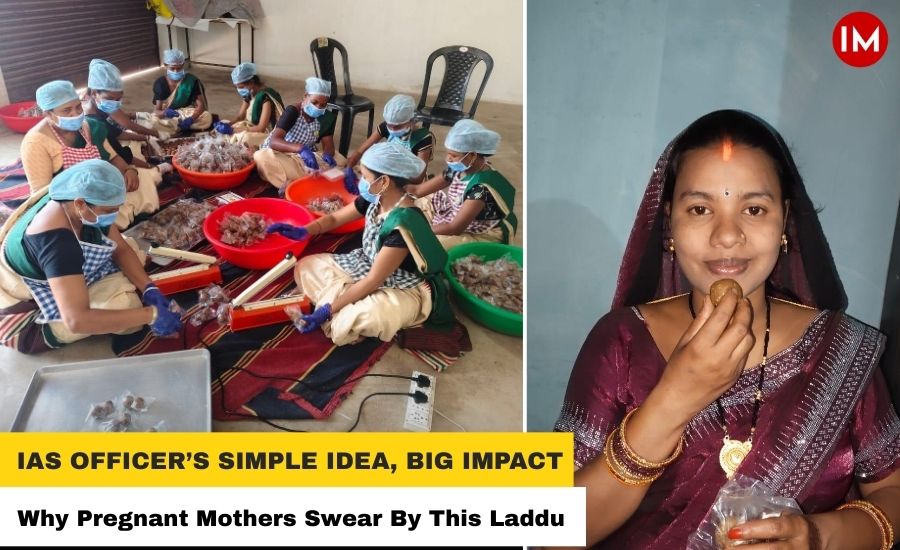
Malnutrition in rural India is not new. Despite decades of government efforts, it continues to haunt the country’s most vulnerable regions. But in the tribal heartland of Chhattisgarh’s Korea district, a simple, traditional sweet has quietly sparked an extraordinary transformation.
Here, babies were too often born under 2.5 kilograms. Mothers were anaemic, exhausted, and afraid. Malnutrition was not just a statistic – it was a daily routine. Until February 2025, nearly 20 percent of children in the district were born underweight, a stark indicator of deep-rooted nutritional deprivation.
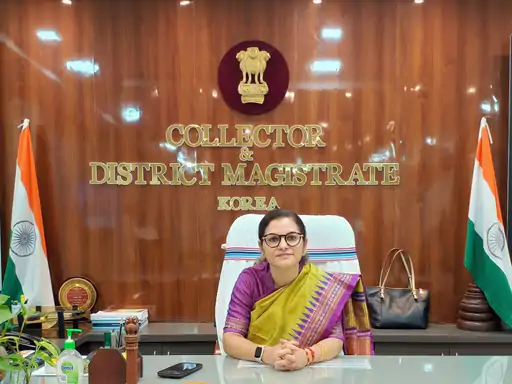
Then came an idea – simple, local, and powerful. In February 2025, Korea District Collector and 2016-batch IAS officer of Chhattisgarh cadre, Ms Chandan Sanjay Tripathi launched the Korea Modak Laddu Initiative. What followed was nothing short of a quiet revolution – one laddu at a time.
Indian Masterminds exclusively interacted with Ms Tripathi to understand the genesis of the Laddu initiative, its community-led implementation, and its remarkable impact on maternal and child health.
Understanding the Crisis on the Ground
Explaining the urgency behind the initiative, Ms Tripathi said the problem was far more alarming than it appeared on paper.
“Here, babies were born underweight, meaning they suffered from malnutrition. This affected both the children and their mothers. A rate of twenty percent is extremely high. It means one out of every five children is born malnourished.”
Underweight babies often begin life trapped in a vicious cycle of poor immunity, delayed development, and higher mortality risks. Mothers, too, were battling anaemia and nutritional neglect, often due to lack of awareness and inadequate dietary support during pregnancy.
Inception of the Korea Modak Laddu Initiative
Determined to break this cycle, Ms Tripathi consulted nutrition experts and dietitians to design a locally sustainable solution. The answer lay in ingredients already present in village kitchens.
She said, “After talking to a dietitian, we decided to make laddoos with ragi, jaggery, groundnuts, sesame seeds, and cardamom. Ragi and groundnuts are abundant here, and jaggery has high iron content.”
Each 20-gram laddu was carefully designed to be nutrient-dense, affordable, and culturally acceptable. Pregnant women were prescribed two laddoos a day, starting from the sixth month of pregnancy, along with iron supplements from the fifth month onwards-delivered directly to their homes.
From Idea to Implementation: A Community-Led Model
However, the real challenge was not making laddoos – it was ensuring that women actually consumed them.
She explained, “If we give iron and folic acid tablets, many women don’t take them. So we needed someone who would ensure the laddoo was eaten.”
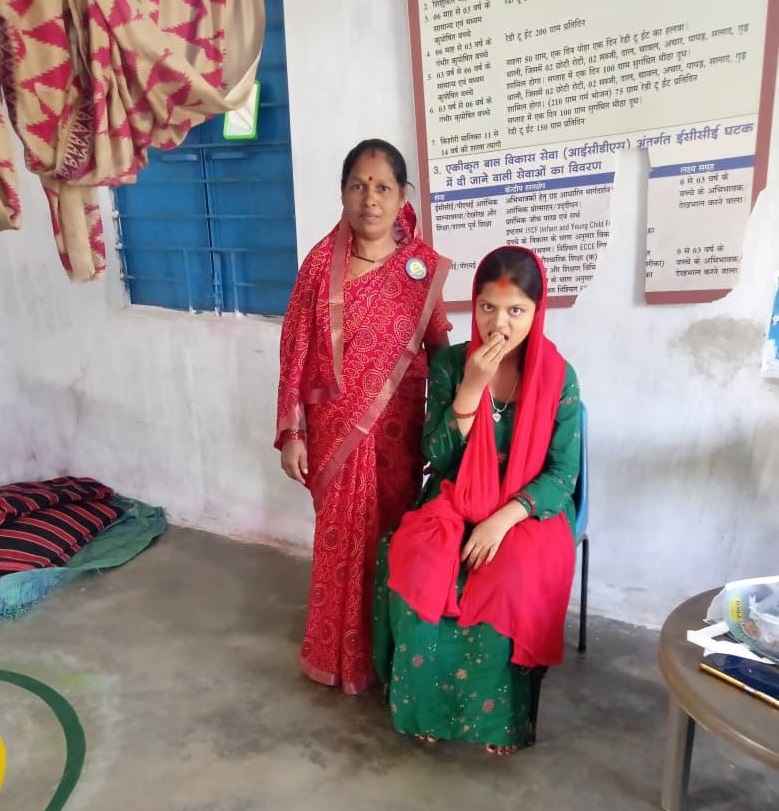
The solution was community trust. Women from self-help groups (SHGs) were selected from within each village and appointed as Poshan Sangwari (nutrition volunteers).
Their role was crucial: every morning and evening, they personally ensured that pregnant women ate the laddoos and consumed their full home-cooked meals – dal, rice, roti, and vegetables.
“The laddoo is a supplement, not the actual food. So someone had to ensure complete nutrition.”
Today, around 2,000 pregnant women consume these laddoos daily under this close monitoring system.
Women Supporting Women: Production and Distribution
The laddoos are prepared by a group of 25 SHG women at Aani Gram Panchayat, located near the Collectorate. A dedicated working shed was constructed for them, ensuring hygiene and efficiency.
Every day, these women produce 10,000 laddoos, which are distributed through Anganwadi centres to nutrition volunteers across the district.
“This was not a top-down scheme. Village women led it,” Ms Tripathi emphasized.
The entire initiative is funded through the District Mineral Fund (DMF), as Korea’s Baikunthpur block is classified as an Aspirational Block, where reducing low birth weight (LBW) was a priority.
Impact: From 20 Percent to Nearly Zero
Strict monitoring in the initial months yielded rapid results. “In the first four to five months, the underweight rate dropped from twenty percent to eleven percent,” she added.
Within a year, the transformation was dramatic. The LBW rate plunged to 3.33 percent, with occasional minor fluctuations between three and five percent due to factors like women going to their maternal homes for delivery.
From 20 percent to nearly 3 percent, the Korea Modak Laddu Initiative has become a benchmark in maternal and child health interventions.
Expansion Across the Entire District
What began as a pilot in Baikunthpur block soon expanded to Sonhat and Podi Bachra, and is now operational across the entire Korea district. All supplies continue to be produced from Aani, maintaining uniform quality and scale.
“Today, the project is running very successfully across the district,” Ms Tripathi said.
Creating Livelihoods Alongside Nutrition
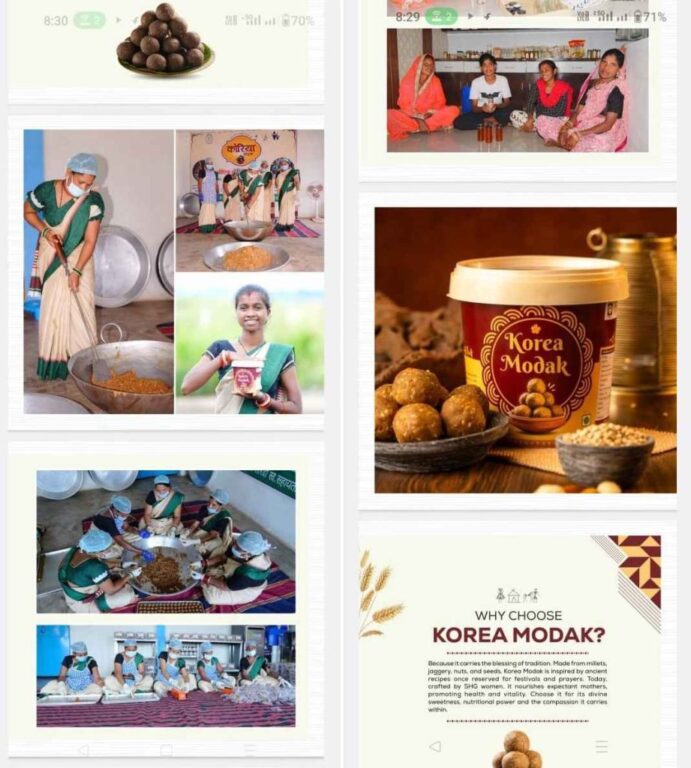
Beyond health outcomes, the initiative has empowered women economically. SHG members earn ₹10,000 to ₹12,000 per month, turning nutritional service into sustainable livelihood.
The women have even begun selling laddoos outside the district—through cafés and exhibitions. Remarkably, they sold 66 kilograms of laddoos at Delhi’s Pragati Maidan, showcasing the model on a national platform.
“They’re not just making laddoos; they’re making change.”
Poshan Sangwaris: Trust as the Backbone
One Poshan Sangwari has been appointed in every village. While they do not receive a fixed honorarium, they are incentivised with gifts for successful outcomes – especially when five healthy, normal-weight babies are born under their supervision.
“The entire scheme runs on trust. If we had simply packed and distributed laddoos, they might not have been eaten.”
Awareness, Dialogue, and Changing Mindsets
A baseline survey revealed a critical gap: lack of awareness within families, especially among in-laws, regarding maternal nutrition and antenatal care (ANC).
To address this, the administration organised a large mother-in-law and daughter-in-law conference, where families were educated on safe motherhood, nutrition, ANC check-ups, and reducing maternal and child mortality.
“All nutritional elements are already available in homes. We only showed them how to use what they already have.”
Discussions on MMR (Maternal Mortality Rate) and child mortality helped families understand one fundamental truth:
“Feed the mother, save the child.”
Overcoming Resistance and Sustaining Change
Not everything was easy. Initial scepticism was widespread. Families clung to old habits. But persistent dialogue, home visits, and conversations with husbands and elders gradually changed perceptions.
Seasonal innovations were also introduced – ragi laddoos in winter, and sattu-based laddoos in summer, ensuring year-round nutritional balance.
“If we strengthen nutrition from the beginning, we completely eliminate the risk of severe malnutrition”, she added.
A Model Worth Replicating
The Korea Modak Laddu Initiative stands out for its simplicity, scalability, and community ownership. It has not only reduced malnutrition but also broken an intergenerational cycle of poor health.
What began as a response to a grim statistic has become a living example of how administrative leadership, local wisdom, and women’s collective power can rewrite the future – sweetly, steadily, and sustainably.