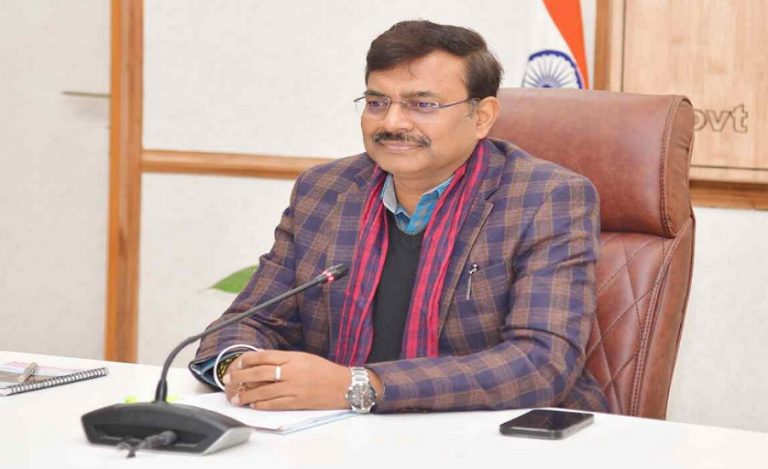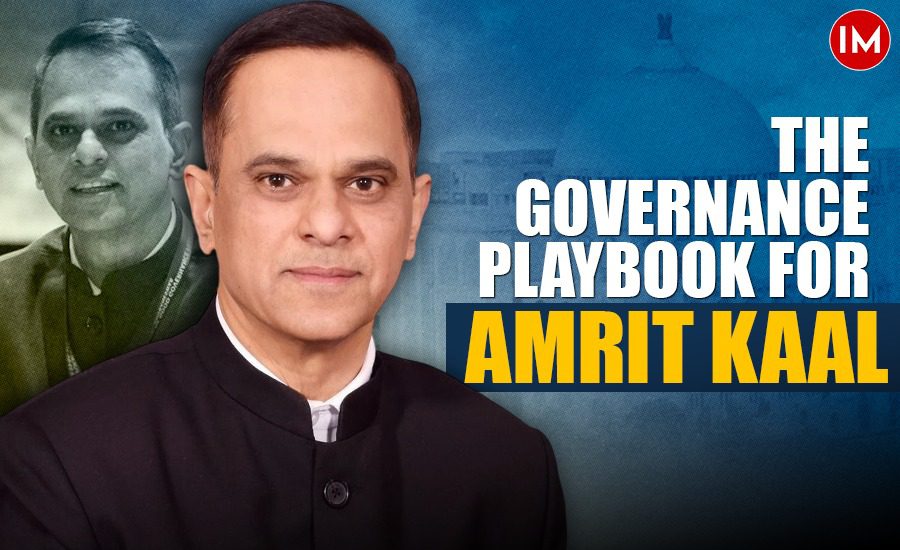
For seven years, IAS officer Mr. V. Srinivas as Secretary, Department of Administrative Reforms and Public Grievances (DARPG), shaped some of the Union Government’s most ambitious reforms—from CPGRAMS 2.0 to Mission Karmayogi and the expansion of NeSDA. Now serving as Chief Secretary of Rajasthan, the 1989-batch IAS officer sits down with Indian Masterminds to decode what good governance should look like in the coming decade. In this interview, he outlines the pillars of Amrit Kaal, the future of digital governance, the rise of AI in administration, and the reforms needed to deliver faster, cleaner, and more citizen-focused governance.
What should be the core pillars of good governance for the next decade?
The core pillars of good governance are the Panch Pran of Amrit Kaal enunciated by Prime Minister Modi from the ramparts of Red Fort on 76th Independence Day – 15th August 2022, these include the Goal of Developed India, Removal of any trace of colonial mindset, Take Pride in our Roots, Unity and Sense of Duty among the Citizens. Prime Minister Modi asked the Nation to focus attention on “Panch Pran” for the coming 25 years, concentrate on fulfilling the dreams of freedom fighters by embracing the Panch Pran by 2047 when the Nation celebrates 100 years of Independence.
The Government’s policy maxim “Maximum Governance – Minimum Government” envisages a digitally empowered citizen and a digitally transformed institution with focus on ease of living for citizens, simplification of rules/ regulations and processes, whole of government approach, qualitative improvements in public grievance redressal, capacity building through i-GOT Karmayogi portal, development of comparative metrics, making IT systems resilient, women led development and special campaigns for institutionalizing swachhata and reducing pendency in government.
During your tenure as Secretary DARPG which reform initiative do you consider the most impactful in transforming day to day governance?
I served in the Department of Administrative Reforms and Public Grievances from 2018-2025 as Additional Secretary/ Special Secretary for 3 years and Secretary for 4 years. The 7-year period gave me an opportunity to implement the Next Generation Administrative Reforms outlined by Prime Minister Modi. The vision outlined by Prime Minister Modi is best summed up in the quote “In this decade of Amrit Kaal, we will give priority to Next Generation Reforms. We will ensure that all facilities like service delivery should reach citizens upto last mile. It should reach the citizens seamlessly, without hesitation or any kind of difficulty. For the overall development of the country, unnecessary interference of government and government processes in the lives of the people has to be ended.”
The vision of Next Generation Reforms of the Prime Minister has been diligently translated into reality by Department of Administrative Reforms and Public Grievances. Secretariat Reforms, Special campaigns, Benchmarking Governance and Services, Redressal of Public Grievances and Improving Service Delivery, Recognizing Meritocracy and Replication of Good Governance Practices formed the core of India’s governance model. Technology adoption in the Central Secretariat also gained significant momentum with the adoption of e-Office. The Digital March of the Central secretariat has had significant spillover effects to attached/ subordinate/ autonomous bodies, all of whom adopted e-Office, as also a number of State Secretariats. The DARPG also gave me an opportunity to present India’s governance models in a global context. As Director General of the National Centre of Good Governance, I could build the Centre into an institute in focus for the Ministry of External Affairs conducting capacity building programs for over 4000 international civil servants from 34 countries. Further my election as President International Institute of Administrative Sciences in June 2025 – the First Indian Presidency in the 100-year history of the IIAS was a milestone moment. Further digital empowerment of pensioners and end to end digitization of pension processes was particularly satisfying.
The National e-Governance Service Delivery Assessment (NeSDA) became a key monitoring tool. How has it changed the behaviour of States and Ministries in improving Digital Services?
To encourage innovation and progress for government services in the country, there is a need to assess and benchmark e-Governance service delivery across Central Ministries/ Departments and States. Government formulated the National e-Services Delivery Assessment (NeSDA) study to assess the depth and effectiveness of e-Governance service delivery. The NeSDA study of 2023 examined 1400 e-Services and noted an improvement in mandatory e-services saturation level from 69 percent in 2021 to 74 percent in 2023. 36 Central Ministries/ Departments were studied and improvements in all the assessment parameters were observed. The top performing Central Ministries/ Departments portals include the Central Public Procurement Portal of Ministry of Finance, the Bhavishya Portal of Department of Pension and Pensioners Welfare, the CPGRAMS portal of Department of Administrative Reforms and Public Grievances, the GSTN portal of Ministry of Finance, the Department of Commerce portal of Government e-Market Place and NIC’s Jeevan Pramaan. It can be said that Nation-wide e-Governance has strengthened with more e-Services. There was also convergence in State and UT portal quality with several portals scoring 100 percent compliance in assessment parameters.
DARPG designed the NeSDA – Way Forward portal and status of implementation dashboard in line with the focus areas of e-Governance.
While Central and State Governments are taking utmost care to improve their service delivery through digital platforms, the NeSDA – Way Forward dashboard aims to create the baseline for e-Services delivery and build an inclusive digital ecosystem. The monthly reports institutionalize the Nation’s endeavors for improved service delivery to promote suo-moto entitlement-based delivery of services, identification of bottlenecks and dissemination of best practices. In the period April 2023 to November 2025, the Nation’s e-Services have increased from 11,500 to 23650. It is expected that the number of e-Services will reach saturation by 2026.
The top e-Services availed by citizens include caste certificate, income certificate, birth certificate, death certificate, e-payment of electricity bills.
The identified ministries are PAN card application/ corrections; e-filing income tax returns, apply for learner’s & driver’s licence, new/ renew passport application, Jeevan Pramaan – Digital Life Certificate for pensioners. The key features driving higher satisfaction rates are online payment facility, password recovery/ reset, search features, status update/ alerts, tracking of applications/ grievances.
Mission Karmayogi aims to reshape bureaucracy. What fundamental cultural shift does it seek, and are we seeing early signs of change on the ground?
Mission Karmayogi envisions a future ready civil service that needs to keep itself abreast with artificial intelligence and information processing, presenting challenges and opportunities. The goal to create human resources that will become the driving force of our Nation’s development to help us achieve Viksit Bharat by 2047. The Karmayogi Competency Model has identified CHAR SANKALP (four resolves) that every Karmayogi, as a representative of Government, should internalize and actively demonstrate by embodying the CHAR GUN (four virtues) through their associated competencies. The Mission Karmayogi can be divided into Ethos, Ethics, Equity and Efficiency. The Ethos includes a people first approach, strategic thinking, organizational awareness, commitment to the organization and leading others.
The Mission Karmayogi encapsulates three transitions – transition from Karmachari to Karmayogi,workplace transformation and shift from rule-based to role based civil servant. The Karmayogi competency model seeks identification and assessment of skill needs of civil service, enhance focus on behavioural and functional capacity building needs, enhance role-based capacity building and empowering officials to take charge of own professional journey, drive standardization, harmonization and shared learning capacity building practices and demand driven capacity building. A Karmayogi will be able to inculcate the Virtues and strive towards the vision by attaining competencies. Mission Karmayogi is very important in grooming civil servants of the country as it can help 24×7 basis interactive sessions amongst trainers and trainees. In today’s fast-paced and ever changing working environments, ongoing learning has become a necessary part of the workflow.
The CPGRAMS Reforms have been widely appreciated. What were the biggest bottlenecks in grievance redressal before the overhaul, and how were they overcome?
The Centralised Public Grievance Redress and Monitoring System (CPGRAMS) is a 24×7 online platform that enables citizens to lodge grievances related to public service delivery. Accessible through www.pgportal.nic.in. it is integrated with all State grievance portals, supports multiple regional languages, and uses advanced AI tools to manage large volumes of data. Citizens can track the status of their complaints using a unique registration ID and also file appeals if dissatisfied with the resolution.
The implementation of 10-step CPGRAMS reforms has significantly improved efficiency, raising monthly grievance redressals to over one lakh and reducing average resolution time from 28 days in 2022 to 15 days in June 2025. The platform has mapped over 1 lakh Grievance Redressal Officers, with nearly 29 lakh registered users filing about 30 lakh grievances annually. More than 80 lakh grievances were resolved between 2022 and 2025.
Recognized as the world’s largest citizen interface platform, CPGRAMS is operational across all Central Ministries, Departments, and autonomous bodies. Its initiatives—such as the Intelligent Grievance Monitoring System, mobile app, and Sevottam-based capacity building—have enhanced trust, accountability, inclusivity, and accessibility. National and global forums, including India Today and the Pan-Commonwealth meeting (2024), have praised CPGRAMS as a transformative model of SMART governance. DARPG is now preparing to launch the upgraded Next Gen CPGRAMS.
You advocated extensively for a whole of government approach. Where do you see the biggest gaps still hindering seamless inter-ministerial coordination?
One of the most impactful examples of the whole-of-government approach led by DARPG is the series of Special Campaigns aimed at institutionalizing swachhata and reducing pendency across government offices. Inspired by Prime Minister Narendra Modi’s vision, these campaigns promote modern, efficient administrative practices by eliminating outdated processes, weeding out old files, enhancing sanitation, and encouraging the adoption of digital tools. They have fostered a nationwide shift in mindset, proving that government workplaces can be clean, aesthetically pleasing, clutter-free, and highly productive.
Since 2021, the Special Campaign for Institutionalizing Swachhata and Reducing Pendency has been conducted annually from October 2–31. The Government has committed to continuing it for the next five years, following a saturation approach that covers all field offices, public-centric ministries, overseas missions, banks, and PSUs. The campaign targets improved cleanliness, better records management, and significant reductions in MPs’ references, Parliamentary assurances, PMO and inter-ministerial references, state government communications, and public grievances. From 2021–2025, it covered 20 lakh offices, weeded out 160 lakh files, freed 950 lakh sq. ft. of space, and generated Rs. 4,085 crore through scrap disposal—demonstrating a transformative and efficient whole-of-government effort.
Many citizens still struggle with last-mile delivery of schemes. What administrative innovations can ensure faster and more reliable service delivery at the district and block levels?
Social justice is at the heart of policy making and the Government has worked to provide equitable opportunities to everyone. Saturation approach of priority sector schemes has been the defining the goal of Government’s all-round, all-pervasive and all-inclusive development model. The important priority sector schemes where saturation approach has been adopted include the Har Ghar Jal Yojana, PM Awas Yojana, Mission Indradhanush, PM Ujjwala Yojana, PM Jan Arogya Yojana, PM SVANidhi, PM Matru Vandana Yojana, PM Vishvakarma Yojana, PM Mudra Yojana, PM Poshan Yojana and Kisan Credit Cards Scheme. The vision of Sabka Saath, Sabka Vikas, Sabka Vishwas, Sabka Prayas has been the overarching national development goal.
Digital Public Infrastructure like Aadhar, UPI and Digilocker has changed governance. What do you see as the next big frontier in digital governance for India?
The landscape of work has evolved at a rapid pace and we have witnessed transformative technology breakthroughs in space technology, biotechnology, semiconductors and computing technology, new materials and composites, energy generation and storage, robots and autonomous systems, AI and information technologies, which have reshaped industries across sectors. Several Universities have adopted course curriculum for experiential learning, cohort based learning and global perspectives based on international case studies with emphasis on innovation, leadership and technology development. The technology transformation has also swept across India’s governance models simplifying ease of living and ease of doing business and are best manifest in the policy maxim “Maximum Governance – Minimum Government”.
How are AI and predictive systems entering public administration and whats their impact?
I had recently visited the Indian Institute of Science, Benguluru and was very impressed by the work being undertaken by the Centre on Data For Public Good. I am a great believer in mathematical models being adopted into Administrative Sciences for improving public policy benefits. The CPGRAMS experience of AI based disaggregated data analytics is a significant success story for Government.
Can Government balance technological efficiency with data privacy and ethical governance?
Yes, Data security and privacy issues are paramount in policy making and a balance can be achieved.
What role should citizen feedback mechanisms play in evaluating government performance, and how can these systems be insulated against tokenism?
Governance in order to be citizen centric should be participative and transparent. It should be effective, efficient and responsive to citizens. Furthermore, the ethos of serving citizens should permeate all organizations. Last but not the least, Government organizations should be accountable to the people. As one of the primary functions of the State is to promote the welfare of its citizens, an evaluation of the functioning of the institutions of governance will ultimately have to be based on the satisfaction they provide to the common man. In this regard prominence would need to be attached to the voice of the citizens themselves.
Read More : The Many Facets of Former IRS Officer and Author, Giselle Mehta | Video Interview
Capacity building for officials especially at the cutting edge is often uneven. How can India create a more standardized and future ready training eco-system?
Mission Karmayogi has provided many significant success stories and the Chintan Shivir model has enabled horizontal and vertical learnings. I am a great supporter of the initiatives of the Capacity Building Commission having undergone/ benefitted from several modules on behavioural competency myself.
You worked on simplifying rules and reducing compliance burden. What is the biggest mindset challenge in persuading departments to let go of outdated procedures?
Deregulation is an important area of work for improving ease of doing business. 23 Priority areas have been identified for deregulation reforms. The Jan Vishwas Act repealed several laws of minor criminal punishments. Deregulation policies cover Land Use, Building and Construction, Labour, Utilities and Permissions. The overarching priorities include enactment of State Jan Vishwas Acts, bringing services under the Single Window System. The deregulation policies are envisaged to cover state level industries, including pharma industry, agro-based industry food processing industry, handloom & handicraft industry, automobile industry, hotel & tourism industry, horticulture industry etc. State level deregulation cells have been operationalized to take forward reforms.
Which States in your assessment have set benchmarks in good governance and why?
Gujarat, Tamil Nadu and Maharashtra have consistently ranked among the top performers in the Good Governance Index. Gujarat leads in five key sectors—commerce and industry, human resource development, public infrastructure and utilities, economic governance, and citizen-centric governance. Tamil Nadu excels in agriculture and allied sectors, human resource development, public health, and judiciary and public safety. Maharashtra performs strongly in agriculture, human resource development, and social welfare. Among the North-Eastern States, Sikkim is the top performer, while Uttarakhand leads in the Hill States category.
Uttar Pradesh has emerged as a top performer in citizen-centric governance. Its DGGI highlights strong grievance redressal, with all 75 districts showing high efficiency. Districts such as Muzaffarnagar, Moradabad, Etawah, Shamli and Saharanpur lead the State. The Jan Sunwai–Samadhan and e-District portals ensure transparent and effortless service delivery, achieving a 99% disposal rate. Common Service Centres act as a robust support system at the Gram Panchayat level.
Gujarat’s DGGI reflects its holistic development model, with Navsari, Rajkot and Ahmedabad topping composite rankings and 18 of 33 districts scoring above 5, showcasing strong governance across sectors.
Governance failures stem from poorly implemented policies. What structural changes can improve implementation discipline across departments?
The Initiative for Increasing Efficiency in Decision Making in Government is one of the pioneering administrative reforms to speed-up decision making to meet the expectations of citizens. It represented one of the most complicated and far reaching administrative reforms witnessed in the central secretariat bringing a silent reform in work culture, reduced hierarchies and resulted in a significant adoption of technology. It has also enabled responsive communication and enhanced efficiency in processing of receipts.
Government adopted a flatter organizational structure and put in place appropriate delegation at various levels to ensure speed and efficiency in decision making in government. This was undertaken after a comprehensive review of the extant practices and procedural frameworks, levels of disposals, channels of submission and existing delegations. The Central Secretariat Manual of Office Procedure was revised in 2019 to incorporate the provisions of e-Office to enable the march to a digital central secretariat. The guidelines for increasing efficiency in central government entailed review of channel of submission for creating flatter organizations, the delegation of financial and administrative powers to lower functionaries, adoption of desk officer system to ensure single points of file disposal, adoption of e-Office version 7.0 and digitization of all receipts in central registration units.
The channel of submission was brought down from 8.01 in January 2020 to 4.17 levels in November 2025 across 84 Ministries/ Departments.
Officers were divided into separate categories with Additional Secretary and Joint Secretary being placed in category II and Deputy Secretary and Under Secretary being placed in category III across Ministries and Departments. Level jumping was adopted so that officers of one level did not put up files to another officer in the same category which meant that they worked in parallel, horizontal organizational structures. The review of the channel of submission resulted in identification of surplus manpower who could be redeployed to other Ministries and Departments. Administrative and Financial delegation for contingent and miscellaneous expenditures across Ministries and Departments was reviewed to bring a degree of uniformity across Government. The administrative delegation was monitored through enhanced adoption of e-HRMS.
Technology adoption by optimizing the e-Office Platform was promoted by due amendments in the Central Secretariat Manual of Office Procedure. This was done to bring transparency, efficiency and accountability in the Government transactions leading to increased promptness and productivity. The reskilling and upskilling of staff was addressed and seamless movement of files across Ministries/ Departments was rolled out. The Central Secretariat digitizes 5 lac receipts and processes them as e-receipts every month. Nearly 40 lac files are being handled as e-Files across government. The proliferation of e-Office in the Central Secretariat was further promoted by adopting a saturation approach to extend e-Office to all attached/ subordinate/ autonomous offices of Government of India. Government developed e-Office analytics to monitor use of VPN’s, inter-ministerial movement of files and levels of file disposal. Government also focused on enhancing cybersecurity of e-Office platform and sensitization workshops on cyber swachhata were introduced.
Why is former PM Atal Bihari Vajpayee’s birthday celebrated as Good Governance Day? What tools of Good Governance are identified with his Governance model?
A major success of DARPG’s whole-of-government approach is the Special Campaigns designed to institutionalize swachhata and reduce pendency across government offices. Guided by Prime Minister Narendra Modi’s vision, these campaigns modernize administrative functioning by removing outdated practices, clearing old files, improving sanitation, and promoting digital adoption. They have reshaped attitudes nationwide, demonstrating that government workplaces can be clean, organized, efficient, and visually appealing.
Since 2021, the Special Campaign for Institutionalizing Swachhata and Reducing Pendency has been conducted every year from October 2–31. The Government has extended it for the next five years, using a saturation strategy to cover all field offices, major public-facing ministries, overseas missions, banks, and PSUs. The campaign focuses on enhancing cleanliness, streamlining records, and cutting pendency in MPs’ references, Parliamentary assurances, PMO and inter-ministerial communications, state references, and public grievances. Between 2021 and 2025, it spanned 20 lakh offices, cleared 160 lakh files, freed 950 lakh sq. ft. of space, and generated Rs. 4,085 crore through scrap disposal, showcasing a transformative governance reform.
On this Good Governance Day, what message would you give young civil servants about the kind of governance India needs as it moved towards becoming a developed Nation?
An agenda of “Maximum Governance – Minimum Government” envisages a digitally empowered citizen and a digitally transformed institution. Bringing Government and Citizens closer using technology is important for ease of living and ease of doing business. Accordingly, the Government seeks to effect qualitative improvements in the grievance redressal systems to make them more sensitive, accessible and meaningful. A whole of government approach to be adopted in formulating and implementing policies and schemes and concerted steps are proposed to be taken for India to become the 3rd largest economy in the world. This will necessitate upskilling and Government has said suitable incentives will be provided for encouraging officers to take full advantage of the capacity building courses and modules available on iGOT Karmayogi portal. Further, governance models need periodic monitoring of quality assessments by developing effective metrics to foster a competitive spirit amongst States and District to encourage them to adopt reforms in different areas of governance particularly in respect of statutory clearances and approvals. Another major area of action is the development of comprehensive action plans for implementing the concept of women led development.