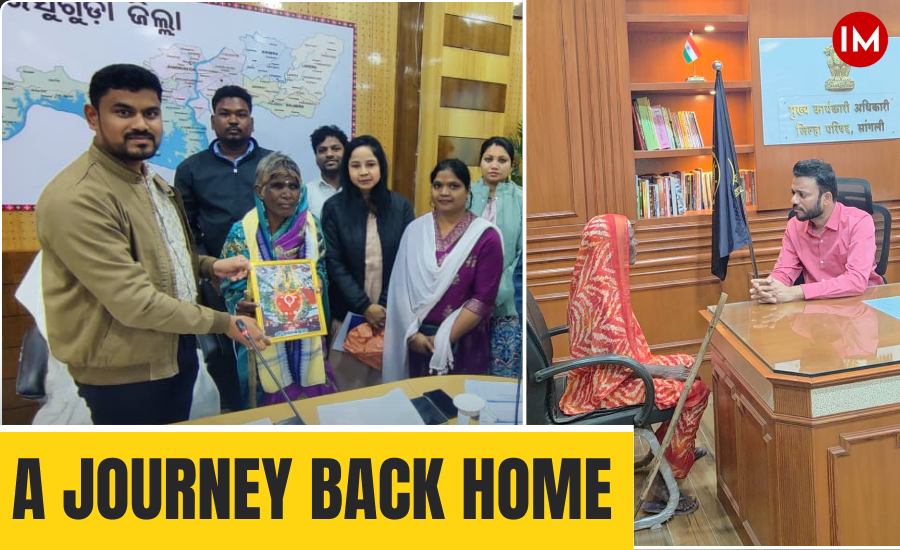
It was 26 November 2025, Constitution Day, when a quiet discovery in Odisha reshaped the life of an elderly woman who had been missing for more than two years. At an old age home in Jharsuguda, an aging woman from Maharashtra—unknown, unidentified, and unheard—was found thousands of kilometers away from the place she once called home. Her name was Vijayabai Raghunath Jadhav, a daily-wage worker from Subhash Nagar, Barshi.
She had no identity card, no phone, and no contact information. She carried nothing except memories that had scattered over time. For her family in Solapur, she had vanished without a trace. For the old age home, she was simply a lost woman with no address to return to.
But for two IAS officers, the discovery triggered a chain of actions that stitched together a fractured story and brought a family back from despair.
IAS officer Vishal Narwade (2020 batch, Maharashtra cadre) shared about the incident in detail with Indian Masterminds.
A CHANCE CONNECTION THAT CHANGED EVERYTHING
During a routine field visit to an old age home run by NGO Vikash in Jharsuguda, District Collector of Jharsuguda, Kunal Chavan (2020 batch Odisha Cadre), noticed Vijayabai. Her frail health, her confusion about where she lived, and the complete absence of any documents raised immediate concern.
Chavan himself belonged to Parbhani district of Maharashtra. More importantly, he was a batchmate of Vishal Narwade, the Chief Executive Officer of Zila Parishad Sangli. What began as a coincidence soon became the bridge that reunited a family.
Without delay, Chavan contacted Narwade and shared the details of the elderly woman. The moment Narwade received the information, he took personal responsibility to ensure that she would return home.
A PUBLIC APPEAL THAT REACHED THE RIGHT EARS
With no documents or identifiers, finding her family required the power of collective effort. Narwade recorded a video message, narrating the situation and sharing it widely on social media. The appeal travelled quickly, carried forward by citizens, local organisations, and volunteers who believed that someone, somewhere, might recognise her.
Days passed, but the search did not lose momentum. And then, on 6 December 2025, a phone call came from Barshi, Solapur district. A relative recognised Vijayabai. They had been searching for her for more than two years.
The voice on the other side of the call carried both relief and disbelief—relief that she was alive, and disbelief that she had been found in a different state altogether.
COORDINATED EFFORTS TO BRING HER HOME
Once the family was traced, Narwade ensured the process moved swiftly and with dignity. He coordinated directly with the old age home in Jharsuguda, arranged all documents required for travel, and personally booked the rail tickets for Vijayabai and a staff member who would accompany her back to Maharashtra. He covered the entire expenditure himself.
This was not a procedural duty. It was a human responsibility—one he embraced wholeheartedly.
On 10 December 2025, coinciding with International Human Rights Day, Vijayabai stepped off the train in Maharashtra. Her family, overwhelmed beyond words, welcomed her home after two long years of uncertainty.
For them, it was not just a reunion—it was the return of hope.
AN ACT OF HUMANITY
The incident moved people across districts and states. Senior officers, community organisations, and public representatives expressed appreciation for Narwade’s efforts and the supportive role of Chavan and the old age home staff in Odisha. The collaboration demonstrated how governance rooted in empathy can transform lives in ways that policies alone cannot.
The National Human Rights Commission, New Delhi, and the Maharashtra State Human Rights Commission, Mumbai, acknowledged the humane intervention. For them, this was more than administrative action—it was a powerful example of upholding human dignity.
On a day dedicated to human rights, the grandmother’s journey home became its truest celebration.