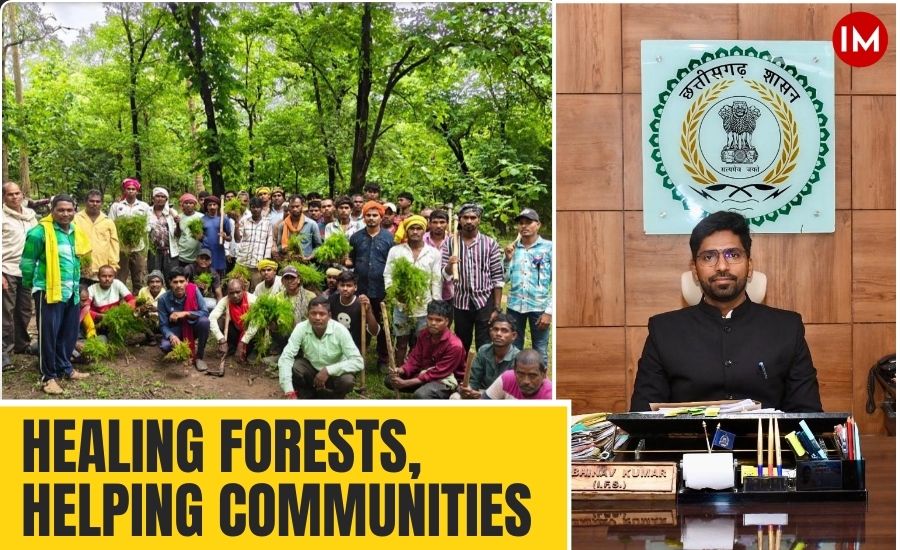
Mungeli district in Chhattisgarh is witnessing a transformative initiative that connects forest health with local livelihoods. Under the guidance of IFS officer Abhinav Kumar, Divisional Forest Officer of Mungeli Forest Division, an in-situ conservation project of medicinal and aromatic plants has been successfully implemented, enhancing biodiversity while supporting tribal and forest-fringe communities.
The project responds to a growing concern: the declining presence of medicinal plants in forests. “These plants have been part of our ecosystem for centuries, but their numbers are decreasing as the forest’s overall health deteriorates,” Abhinav Kumar shared in a conversation with Indian Masterminds. The initiative was designed to restore and strengthen the forest ecosystem by nurturing these plants directly within their natural habitat.
RESTORING THE FOREST ECOSYSTEM
The in-situ conservation project focuses on species that naturally coexist with native trees, ensuring ecological compatibility and long-term sustainability. Key species include Shatavar (Asparagus racemosus), Anantmool, Sarpagandha, Baheda (Terminalia bellirica), Amla, Vetiver, and Lemongrass. These plants were selected based on their ecological role, traditional use, and ease of propagation.
“Most of these species propagate through roots. Once planted, they spread naturally without needing to be replanted every year,” Abhinav Kumar explains. This approach not only strengthens forest biodiversity but also ensures that the plants can thrive with minimal maintenance.
LINKING CONSERVATION TO COMMUNITY LIVELIHOODS
The project also aims to create socio-economic benefits for local communities, especially tribal groups. Mungeli is home to the Baiga tribe, a Particularly Vulnerable Tribal Group (PVTG). By involving them in the cultivation of medicinal plants, the initiative preserves traditional knowledge and generates new livelihood opportunities.
Door-to-door surveys were conducted to identify which plants local communities have historically used. This ensured that the cultivated species were familiar and valuable to them. “If we plant species that the communities already know, they are more likely to protect and nurture them,” says Abhinav Kumar.
Several of these plants also have significant market potential. For example, Sarpagandha root currently sells for around ₹700–800 per kilogram. Vetiver plantations can generate income up to ₹11 crore over a two-year cycle, while Sarpagandha cultivation can bring around ₹4 crore in the same period. By combining ecological restoration with income generation, the project creates a win-win situation for both the forest and the people.
MONITORING SUCCESS AND OVERCOMING CHALLENGES
To track progress, the Mungeli Forest Division monitors physical growth, root development, natural propagation rates, and the emergence of new shoots. Early feedback has been positive, with tribal communities actively participating and independent third-party verification confirming the project’s effectiveness.
Convincing communities to allocate land for medicinal plants, however, has not been easy. Abhinav Kumar explains, “People are heavily dependent on rice, so convincing them to spare land for medicinal plants requires patience and demonstration of tangible benefits.”
The project addresses this challenge by supporting a few willing families as role models. Their success motivates others within the community to adopt medicinal plant cultivation. “Locals trust and follow others from their own community. Once a few families succeed, more naturally join in,” he adds.
FUTURE PLANS AND RECOGNITION
Looking ahead, the project aims to expand by providing free plants and technical support to more families, tapping multiple funding sources such as MGNREGA, District Mineral Fund, and CSR contributions. Awareness campaigns and community-led role models will continue to drive adoption of medicinal plant cultivation.
The initiative has gained national recognition. Abhinav Kumar recently received the “Millionaire Farmers of India Award” (MFI Award) for his work in in-situ conservation of medicinal and aromatic plants. This award highlights the project’s success in integrating biodiversity conservation, traditional knowledge preservation, and livelihood enhancement.
MEDICINAL PLANTS
Medicinal plants have always been central to traditional medicine, supporting both human health and the local economy. By promoting their cultivation, Chhattisgarh reinforces its identity as a herbal state while providing economic opportunities for forest-fringe communities.
“The goal is simple: conserve biodiversity, support local communities, and keep traditional knowledge alive,” Abhinav Kumar says. “When forests, people, and plants benefit together, the ecosystem becomes stronger and communities thrive.”
The Mungeli in-situ conservation project exemplifies how sustainable forestry practices can safeguard biodiversity, sustain traditional practices, and generate tangible socio-economic benefits. By focusing on species native to the region and deeply rooted in tribal knowledge, the initiative demonstrates that conservation and livelihood development can go hand in hand.