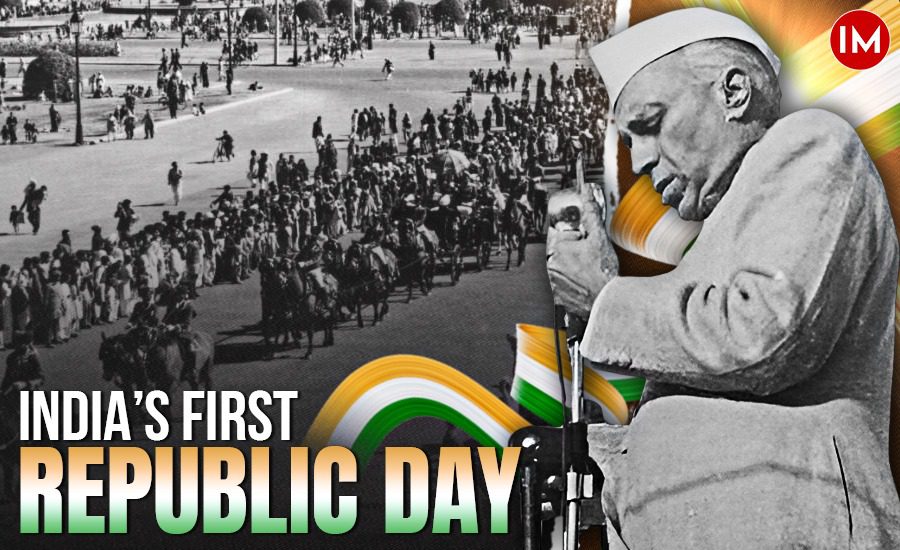
As the 77th Republic Day approaches, the National Capital is buzzing with rehearsals. Military bands march in formation along Rajpath, troops practice their drills, and fighter jets cut precise patterns across the winter sky. For many, the Republic Day parade is the defining image of India’s democracy, but it wasn’t always this grand. The story of India’s Republic Day begins modestly, in 1950, with ceremonies and traditions that would shape the country’s celebrations for decades.
THE HISTORIC MORNING OF 26 JANUARY 1950
On that historic day, the Durbar Hall of the Viceroy’s House in New Delhi, now Rashtrapati Bhavan, was the center of a solemn ceremony. At exactly 10:18 AM, C. Rajagopalachari, India’s first and last Governor-General, declared India a republic. Just six minutes later, Dr. Rajendra Prasad was sworn in as the nation’s first President, marking a symbolic transition from colonial administrators to Indian leadership.
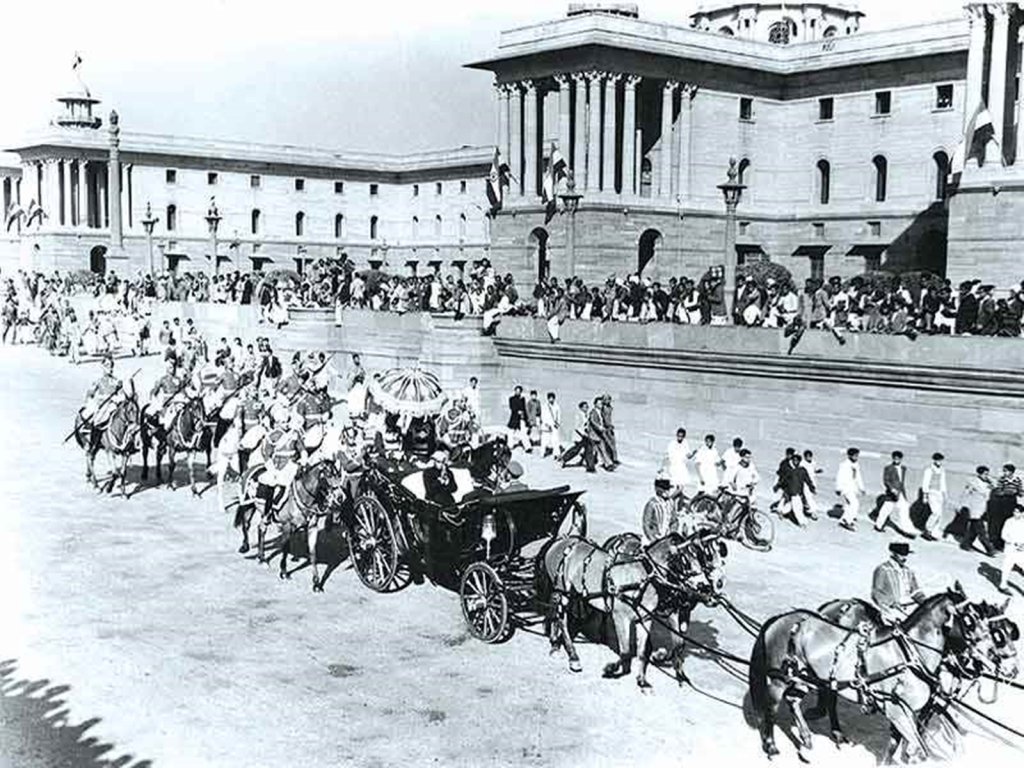
Outside, crowds lined Kingsway, waiting to see the President step out in a gold-plated, horse-drawn state carriage, flanked by mounted bodyguards. The carriage, originally used by the Viceroy, was repurposed as the Presidential Buggy, symbolising continuity and transformation. As The Hindu reported: “Simultaneously the President’s flag replaced the Governor-General’s flag on the top of Government House, and a 31-gun salute was fired to mark the assumption of office by the President.”
THE FIRST PARADE: MODESTY AND MILITARY DISCIPLINE
Following the oath ceremony, the first Republic Day parade was held at the Irwin Amphitheatre, now the Major Dhyan Chand National Stadium. Unlike today’s parades, there were no tableaux, no motorcycle stunts, no cultural performances. The event focused entirely on the armed forces. Around 3,000 troops marched in formation, including infantry, artillery, and cavalry units.
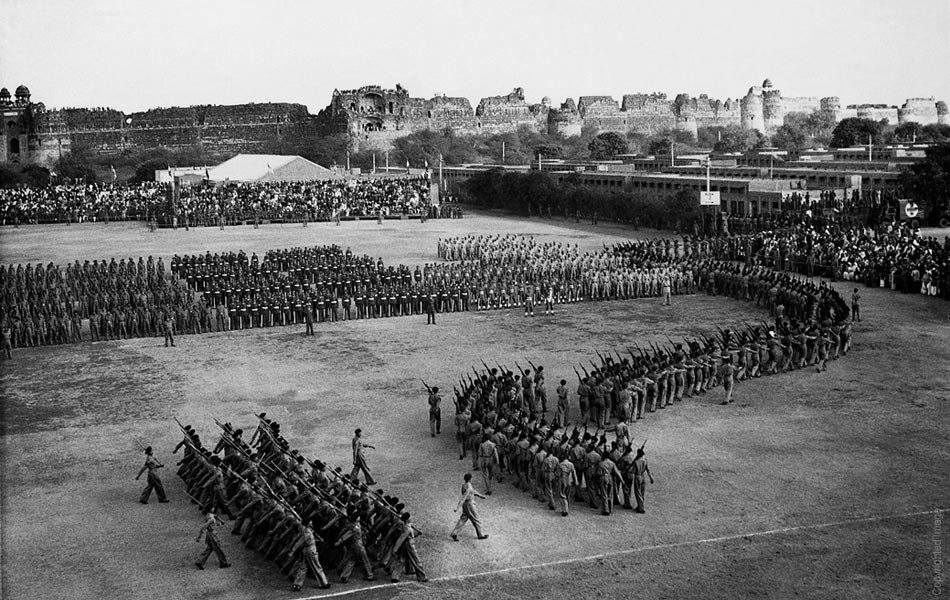
Leading the parade was Brigadier Moti Sagar of the Gorkha Regiment, a respected officer known for his leadership in the early Indian Army. Brigadier Sagar’s command ensured the parade maintained discipline and professionalism, reflecting the young nation’s aspirations. The parade concluded with a fly-past by the Indian Air Force, a modest formation of Liberator planes, while a 31-gun salute punctuated the ceremony. Even in its simplicity, the parade was a statement of India’s sovereignty and ability to defend its independence.
THE PRESIDENTIAL BUGGY: FROM COLONIAL CARRIAGE TO NATIONAL SYMBOL
The gold-plated, six-horse drawn carriage, with red velvet interiors and embossed Ashoka Chakra, has been one of the most enduring symbols of India’s Republic Day. Originally, it belonged to the Viceroy of India during British rule and was used for ceremonial purposes around the Viceroy’s estate.
On India’s first Republic Day in 1950, Dr. Rajendra Prasad rode in this carriage from Rashtrapati Bhavan to the Irwin Amphitheatre, flanked by mounted bodyguards, marking a transition from colonial authority to Indian leadership.
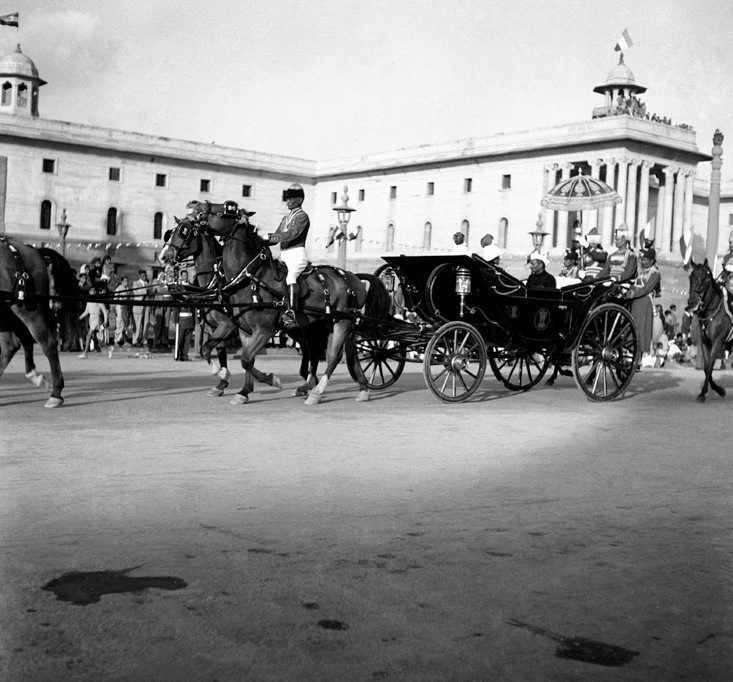
After independence, the fate of the luxurious buggy became a matter of international chance. Both India and the newly formed Pakistan laid claim to the carriage. To resolve the dispute, a simple yet extraordinary decision was made: a coin toss. India was represented by Colonel Thakur Govind Singh, and Pakistan by Sahabzada Yaqub Khan. As fate would have it, Colonel Singh won the toss, and the historic carriage officially became India’s.
In the years that followed, the buggy continued to serve the Presidents of India, transporting them for oath-taking ceremonies at Parliament and for the Beating Retreat ceremony at Vijay Chowk to mark the conclusion of Republic Day celebrations. However, by the late 20th century, security concerns led to the carriage being replaced by bullet-proof vehicles.
The open-air buggy made a high-profile comeback in 2014 when President Pranab Mukherjee used it to attend the Beating Retreat ceremony. More recently, on India’s 75th Republic Day, President Droupadi Murmu and French President Emmanuel Macron rode the carriage from Rashtrapati Bhavan to Kartavya Path, returning the colonial-era buggy to public view after a 40-year hiatus.
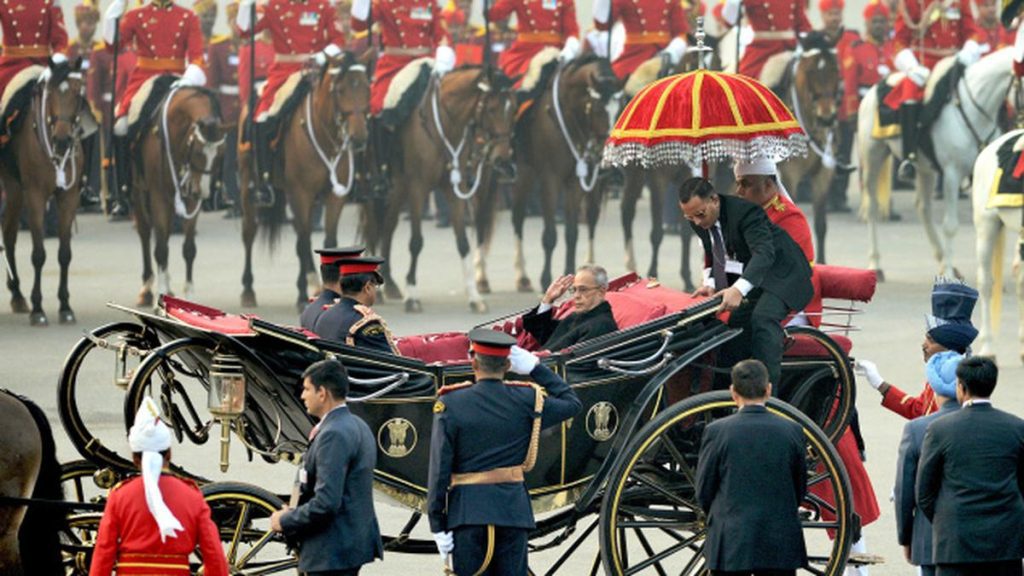
The story of the Presidential Buggy—its colonial origins, the coin toss that decided its ownership, and its enduring presence in ceremonial events—adds layers of history and human interest to the Republic Day narrative. It stands as a tangible link between India’s past and its present, carrying both symbolism and tradition every January 26.
THE FIRST CHIEF GUEST: SUKARNO OF INDONESIA
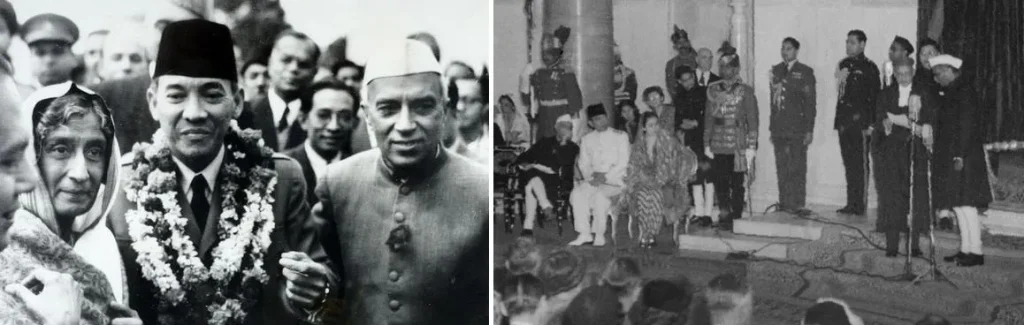
The tradition of inviting a foreign dignitary began in 1950 with Indonesian President Sukarno. The visit reflected India’s diplomatic priorities: in 1947, Prime Minister Jawaharlal Nehru had quietly supported Indonesia’s independence struggle against Dutch rule. Sukarno’s presence was thus a celebration of solidarity between newly independent nations, a message that India sought to send to the world.
GALLANTRY AWARDS AND RECOGNITION OF BRAVERY
The first Republic Day also saw the announcement of India’s top military honours: the Param Vir Chakra, Maha Vir Chakra, and Vir Chakra, recognising bravery during the Kashmir War of 1947–48. The first recipients of the Param Vir Chakra were:
- Major Somnath Sharma (Posthumous)
- Lieutenant Ram Raghoba Rane
- Lance Naik Karam Singh
- Naik Jadunath Singh (Posthumous)
- Company Havaldar Major Piru Singh Shekhawat (Posthumous)
Though announced in 1950, these awards were formally conferred during the second Republic Day parade in 1951, with Piru Singh receiving his award in 1952. This established the Republic Day parade as a venue for recognising military heroism.
A MILESTONE IN GENDER INCLUSION: WOMEN MAKING THEIR MARK
The Republic Day parade has long been a stage to showcase the armed forces, and over the years, women have increasingly taken centre stage, breaking barriers and setting historic firsts. One of the most notable milestones occurred on 26 January 2019, when Lieutenant Bhavana Kasturi became the first woman officer to lead an all-male Army Service Corps (ASC) contingent. Kasturi, 26, from Hyderabad, had studied microbiology at Osmania University and was a former NCC cadet.
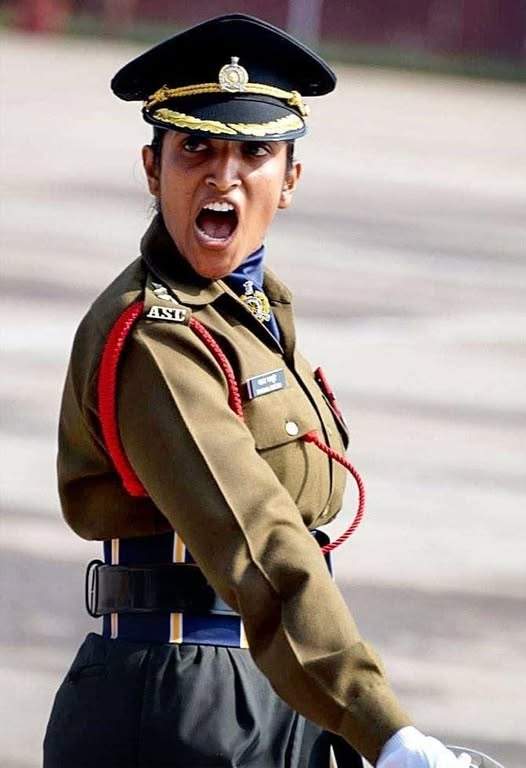
After clearing the Services Selection Board exam in 2016, she trained rigorously at the Officers Training Academy in Chennai, running long distances while carrying heavy loads and mastering the skills required to command her unit. On that historic day, she led 144 men, with then Army Chief Bipin Rawat taking the salute.
Reflecting on the moment, she said, “One of the most memorable moments for me was when I saluted the President during the parade. Another was seeing the enthusiasm and satisfaction in the eyes of my jawans when we completed the parade and reached Red Fort. I will always remember that moment.”
2019 was a landmark year for women in other areas as well. For the first time, an all-women contingent of the Assam Rifles participated in the parade. The 146-member unit was led by Major Khushboo Kanwar, who said at the time: “I am the daughter of a bus conductor, and if I can accomplish this, then any girl can fulfil her dream.”
Women’s participation in the armed forces’ contingents had begun earlier but gradually expanded. In 2015, all-women contingents of the Army, Navy, and Air Force marched at Rajpath for the first time. The Army contingent was led by Captain Divya Ajith, the Navy by Lt Commander Sandhya Chauhan, and the Air Force by Squadron Leader Sneha Shekhawat. Shekhawat had also become the first woman pilot to lead the IAF contingent in 2012.
Other firsts continued in the 2020s. Women of the CRPF bikers team made their debut performing daredevil stunts, with Seema Nag leading the 65-member group. In 2021, Flight Lieutenant Bhawana Kanth, India’s first woman fighter pilot qualified for combat missions, became the first woman fighter pilot to appear on the IAF tableau, while Flight Lieutenant Swati Rathore became the first woman to participate in the flypast over Rajpath. Even the BSF camel contingent, part of the parade since 1976, included women praharis for the first time in recent years, with riders like Nisha remarking, “Not everyone gets this chance. Mushkil tha, lekin ye gaurav ki baat hai.”
The inclusion of women like Lt. Colonel Deepika Rathore and Lieutenant Anita Kumari, who marched in 2013 in the Army Ordnance Corps, adds to the legacy. Deepika Rathore, who had scaled Mount Everest in 2012, was part of the parade three times: as an NCC cadet, in the 2013 parade, and in 2015 on a mountaineering tableau.
CONTINUITY AND TRADITION
Over the years, the Presidential Buggy remained a constant presence, while the practice of inviting foreign chief guests continued, highlighting India’s growing diplomatic relationships. Leaders such as Nelson Mandela (1995), Barack Obama (2015), and Emmanuel Macron (2024) have attended, symbolising India’s evolving role on the global stage.
The first Republic Day laid the foundation for traditions that continue today: a military parade, ceremonial salute, fly-past, gallantry awards, and the involvement of foreign dignitaries. It established a balance between discipline, ceremony, and national pride that has carried through more than seven decades of celebrations.