The Sundarbans, the world’s largest mangrove delta and home to nearly 4.5 million people, is fighting for its very survival. Rising tides, sinking land, and increasingly frequent cyclones have relentlessly eaten away at embankments, swallowed farmland, and threatened the livelihoods of countless families. In this fragile ecosystem, erosion is not just an environmental issue – it is a daily struggle for life, land, and identity.
Now, a centuries-old technique is offering hope. Terracotta rings, once used to line wells, are being repurposed to trap silt, stabilize shorelines, and support mangrove growth. Simple, low-cost, and eco-friendly, these humble rings are helping communities and nature alike withstand the growing power of the sea.
Indian Masterminds interacted with S. Justin Jones, an Indian Forest Service (IFS) officer of the 2018 batch and Deputy Director of the Sundarbans Tiger Reserve, to understand how this initiative works and why it is showing promise.
When Cyclone Aila Changed Everything
The devastation caused by Cyclone Aila in 2009 still haunts the Sundarbans. Entire villages were battered as storm surges broke through embankments. Fish rotted in ponds, the stench of dead cattle, birds, and dogs hung in the air, and outbreaks of diarrhoea affected almost everyone. Earthen embankments collapsed near rivers, claiming many lives.
Thousands were forced to migrate to cities like Chennai and Kerala in search of work, only returning years later to a land forever altered by the sea.
The Limits of Concrete Embankments
Embankments in the Sundarbans have had to be rebuilt repeatedly. While concrete embankments appear strong, they are expensive, difficult to maintain, and often ineffective against the dynamic tidal forces of the delta. Earthen dams too fail under constant erosion.
Faced with these challenges, ecologists and forest officials began looking beyond modern engineering -and found answers in traditional knowledge.
Turning to an Ancient Technique
Adopting a centuries-old well-building method, the Indian Forest Department, in collaboration with WWF-India, launched a pilot project using terracotta rings to prevent siltation and erosion.
What Are These Terracotta Rings?
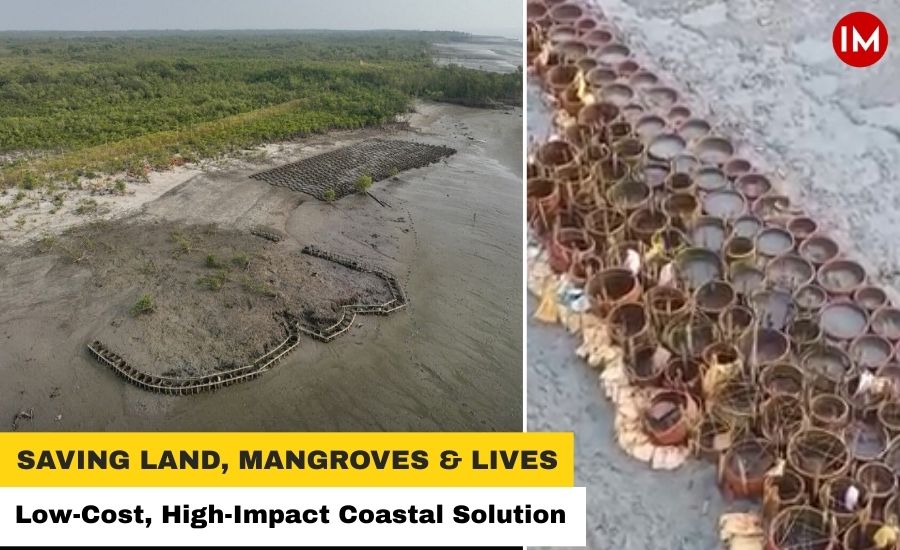
The terracotta rings are hollow, circular structures made using a mixture of sand, clay, and silt. This material composition makes them biodegradable, durable, and significantly cheaper than concrete.
Historically, such rings were used to line wells. Today, they are being repurposed to protect shorelines in one of the most fragile ecosystems in the world.
These rings are made locally, using traditional knowledge that has existed for centuries. Compared to concrete embankments, they are cheaper and act as a natural barrier for the forest land behind them.
How Are the Rings Used?
The rings are placed in a grid-like pattern along riverbanks and embankments in both human-inhabited and forested areas. When high tides roll in carrying silt, the hollow rings trap the sediment instead of letting it wash away.
“Basically, the idea is to stop erosion at the surface where it is occurring,” Mr Jones explained. “Once enough soil accumulates, we have also experimented with planting mangrove saplings there.”
In some locations, the rings have been arranged in pyramid-like structures to reduce lateral erosion caused by strong tidal currents.
Why Do These Rings Still Work?
The strength of the terracotta rings lies in their porous and flexible design. Unlike rigid concrete structures that crack or collapse under pressure, the rings allow water to flow through while slowing it down enough to deposit silt.
“This was installed about six months ago,” IFS Jones noted, “and the way it has held up – and the way silt is accumulating – shows that other organisms are also making it their habitat. Even if it gets submerged during a cyclone, there is no danger.”
Field observations over a 12-month period show that the rings accumulated enough sediment to outpace annual sea-level rise by two to three times, effectively stabilising the shoreline.
Scale and Results of the Pilot Project
The pilot project began around one-and-a-half to two years ago and has since expanded across several sites.
“We started with a small experiment,” IFS Jones said. “One patch of around twenty metres and another of about thirty square metres. The results were very good, so we are now trying to replicate it in other places.”
So far –
Over 8,000 terracotta silt traps have been installed across 3,800 square metres at seven sites in forest-fringe islands such as G-Plot (Patharpratima Block), Satjelia, and Kumirmari (Gosaba Block).
Another 2,800 silt traps cover 1,480 square metres across three sites in Dhanchi, a forest island near Patharpratima.
To create an additional line of defence, oyster reefs have also been established at some locations. A year later, the oysters are thriving, and the rings are filled with sediment that can now be used for mangrove regeneration.
Why Was This Initiative Needed?
River erosion remains the single biggest challenge for the people of the Sundarbans. Every metre of land lost pushes families closer to displacement.
“For the millions living near the delta, saving even a small piece of land makes life a little easier,” said a local resident. “If erosion stops, we won’t have to face such problems. We like it here. This is our homeland.”
The terracotta rings offer a nature-based, low-cost, and scalable solution in a region where conventional infrastructure has repeatedly failed.
A Boost for Local Artisans and the Environment
An added benefit of the project is the revival of traditional craftsmanship. The rings are made by local potters who carefully mix three types of material – sand, silt, and clay – in precise proportions.
“For the mangrove project, we fire the terracotta for a longer time,” explained a local artisan, “otherwise it could break due to the waves. I am proud that this material is being used for such an important purpose.”
Compared to concrete, terracotta also has a lower carbon footprint. Cement production releases large amounts of carbon dioxide, while the environmental impact of terracotta mainly depends on kiln fuel, which can be better controlled.
Towards a Living Shoreline
Mangroves have already begun taking root inside some of the rings, while oysters have colonised others – both unexpected but welcome outcomes. The long-term vision is to create a “living shoreline” that supports wildlife while protecting human settlements.
“This is not the only solution, and it won’t work everywhere,” IFS Jones cautioned. “But it clearly shows that local, traditional knowledge can help us adapt to a changing world.”
A Simple Ring with a Big Promise
The Sundarbans, India’s largest mangrove forest, continues to face grave threats from rising seas, cyclones, and coastal erosion. While local ingenuity alone cannot secure its future, initiatives like the terracotta ring project demonstrate how science-backed, community-driven solutions can make a real difference.
This simple ring of baked earth may not stop the sea entirely – but it offers hope that the land, the mangroves, and the people of the Sundarbans can hold their ground a little longer.