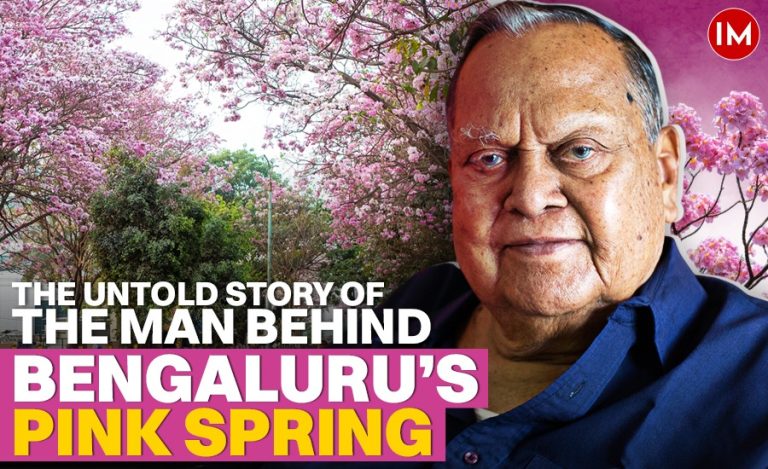
Every spring, when Bengaluru turns pink with blooming Tabebuia and gulmohar, social media calls it magic.
But this magic has a name.
It is Sethuram Gopalrao Neginhal.
Long before urban forestry became a buzzword, before climate change entered daily conversations, this quiet Indian Forest Service officer imagined a city covered in trees. He did not just imagine it. He built it — one sapling at a time.
For those who do not know, it was his painstaking effort and visionary planning that gave Bengaluru over a million trees and strengthened its identity as India’s Garden City.
ROOTS OF A FOREST MIND
Born on 1 May 1929 in Dharwad, then part of the Bombay Presidency, Neginhal grew up around forests. His father was a forest officer trained at the Rangers College in Dehradun. Forest walks were not outings for him. They were lessons.
As a teenager, he joined the Quit India Movement. In 1951, he began his forestry service — the same year he formally stepped into the profession that would define him.
Forests were not just his career. They were his inheritance.
For nearly two decades in his early years, he served in the dense forests of Uttara Kannada. Those years shaped him. They gave him an intimate understanding of the Western Ghats — its trees, its birds, its fragile balance.
Former IFS officer Dipak Sarmah, his close friend, recalled those days in an emotional conversation with Indian Masterminds.
“He belonged to the forest,” Mr. Sarmah said softly. “Those years in Uttara Kannada made him what he was. He understood the Western Ghats like few others ever did.”
According to Mr. Sarmah, Neginhal’s love for trees was not academic. It was born out of long field postings, muddy boots, and endless forest patrols. “His affection for trees came from exposure, not theory,” he said. “He knew them like old friends.”
THE TIGER YEARS
In the early 1970s, Neginhal moved into wildlife administration. From 1972 to 1980, he administered most of Karnataka’s wildlife sanctuaries — travelling constantly, studying animals and birds even beyond official duty hours.
He underwent specialised wildlife training at the Forest Research Institute, Dehradun, in 1971–72, sharpening his conservation vision.
When Project Tiger was launched in 1973 at Bandipur Tiger Reserve, it was Neginhal who drafted its first management plan. He helped shape Bandipur into Karnataka’s pioneering tiger reserve.
In 1974, he discovered the now-famous Kokkarebellur Pelicanry, bringing global attention to a village where spot-billed pelicans nested among people. The same year, he played a key role in declaring the Biligirirangan Hills a sanctuary and in creating a new sanctuary for wolves at Melkote.
He worked closely with legendary ornithologist Salim Ali and renowned wildlife photographer M. Krishnan.
“He was in close contact with the finest naturalists of the country,” Mr. Sarmah told Indian Masterminds. “But despite that, he remained simple. Grounded. Always curious.”
Yet, his biggest battle was not in the deep forest. It was in the city.
A CITY LOSING ITS GREEN
By the early 1980s, Bengaluru was expanding fast. Old trees were cut. Layouts replaced orchards. Concrete spread quickly.
The then Chief Minister R. Gundu Rao wanted one lakh trees planted every year. In 1982, Neginhal was brought to Bengaluru to head the new urban forestry division.
What followed was not a plantation drive. It was a movement.
He studied past failures. He redesigned tree guards. He raised taller saplings. He set up nurseries. He involved citizens.
For five relentless years, he worked without pause.
Between 1982 and 1987, nearly 15 lakh saplings were planted across Bengaluru.
Mr. Sarmah’s voice grew heavy as he remembered that phase. “He was responsible for the massive greening of Bengaluru,” he said. “Fifteen lakh trees. Think about that. Not files. Not proposals. Trees. Living, breathing trees.”
THE SCHOLAR OF THE WESTERN GHATS
Even amidst fieldwork and administration, Neginhal wrote extensively.
His book on the flora of the Western Ghats became particularly popular and immensely helpful to students and forest officers. He also authored works such as Forest Trees of South India, Forest Trees of the Western Ghats, Sanctuaries and Wildlife of Karnataka, and Your Bangalore: The Trees.
“He documented what he loved,” Mr. Sarmah reflected. “His writings were not ornamental. They were practical. They guided generations.”
A FORESTER FOREVER
Even after retirement at the Principal Chief Conservator level, he continued visiting sanctuaries. He kept observing birds. He kept studying forests.
He warned against reckless felling. He believed every individual needed at least two trees for balanced oxygen exchange.
On 2 May 2021, a day after turning 92, he passed away due to COVID-19 complications.
But his friend prefers to remember him differently.
“When Bengaluru blooms,” Mr. Sarmah said during his conversation with Indian Masterminds, “I feel he is still here. Every flowering tree is a reminder. He never chased recognition. He just wanted trees to survive.”
THE LEGACY
Today, when pink trumpet trees flood Instagram feeds, many admire the beauty. Few know the labour behind it.
It took vision. It took systems. It took innovation.
And it took one determined forest officer who refused to let a city lose its soul.
S.G. Neginhal did not just plant trees.
He planted an idea — that cities can breathe.
He planted an idea — that cities and nature can grow together.