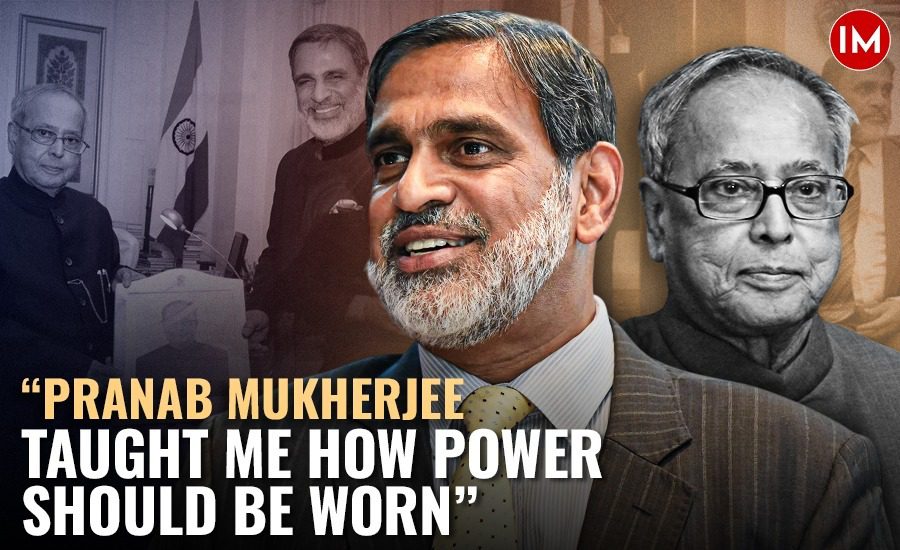
Few Presidents of India combined political wisdom, administrative depth and human warmth the way Pranab Mukherjee did. A consummate statesman with decades of parliamentary experience, Mukherjee believed that the Presidency must not remain distant or ceremonial but should reflect the aspirations of ordinary Indians. During his tenure from 2012 to 2017, Rashtrapati Bhavan was transformed from a guarded colonial-era structure into a living, breathing people’s monument. Standing close to him through this transformative phase was senior diplomat Venu Rajamony, who served as Press Secretary to the President and became one of the most trusted members of his inner circle.
THE MAN BEHIND THE PRESIDENT’S VOICE
As Press Secretary, Venu Rajamony’s formal responsibility was media management—communicating presidential decisions, organising press interactions and conveying the President’s perspective to the nation. But his role went far beyond that. He was part of every major visit, meeting and ceremony, accompanying President Mukherjee during engagements with Indian leaders, foreign dignitaries and global heads of state, including US President Barack Obama and leaders from Japan and the UAE.
Speaking to Indian Masterminds, Mr. Rajamony recalled, “Everything to do with the media was my primary charter, but I was also involved in all his visits, important meetings and functions. I had a ringside view of how the highest constitutional office functions on a daily basis.”
WORKING WITH A STATESMAN AND A TEACHER
Those who worked closely with Pranab Mukherjee often describe him as a walking encyclopedia—and Rajamony echoes that sentiment. Despite his towering political stature, Mukherjee was deeply human, affectionate and always willing to mentor younger colleagues. He possessed an extraordinary memory for facts, figures and political history, often recounting post-Independence developments in remarkable detail.
“He was a teacher at heart,” Rajamony told Indian Masterminds. “You asked him a question, and he would open up completely – especially if it involved politics or governance. He was a father figure who loved to share knowledge.”
MAKING RASHTRAPATI BHAVAN A PEOPLE’S MONUMENT
One of the most enduring legacies of President Mukherjee’s tenure was opening Rashtrapati Bhavan to the public. Under his leadership, museums were created, public access was expanded, and new initiatives like the Change of Guard ceremony were institutionalised. Programmes such as Innovators-in-Residence, Teachers-in-Residence and Artists-in-Residence brought diverse citizens into the President’s House, reinforcing the idea that the highest office belongs to the people.
Rajamony played a key role in implementing these reforms, ensuring that communication, outreach and logistics aligned with the President’s vision. Rashtrapati Bhavan, once perceived as distant, became a vibrant hub connected not just to Delhi but to the entire nation.
CHRONICLING HISTORY, PROTECTING SECRETS
Rajamony also assisted President Mukherjee in writing his autobiography—a deeply personal process marked by intense discussions and careful reflection. Mukherjee was firm that no confidential information or sensitive political details should harm individuals or institutions.
“He was extremely conscious of history and responsibility,” Rajamony noted. “Some information, he felt, must die with him. He never believed in gossip, only in record.”
A DISTINGUISHED CAREER BEYOND RASHTRAPATI BHAVAN
Born in 1960, Venu Rajamony is a seasoned Indian Foreign Service officer who later served as Ambassador of India to the Netherlands and India’s Permanent Representative to the OPCW. He currently teaches Diplomatic Practice at O.P. Jindal Global University and has authored several acclaimed books on geopolitics, art and India’s global engagements.
Yet, among his many achievements, his years with President Pranab Mukherjee remain uniquely defining—a period where diplomacy met statesmanship, and communication became a tool to bring the Republic closer to its people.