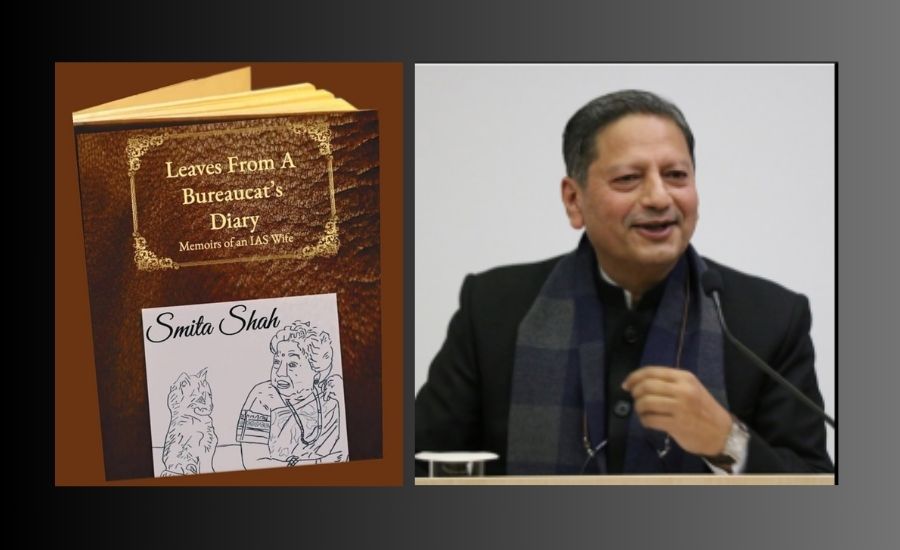
I write this book review with a sense of deep personal regret. Smita Shah- the author, presented me a copy of her book ‘Leaves From A Bureaucat’s Diary : memoirs of an IAS wife’ on the occasion of the Sardar Patel Memorial Lecture at Teen Murti (Prime Minister’s Memorial and Library) on February 12, and I promised her (as well as her publisher Sanjay Arya) that I will review the book in my weekly column, and place a copy at the LBSNAA, IIC and VoW libraries. As I normally like to read three to four books at any point of time, and also devote two to three days on the background work for my fortnightly column ‘state of the state’, I could not complete this beautifully penned, and elegantly produced 264 page book offering by Shubhi Publications.
Last evening, at about 5 pm Rashmi got the message on her IASOWA (Indian Administrative Service Officers’ Wives Association) group that she had breathed her last. We were both shell shocked, and I picked up her book again, even as we shared remembrances about her. Before we discuss her book, let me mention that Rajeeva Ratan Shah’s autobiographical offering ‘Footprints on the sand’ was featured in an online session of Valley of Words (VoW’s) ‘Afternoons with an Author’ during the difficult times of Covid.
The book under reference stands out for four distinct reasons. First and foremost, for adding a new word to the lexicon – bureaucat – the cat in the bureaucrat – the power behind the IAS husband who slogs it out, day in and day out in such a wide range of postings – from towns in the mofussil to the high table in the World Bank and economic ministries.
The second highlight of Bureaucats is its ability capture the ‘weltanschauung’ (world view) of the spouse of a service officer who joined the civil services in the late sixties when the norms for selection and the accepted etiquette was more on the lines of the predecessor service : the ICS. In fact, till the acceptance of the Kothari Commission recommendations by the UPSC in which the salience of English language was toned down considerably, the IAS continued to be the preserve of the elite–the sons (very few daughters) of the top ranking officials, judges, professors and key professionals. We get a flavour of this charmed life from Ms. Shah’s recollection of her childhood – as the daughter of higher judicial service officer in the Civil Lines of Allahabad and granddaughter of a district judge of Ajmer where she spent her vacations.
Much before Amazon started home delivery of products and services, the charmed denizens of civil lines had their own ‘exclusive’ vendors offering their wares. We learn about the Anglo Indian community, which has all but disappeared from Allahabad, the city where she, and her future husband grew up, in a similar neighborhood. She candidly admits that Rajeeva and she ‘were destined’ to be life partners as her family (the Kapoors ) and that of Rajeeva (the Shahs) had a close relationship. They grew up together, and she recollects her first official ‘date’ with him when they shared a rickshaw ride to watch a movie called Kavi Kalidas. He was fourteen and she was eleven ! She recalls the shift of her uncle from the palatial house of the Deputy Commissioner of Delhi to the first floor of Bapa Nagar on Zakir Hussain Marg – the entitlement of a Joint Secretary to the Government of India, making the kids wonder if it was actually a promotion or a demotion !
The third distinguishing feature of this book is the section on saints and peers she got to interact with. As a devout Hindu and as a firm believer in its innate eclecticism and sarvadharma samvad, this section is dedicated to the time she (and Rajeeva) spent in the company of saints like Neem Karoli Baba, Deoraha Baba, Sai Baba of Puttuparthi, Swami Rama, Ma Anandmayee, Mother Theresa, Swami Chidanand Muni and Sri Sri Ravi Shankar, besides the Shankaracharya of Kanchi and His Holiness the Dalai Lama. Each of them, though unique in their own ways, faith and traditions; had a sense of clairvoyance and recognized people for their intrinsic worth.
Some of them, like Neem Karoli and Deoraha Baba led very simple lives : others like Sathya Sai Baba of Puttaparthi, Chidananad Muni of Parmarth Niketan and Sri Sri Ravi Shankar established institutions which combined spiritual awakening with material comforts, and others like Mother Theresa who raised resources, but led a life of voluntary poverty and barebone simplicity. Then there is her encounter with Swami Rama – a direct spiritual descendant of Maha Avatar Babaji : he had allowed himself to be subjected to ‘bio-feedback’ by the Menninger Foundation of the USA. He stopped his heartbeat, and was clinically dead before he revived himself with his inbuilt Yogic powers.
The last section of the book has twenty nine short epistles under the sub heading My Muse. These range from her experiences shepherding a group of burly, bucolic, non-English speaking Punjabis on their first ever air trip to Europe, the story of IASOWA, Banaras – the eternal city, ‘consumeritis’ and last but not the least Of sahebs and MemSahebs. I cannot delve into all of them, but the founding of IASOWA, of which my better half has been an active member and the cadre representative of West Bengal deserves a special mention, and Sahebs and Mem Sahebs deserve a special mention.
The IASOWA story is based on the recall of Ms. Krishna Chandra, the better half of Satish Chandra of the 1941 batch of the ICS. Chandra was a founder member and the first Treasurer of the Association which came up in 1965. The spouses of IAS officers’ posted in New Delhi would meet informally, once a month at the residence of the Cabinet Secretary. After three years, it was formally registered as the ICS/IAS officers’ Wives Association. At the turn of the century, ICS was dropped : this was two decades before the IC&AS ( Indian Civil and Administrative Service Officers’ Association) dropped ‘civil’ from the name of their association. No wonder then, that it can be said that the better halves have always led the way.
In Sahebs and Mem Sahebs, Shah regales us with vignettes from a life in the heydays of the Raj when the Collector’s bungalow had its own entourage of cooks, janitors, water carriers, orderlies, supervisors, farriers, stable boys and maids to take care of every possible requirement of the officers and their wives. As the Mem Sahebs would often retire to cooler climes in the summers, the Sahebs could not resist nocturnal dalliances with the wives and daughters of the domestic helps. Much of this life has been captured by Flora Annie Steel, the only serious contender to Rudyard Kipling in terms of capturing the narratives of the Raj.
A picture is much more than a thousand words ! The book is replete with photographs of the Shah family on their several trips – on the cruise with Sri Sri Ravi Shankar, at Jasper National park, the Istanbul Blue Mosque, the Empire State Building, at Angkor vat and Borobudur Jogkarata. Hers, along with her husband Rajeeva, was a life well lived, and it is my earnest regret that I could not invite her for a conversation and archive her thoughts, feelings, emotions and quintessential wisdom for posterity.
But thank you Smita Shah for coining this new word, and writing a book under this title ! And with this, I strongly commend this book to readers !
(Sanjeev Chopra is a retired IAS officer from the 1985 batch. He has served in several key administrative roles, including as the Director of the Lal Bahadur Shastri National Academy of Administration. An accomplished author, he penned We, the People of the States of Bharat: The Making and Remaking of India’s Internal Boundaries, published in 2022.)