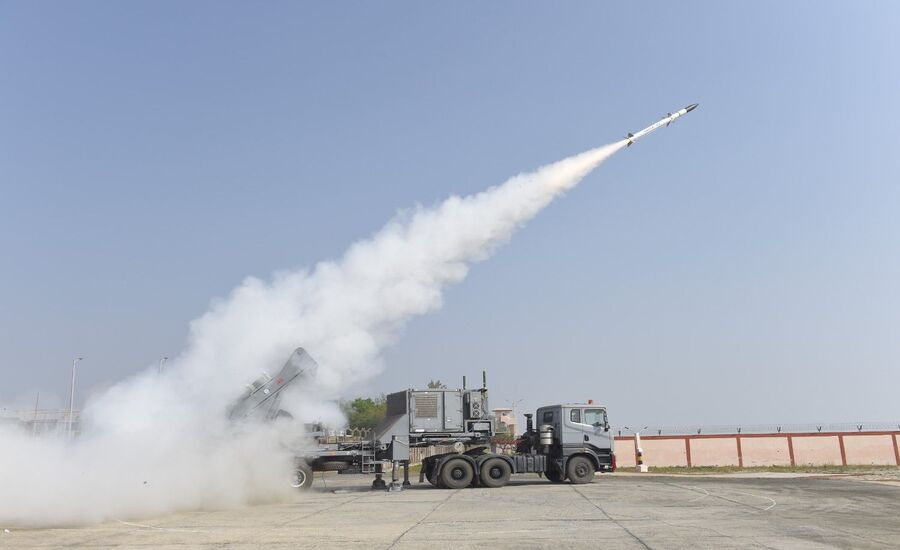
New Delhi: The MAK Controls launcher for Akash-NG program has been officially inducted after rigorous trials, marking a significant milestone in India’s defence manufacturing landscape.
This development — led by MAK Controls and Systems — demonstrates the strength of private industry in enhancing the Akash-NG missile system’s operational readiness under the Atmanirbhar Bharat initiative.
What Is the Akash-NG Missile System?
The Akash-NG (Next Generation) is an advanced medium-range surface-to-air missile system developed by the Defence Research and Development Organisation (DRDO).
Designed to strengthen India’s air defence network, it offers:
- Extended range and higher accuracy compared with older Akash versions.
- A smaller, canisterised launcher system that enhances mobility and rapid deployment.
- Indigenous radio-frequency seeker technology and mobile launch vehicles.
Akash-NG has been undergoing a series of formal evaluation and user trials, successfully meeting all key operational performance requirements, positioning it for imminent induction into the Indian Armed Forces.
MAK Controls Launcher for Akash-NG Program: A Made-in-India Triumph
MAK Controls and Systems, a defence technology firm based in Coimbatore, has recently achieved a landmark success by developing and inducting a launcher unit for the Akash-NG missile system following comprehensive end-to-end trials conducted in late 2025.
Key Features of the MAK Controls Launcher for Akash-NG Program
- Six-canister configuration: The launcher carries six Akash-NG missiles and is mounted on a high-mobility vehicle platform.
- Indigenous Design & Build: Entirely developed at MAK Controls’ Karur facility with minimal external capital investment.
- Stringent Trials: Successfully passed rigorous performance and integration tests under DRDO supervision.
Development Timeline
The launcher project took approximately four years from conception to induction, including prototype development and systematic validation phases.
Path to Formal Acceptance and Scaling Production
Following the successful trial phase, the next procedural step is the formalisation of the Acceptance of Necessity (AoN) for an initial order of at least 10 firing units. This approval will pave the way for larger-scale commercial production by MAK Controls over the coming two years.
Importantly, the company’s existing manufacturing infrastructure — without the need for significant new capital — will support this scaling, highlighting a cost-efficient model for defence production.
What is the Importance of MAK Controls Launcher for Akash-NG Program
The integration of a locally developed launcher into a core missile program reinforces the self-reliance agenda championed by the Government of India, particularly for critical defence hardware.
Enhancing Operational Readiness
With the launcher inducted, Akash-NG systems can be more quickly mobilised and deployed, increasing the combat readiness and flexibility of air defence units.
Growth of Private Defence Manufacturing
MAK Controls’ success highlights the rising capability of Indian private sector firms to contribute beyond component supply into full systems integration, bridging gaps between research and wide-scale field deployment.
Looking Ahead: Opportunities and Expansion
MAK Controls is reportedly exploring opportunities to develop additional support systems for the Akash-NG ecosystem, such as ground support equipment and related hardware. Beyond Akash, the company is positioning itself for involvement in other DRDO-led missile and defence programs, potentially including export-oriented avenues in the future.
This achievement also strengthens Coimbatore’s defence manufacturing hub, further decentralising high-technology production outside traditional defence industry centres.