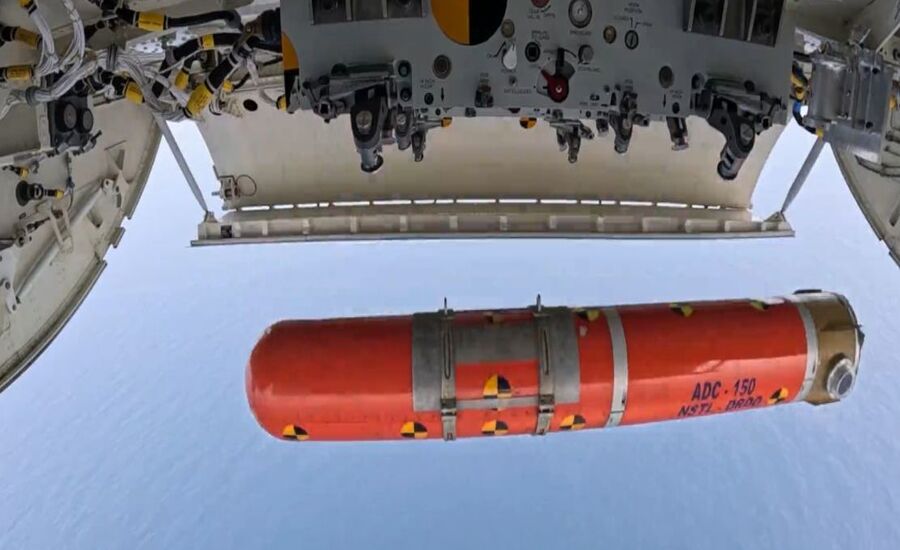
New Delhi: India has achieved another milestone in defence technology with the successful testing of the indigenous Air Droppable Container ADC-150 developed by the Defence Research and Development Organisation (DRDO) for the Indian Navy.
According to an official report, the ADC-150 Air Droppable Container was successfully tested through multiple in-flight trials from a P-8I maritime patrol aircraft off the coast of Goa.
The new system is designed to deliver up to 150 kg of critical supplies to naval ships deployed far from the coast, helping the Navy respond quickly during emergencies or long-duration sea missions. The successful trials mark a significant step toward strengthening India’s naval logistics and operational readiness.
Details of ADC-150 Air Droppable Container Trials
The Defence Research and Development Organisation (DRDO) and the Indian Navy jointly conducted four successful in-flight release trials of the ADC-150 container.
These trials were carried out between February 21 and March 1, 2026, from the P-8I aircraft over the Arabian Sea near the coast of Goa. The tests were performed under different and extreme release conditions to evaluate the system’s reliability and operational capability.
All the trials were completed successfully, demonstrating that the system can safely deliver supplies to ships operating far from shore.
What is the ADC-150 Air Droppable Container?
The ADC-150 is an indigenously designed air-delivery system capable of carrying payloads of up to 150 kilograms.
It is mainly intended to supply essential items to naval vessels operating in the open sea.
Key Capabilities
- Delivers up to 150 kg payload
- Dropped from P-8I maritime patrol aircraft
- Equipped with a parachute system for safe landing
- Designed for emergency and logistics support at sea
The system can deliver items such as:
- Critical spare parts
- Equipment and supplies
- Medical aid and emergency materials
This allows naval ships to receive urgent assistance without returning to port or approaching the coastline.
Why the ADC-150 System is Important
Modern naval missions often take place hundreds or even thousands of kilometres from the coast.
In such situations, ships may need urgent supplies but cannot leave their operational area. The ADC-150 helps solve this problem by enabling rapid aerial delivery of essential items.
Major Benefits
- Faster response during emergencies at sea
- Improved logistics support for long missions
- Reduced need for ships to return to base
- Better operational readiness of the Navy
This capability is especially useful for missions in the Indian Ocean Region (IOR) where ships operate far from shore.
DRDO Labs and Institutions Involved
Several specialised DRDO laboratories and defence institutions collaborated to develop the ADC-150 system.
Key organisations involved
Naval Science & Technological Laboratory (NSTL), Visakhapatnam
- Served as the nodal laboratory for the project.
Aerial Delivery Research & Development Establishment (ADRDE), Agra
- Developed the parachute system used for safe air delivery.
Centre for Military Airworthiness & Certification (CEMILAC), Bengaluru
- Provided flight clearance and certification for the system.
Defence Research & Development Laboratory (DRDL), Hyderabad
- Supplied instrumentation support for the trials.
This multi-institution collaboration highlights the complexity and technological depth of modern defence systems.
Role of the P-8I Aircraft in ADC-150 Air Droppable Container Trials
The P-8I maritime patrol aircraft is one of the Indian Navy’s most advanced platforms.
Originally designed for long-range maritime surveillance and anti-submarine warfare, the aircraft can now also perform aerial logistics missions using the ADC-150 system.
This significantly expands the aircraft’s operational capabilities, allowing it to:
- Patrol vast ocean regions
- Track submarines and ships
- Deliver emergency supplies to naval vessels