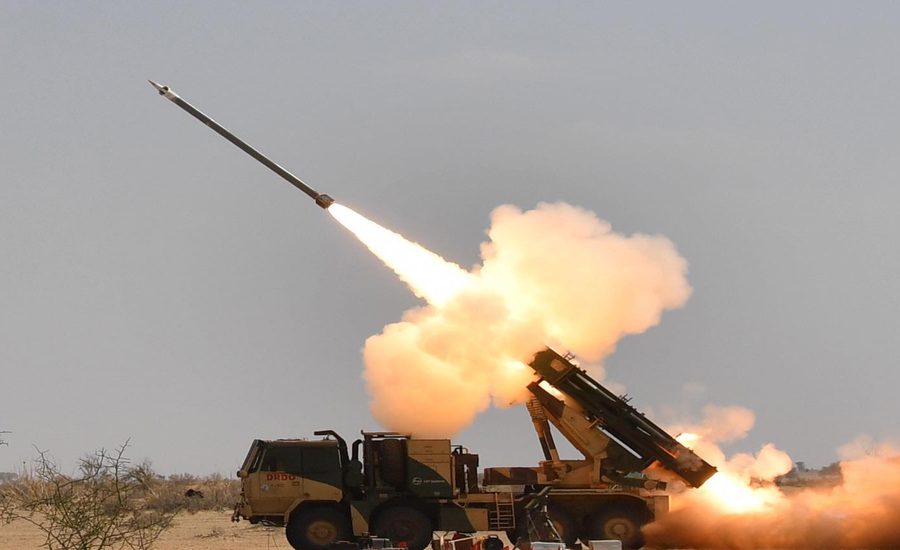
New Delhi: The Defence Research and Development Organisation (DRDO) has officially unveiled the Pinaka Mk-4 — a long-range, guided rocket system with a striking 300 kilometre reach. This development marks a transformative leap in India’s indigenous rocket artillery capabilities. The system is poised for induction into the armies of both the Indian Army and the Indian Air Force (IAF), enhancing their striking power with deep-strike capabilities previously reserved for costly cruise or ballistic missiles.
The Pinaka Mk-4 bridges the gap between conventional multi-barrel rocket launchers (MBRLs) and strategic/tactical missile systems, combining cost-effectiveness, flexibility, and battlefield potency into one potent package. In short: India’s artillery may never be the same again.
Background of Pinaka Multi – Barrel Rocket
The journey of the Pinaka Multi‑Barrel Rocket Launcher (MBRL) began in the late 1980s — a project initiated by DRDO to reduce reliance on foreign rocket systems and provide the Indian armed forces with indigenous, reliable, high-volume artillery firepower.
The original Pinaka (Mk-I) had a range of roughly 37–40 km. It was first deployed in the 1990s and saw combat, including during the 1999 Kargil conflict.
Over the years, upgrades followed. The Mk-II and improved “Extended Range” variants pushed the effective range to 60–75 km.
A major evolution came with the guided Pinaka rockets, enabling much greater accuracy and readying the system for future long-range variants.
Thus, over nearly four decades, Pinaka transformed from a standard-area saturation rocket system into a precision-guided, long-range strike weapon — culminating now in the Mk-4.
What’s New in Pinaka Mk-4 Rocket System
Exceptional Range + Deep-Strike Capability: The Mk-4 boasts a range of up to 300 km, putting it in the quasi-ballistic class — far beyond the typical reach of older MBRLs.
With such reach, Pinaka Mk-4 can target enemy airfields, radar installations, missile batteries, logistics hubs or command posts located deep behind front-line positions — a capability hitherto reserved for expensive cruise or ballistic missiles.
Cost-Effective Alternative to Missiles: According to DRDO, the Mk-4 delivers cruise-missile-grade strike potential at around 25% of the cost of a typical cruise missile.
This cost-efficiency allows for larger scale deployment, more regiments, and greater flexibility in future warfare scenarios.
Advanced Guidance, Precision & Survivability: The new variant is designed with a dual-mode guidance system — likely combining inertial navigation (INS/GPS/NAVIC) with a terminal seeker (possibly radar-based) — to deliver high terminal accuracy (CEP reportedly under 5 meters) even against moving or relocatable targets.
Its propulsion system is expected to be throttleable, allowing for trajectory corrections in-flight — improving accuracy, evasion capacity, and survivability against enemy air-defence systems.
The Mk-4 is built on a modular design, enabling the launch of a variety of payloads, including cluster munitions, anti-radiation warheads, or, potentially, future loitering munitions.
Flexible Deployment — Land, Air & Sea: While primarily intended for the Indian Army, the Mk-4 is expected to be usable by the Indian Air Force in a surface-to-surface role, and possibly in air-to-surface configurations for fighter-bombers.
A naval/coastal-defence variant is reportedly under development, enabling the Indian Navy (or coastal batteries) to deploy the Mk-4 for maritime strike and anti-ship operations.
Rapid Fire, High Volume: Like previous Pinaka versions, the Mk-4 retains the multi-barrel, salvo-fire heritage: a single launcher can fire 12 rockets in just 44 seconds — offering both saturation strike and precision strike depending on the mission.
This mix of rapid salvo capability and deep-strike precision is a powerful force multiplier, especially in a battlefield with layered defence systems and high-value targets.
Strategic Implications of Pinaka Mk-4 Rocket System
Bridging the Gap Between Artillery and Missiles: With the 300 km range, Pinaka Mk-4 occupies a middle ground — longer reach than traditional artillery, but much cheaper and easier to deploy than cruise or ballistic missiles. This gives India a versatile tool for both conventional war and limited conflicts, expanding deterrence without the cost burden of missiles.
Enhanced Deterrence Along Borders and Strategic Deterrence: Against near-border threats — be it in high-altitude regions, desert sectors, or along the coasts — the Mk-4 provides India the ability to strike deep behind enemy lines, hitting infrastructure, supply lines, and command centres with precision. This could significantly alter calculations for adversaries.
Boost to Indigenisation and Self-Reliance: The success of Pinaka — from Mk-I to Mk-IV — demonstrates the maturity and strength of India’s domestic defence industrial base, spearheaded by DRDO. It reflects a shift toward “Make in India” doctrine in strategic weapons technology, reducing dependence on imports.
Force Multiplication Without Escalation — Manageable Costs: Because the Mk-4 is cheaper than typical cruise missiles, India can deploy more units, keep them on standby, and use them in a broader range of scenarios — from conventional war to counter-insurgency or limited skirmishes — without spiraling costs or raising the stakes as much as launching ballistic missiles.
Layered Naval and Air Capability — Multi-Domain Flexibility: With ongoing development for Air Force and Navy variants, Pinaka Mk-4 could become a multi-domain weapon — useful for coastal defence, air-to-ground missions, and surface-to-surface strikes — offering joint-service flexibility that complements existing arsenals like missiles, artillery, and air defence systems.
What’s Next: Induction Timeline & Road Ahead
The development of Mk-4 reportedly is in its final stages. Prototypes have already been revealed to the public.
Induction into the Indian Army and IAF is expected “soon,” though exact dates remain classified. Some reports point to a potential induction by 2028–2030 as part of a broader artillery modernization plan.
Parallel development is underway for naval/coastal variants, and for integration with existing command & control networks, potentially enabling real-time target acquisition and joint-force operation.
In the near-to-mid term, the arrival of Pinaka Mk-3 (with 120 km range) followed by Mk-4 will significantly augment India’s strike and deterrence capabilities.
Key Challenges & Considerations
Collateral Damage / Rules of Engagement: As with any long-range strike system, the risk of collateral damage increases when targeting behind-border infrastructure or near civilian areas. The rules of engagement and target discrimination must be carefully managed.
Air Defence and Countermeasures: Deploying rocket systems that rely on rocket propulsion and ballistic/arcing trajectories may face detection and interception by advanced air-defence and radar systems. The Mk-4’s guidance and manoeuvrability are designed to address that — but the real test will come in operational scenarios.
Command, Control & Intelligence (C2I) Dependence: Precision and deep-strike capability demand accurate real-time intelligence and robust command & control, especially for dynamic targets or moving assets.
Arms Race and Regional Stability: Introduction of a 300 km-class indigenous rocket system may trigger regional adversaries to respond with their own force upgrades — possibly escalating a new rocket/missile arms race.