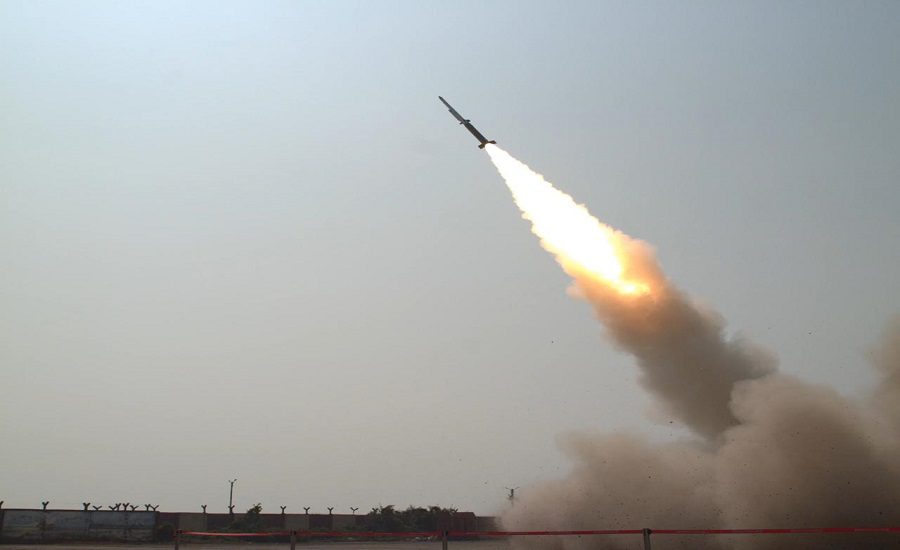
Chandipur, Odisha: The Defence Research & Development Organisation (DRDO) achieved a major technological milestone with the successful demonstration of Solid Fuel Ducted Ramjet (SFDR) technology on February 3, 2026, from the Integrated Test Range (ITR), Chandipur, off the coast of Odisha at around 10:45 hrs.
This success places India among an elite group of nations capable of developing long-range air-to-air missiles powered by SFDR technology, providing a significant tactical edge in modern aerial combat scenarios.
Successful Flight Test and Performance Verification
During the test, all critical subsystems – including the Nozzle-less Booster, Solid Fuel Ducted Ramjet motor, and Fuel Flow Controller – performed flawlessly. The missile was initially propelled by a ground booster motor to the desired Mach number, after which the ramjet motor sustained high-speed propulsion.
Read also: DRDO Surya Laser Weapon Explained: Range, Technology, Capabilities, and Strategic Impact
The flight performance was closely monitored and confirmed using multiple tracking instruments deployed at ITR Chandipur along the Bay of Bengal coast. Senior scientists from DRDO laboratories, including Defence Research & Development Laboratory (DRDL), High Energy Materials Research Laboratory (HEMRL), Research Centre Imarat (RCI), and ITR, oversaw the launch and validated its success.
Praise from Defence Leadership
Raksha Mantri Rajnath Singh congratulated DRDO and participating industry partners for the successful demonstration, noting the importance of such technological advances for India’s strategic defense capabilities.
Dr Samir V Kamat, Secretary of the Department of Defence R&D and Chairman of DRDO, extended his congratulations to all teams involved, emphasizing the collaboration across multiple laboratories and research centres that made this milestone possible.
Significance of SFDR Technology
SFDR technology represents a quantum leap in air-to-air missile propulsion, combining the range and speed advantages of a ramjet with solid fuel reliability. This enables the development of missiles capable of sustained high-speed flight over longer distances, giving Indian armed forces a critical operational advantage in aerial combat.
The successful demonstration underscores DRDO’s commitment to self-reliance in defense technology and strengthens India’s position as a global leader in advanced missile systems.
About DRDO
DRDO is India’s premier agency under the Ministry of Defence, dedicated to researching, designing, and developing advanced, indigenous defence technologies and systems for the Armed Forces. Formed in 1958, it works toward self-reliance, with 50+ labs focusing on missiles, combat vehicles, electronics, and life sciences.
Key aspects of DRDO include –
- Mission: To equip the Indian Armed Forces with state-of-the-art weapon systems, platforms, and equipment while achieving self-reliance in critical defence technologies.
- Major Projects: Development of the Agni and Prithvi missile series, Tejas Light Combat Aircraft, Pinaka multi-barrel rocket launchers, Akash air defence systems, and various radars and electronic warfare systems.
- Structure: Operates as part of the Department of Defence Research and Development, with headquarters in New Delhi.
- Focus Areas: Covers aeronautics, armaments, combat vehicles, electronics, engineering systems, missiles, materials, and naval systems.
DRDO also fosters a robust defence industry ecosystem through technology transfers and indigenous production to enhance national security and economic growth.
Read also: What Is the Su-57E and Why Is India in Talks With Russia for Joint Production?