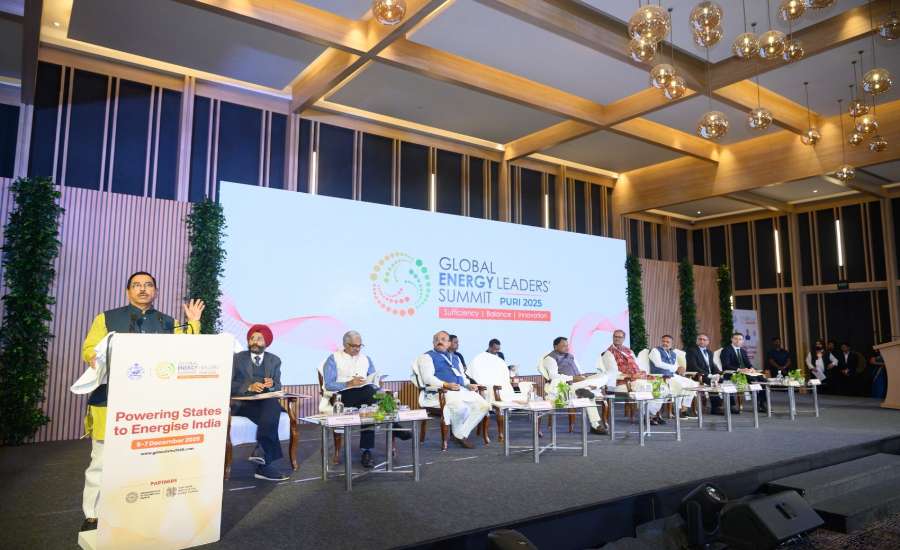
On 6 December 2025 at the Global Energy Leaders’ Summit 2025 (GELS) in Puri, Odisha, Pralhad Joshi — Union Minister for New and Renewable Energy — announced that India has recorded its highest-ever non-fossil capacity addition in the current financial year: 31.25 GW, including 24.28 GW of solar power.
Alongside this landmark national achievement, the Minister unveiled a major renewable energy initiative for the state of Odisha — a new “Utility-Led Aggregation (ULA)” model under the PM Surya Ghar programme to deploy 1.5 lakh rooftop solar units (each 1 kW), targeting to benefit 7–8 lakh citizens, especially from economically weaker households.
The twin announcements — of record national non-fossil capacity expansion and a people-centric solar plan for Odisha — underscore India’s accelerating clean energy transition while reaffirming its commitment to inclusive, equitable access to renewable power.
Global Energy Leaders Summit 2025: Unprecedented Non-Fossil Addition in FY 2025–26
According to Minister Joshi, India has achieved a total addition of 31.25 GW of non-fossil fuel capacity in FY 2025–26, with 24.28 GW contributed by solar alone.
This figure marks the highest ever single-year increase in non-fossil capacity for the country, reflecting the unrelenting momentum of India’s renewable energy push. The surge is part of a broader national effort to wean the power sector off fossil-fuel dominance and align with global climate and energy-security priorities.
Solar — The Workhorse of Expansion
From just 2.8 GW of solar capacity 11 years ago, India’s solar capacity has now soared to approximately 130 GW — a staggering growth of more than 4,500 %.
Between 2022 and 2024 alone, India added around 46 GW of solar capacity, making it the third-largest global contributor to solar expansion during that period.
Such rapid growth in solar — both large scale and rooftop — signals a deepening structural shift in the national energy mix, away from fossil-driven generation toward renewable dominance.
Non-Fossil Share Surpasses Key Milestone
Recent data shows that, as of October 2025, India’s non-fossil installed electricity capacity reached around 259 GW — crossing the 50% share of total installed capacity, five years ahead of the target set under its climate commitments.
This milestone is particularly significant given India’s historical reliance on coal: the country holds the world’s fifth-largest coal reserves and remains the second-largest global consumer of coal.
The shift therefore represents not just an environmental or climate-driven ambition, but a strategic move aligning with evolving industrial competitiveness, global energy dynamics, and long-term energy security.
Importance of Renewable Energy Surging
At the summit, Minister Joshi emphasized that while the world took nearly 70 years to reach its first terawatt (TW) of renewable energy capacity by 2022, the second TW was added by 2024 — in just two years.
India’s recent contribution — driven largely by solar — has played a pivotal role in this global acceleration. By adding tens of gigawatts in a short span, India emerges not just as a participant, but as a key driver of the global clean-energy surge.
For climate goals, energy security, and economic transformation, India’s trajectory demonstrates how developing nations can leapfrog to sustainable energy models — bypassing decades of fossil dependence.
Odisha’s New ULA Rooftop Solar Push
Under the new ULA model approved during the summit, 1.5 lakh rooftop solar units (1 kW each) will be installed across Odisha, under the aegis of PM Surya Ghar. This initiative aims to directly benefit 7–8 lakh citizens, mostly from economically weaker and marginalized households.
The “consumer-owned Utility-Led Aggregation” approach aims to simplify deployment, aggregation, and management of rooftop solar installations, ensuring wider coverage and efficient implementation.
Odisha’s Clean Energy Footprint
Odisha has already made substantial strides in clean energy: the state currently has over 3.1 GW of renewable capacity installed, with clean energy contributing more than 34% of its total installed power capacity.
Under PM Surya Ghar, of the 1.6 lakh households that applied for rooftop solar systems, over 23,000 installations have already been completed. More than 19,200 families have received subsidies amounting to over ₹147 crore credited directly into their bank accounts.
Significance for Social Equity and Energy Access
This initiative is emblematic of India’s commitment to not just large-scale renewable projects — but also decentralized, people-centric energy solutions. By targeting economically weaker households, the ULA rooftop solar push promises to democratize access to clean energy, lower electricity bills, enhance energy security at household level, and foster sustainable livelihoods.
In a state like Odisha, with substantial rural population and varying levels of grid access, such rooftop initiatives can play a transformative role in bridging energy inequity and promoting climate resilience.
Structural Drivers Behind the Surge
According to Minister Joshi, the rapid expansion of renewable energy in India is supported by a confluence of factors:
An enabling ecosystem shaped by the policies of Narendra Modi government — including streamlined procedures, investor-friendly reforms, and emphasis on ease of doing business.

Confidence from domestic and international investors, buoyed by stable regulatory frameworks, demand-driven schemes, and strong Centre–State cooperation.
Diversified renewable capacity addition, not only via large-scale utility projects, but also through rooftop solar, open-access/wheeling models for commercial & industrial (C&I) consumers, and hybrid or storage-backed renewable deployments.
These structural enablers have allowed India to accelerate beyond traditional energy pathways and embrace a future oriented around sustainability, self-reliance, and equitable growth.
What Lies Ahead: Implications and Prospects
The current surge sets the stage for India to meet — and possibly surpass — its ambitious renewable energy and climate commitments. Key implications and prospects include:
Accelerated Clean Energy Transition: With non-fossil capacity crossing 50%, India is inching closer to its goal of 500 GW non-fossil electricity capacity by 2030 (as envisaged under national climate pledges).
Energy Security + Climate Goals: Diversifying energy sources reduces dependence on coal and fossil imports, while cutting carbon emissions — aiding India’s long-term climate targets and net-zero ambition.
Economic & Social Inclusion: Rooftop solar ULA models democratize energy access, especially for economically weaker households, bridging energy inequality and contributing to livelihoods, savings, and local economic uplift.
Industrial Competitiveness: As global mechanisms reshape industrial competitiveness with sustainability as a criterion, India’s renewable push enhances attractiveness for green investments, manufacturing, and technology deployment.
Leadership in Global Energy Transition: By contributing significantly to global renewable additions, India strengthens its position as a leader in the clean energy transition — influencing global trajectories, climate diplomacy, and international investment flows.