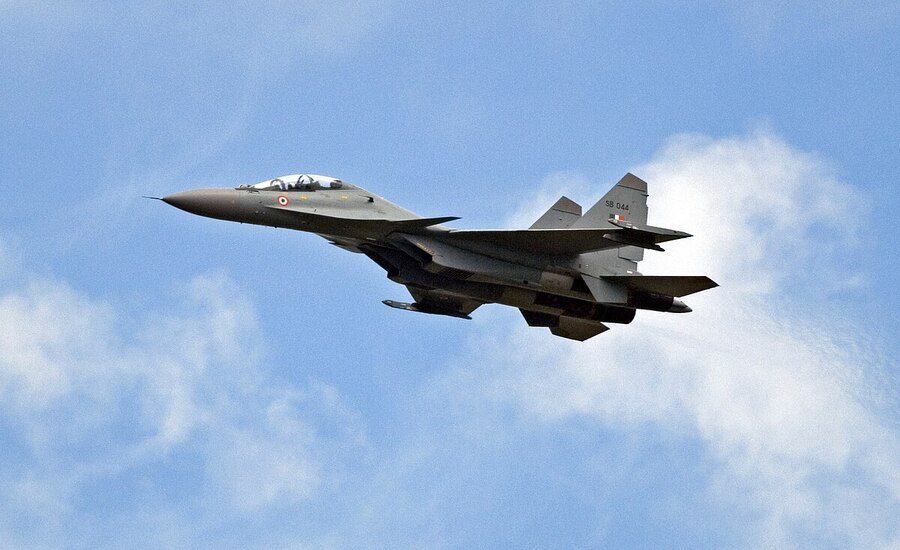
New Delhi: In a landmark development for India’s defence industrial ecosystem, Hindustan Aeronautics Limited (HAL), in strategic collaboration with the Defence Research and Development Organisation (DRDO) and Indian private sector partners, has unveiled a comprehensive roadmap to significantly elevate the indigenous content of the Su-30MKI fighter aircraft to 78%.
What is Indigenous Su-30MKI Programme
Originally developed as a joint Indo-Russian platform, the Su-30MKI has been the mainstay of India’s air combat capability for decades. Over the years, HAL has progressively localised manufacturing and maintenance, yet reliance on imported subsystems persisted.
The latest upgrade blueprint marks a decisive shift, aiming for a transformation where 78% of components and systems are sourced, developed, and integrated indigenously.
According to official disclosures, this figure represents one of the most ambitious localisation targets for a frontline combat aircraft in India’s defence modernisation history.
What are the Key Pillars of the Indigenous Su-30MKI Initiative
Here are the key pillars of the indigenous su-30mki initiative;
1. Advanced Radar and Sensor Suite
At the forefront of this transformative programme is the integration of indigenous sensors, most notably the Uttam Active Electronically Scanned Array (AESA) radar.
AESA technology brings enhanced multi-target tracking, electronic warfare (EW) resilience, and superior situational awareness — critical for high-intensity air combat and counter-stealth operations.
2. Home-Grown Mission Computer and Avionics
The mission computer, regarded as the aircraft’s “brain,” will be fully developed in India, enabling faster data processing, autonomous decision-making capabilities, and rapid integration of tactical upgrades without foreign approvals.
3. Electronic Warfare (EW) Suite
India’s indigenous EW subsystem will provide enhanced missile evasion tactics, digital radar jamming, and countermeasure capabilities.
The new suite is expected to substantially increase survivability against modern threats, including advanced surface-to-air missiles.
4. Weapons Integration
Integration with Indian missiles — such as the Astra beyond-visual-range air-to-air missile and the BrahMos supersonic cruise missile — will substantially raise the Su-30MKI’s lethality and flexibility. This marks a strategic pivot from reliance on traditional foreign armaments to a more versatile indigenous weapons ecosystem.
What are the Key Importance of Indigenous Su-30MKI Initiative
Here are the key importance of Indigenous Su-30MKI initiative;
Mitigating Supply Chain Vulnerabilities
India’s dependence on foreign suppliers, especially for critical avionics and sensors, has historically introduced bottlenecks in maintenance and upgrades.
The 78% indigenous content target will dramatically reduce wait times for spares and system enhancements, enabling better operational readiness and strategic autonomy.
Leveraging Domestic Defence Industry
The initiative is poised to generate thousands of high-skilled jobs across manufacturing, engineering, and aerospace R&D sectors. Key defence players — from established firms like Bharat Electronics Limited (BEL) to emerging private startups — are expected to benefit from new production orders and technology transfer opportunities.
Strengthening India’s Strategic Posture
A more self-sufficient Su-30MKI fleet will enhance India’s capability to maintain air superiority across its two-front threat spectrum, particularly along borders with China and Pakistan. More importantly, it marks a strategic pivot toward long-term deterrence without reliance on external geopolitical conditions.
Industry and Technological Impact of Indigenous Su-30MKI
The upgrade project will also serve as a technology incubator for future Indian combat aircraft programs such as the Advanced Medium Combat Aircraft (AMCA).
Innovations in radar, avionics, and mission computing are expected to flow into next-generation platforms, accelerating India’s indigenous aerospace capabilities.
Moreover, collaborative efforts between HAL, DRDO, and private sector partners exemplify a maturing defence industrial base — one capable of taking on complex systems integration and manufacturing challenges previously dominated by foreign OEMs.
Key Challenges and the Road Ahead
While the 78% indigenisation target is transformative, it is not without challenges. Scaling production of sophisticated systems — especially AESA radars and EW suites — requires sustained R&D investments and supply chain coordination. However, experts note that India’s expanding defence ecosystem, combined with political backing for localisation, creates a favorable environment to overcome these hurdles.
Read also: Akash-NG Missile Trials: DRDO Confirms High-Precision Intercepts and Combat Readiness