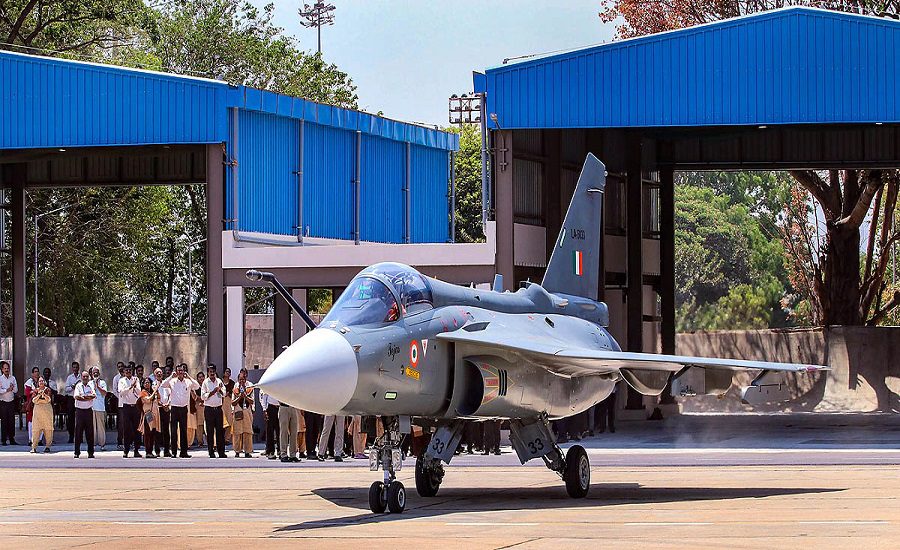
New Delhi: India’s push for defence self-reliance has received a major boost with HAL Nashik HIP facility becoming operational for processing carbon-carbon brake discs used in the LCA Tejas Mk1A fighter aircraft.
Hindustan Aeronautics Limited (HAL) has commissioned a Hot Isostatic Press (HIP) facility at its Nashik Division to support the indigenous fighter programme and strengthen domestic aerospace manufacturing capability. The advanced facility will help process high-performance brake discs required for fighter jets and reduce dependence on foreign suppliers. The development is part of India’s broader effort to strengthen the Atmanirbhar Bharat defence ecosystem and accelerate the production of Tejas Mk1A aircraft for the Indian Air Force.
Details of HAL Nashik HIP Facility
State-owned aerospace major Hindustan Aeronautics Limited (HAL) has operationalised a Hot Isostatic Press (HIP) facility at its Nashik Division. The facility will process carbon-carbon brake discs used in the Tejas Mk1A light combat aircraft.
HIP is a specialised aerospace manufacturing process where high pressure and temperature are applied simultaneously to improve the strength, density, and durability of advanced materials. This technology is widely used in aviation, space, and defence industries for producing high-performance components.
With this capability, HAL can process critical brake disc materials domestically, strengthening India’s defence supply chain.
Why Carbon-Carbon Brake Discs Are Important
Carbon-carbon brake discs are used in modern fighter aircraft because they provide exceptional performance under extreme conditions.
Key advantages include:
- Ability to withstand very high temperatures during landing
- Lightweight design, which improves aircraft efficiency
- High durability and wear resistance
- Better braking performance for high-speed fighter jets
For aircraft like Tejas Mk1A, which operate at high speeds and require short landing distances, reliable braking systems are essential for safe operations.
What is the Importance of HAL Nashik HIP Facility for the Tejas Mk1A Program
The Tejas Mk1A is the advanced variant of India’s indigenous Light Combat Aircraft developed to strengthen the Indian Air Force.
Key improvements in the Mk1A variant include:
- Advanced AESA radar
- Improved electronic warfare systems
- Beyond-visual-range missile capability
- Modern avionics and flight control systems
The aircraft is expected to become a key part of India’s fighter fleet in the coming decade. India has already ordered 83 Tejas Mk1A jets in 2021 and an additional 97 aircraft in 2025, reflecting strong long-term demand for the platform.
The new HIP facility will support this production scale-up by ensuring the availability of critical components such as brake discs.
Nashik Facility Emerging as a Major Aerospace Hub
HAL’s Nashik complex has historically been known for producing aircraft such as the MiG-21 and Su-30MKI under licence.
In recent years, the facility has been upgraded to support India’s indigenous aircraft programmes. Key developments include:
- A new production line for Tejas Mk1A
- Manufacturing of HTT-40 trainer aircraft
- Infrastructure expansion to increase fighter aircraft production
The Nashik plant now contributes significantly to India’s domestic fighter jet manufacturing capacity and plays a crucial role in strengthening the country’s defence ecosystem.
Significance of HAL Nashik HIP Facility
The commissioning of the HIP facility is aligned with the Government of India’s Atmanirbhar Bharat initiative in defence manufacturing.
Benefits of this development include:
- Reduced dependence on imported aerospace components
- Stronger domestic defence supply chain
- Faster production of Tejas Mk1A aircraft
- Enhanced technological capability in advanced materials processing
Such facilities are critical for building a self-sufficient defence industrial base, enabling India to design, manufacture, and maintain complex military platforms within the country.
What This Means for India’s Aerospace Future
The new HIP facility represents more than just a manufacturing upgrade. It demonstrates India’s growing expertise in advanced aerospace materials and manufacturing technologies.
As India scales up production of the Tejas Mk1A and develops next-generation fighters such as Tejas Mk2 and AMCA, capabilities like HIP processing will play an important role in ensuring that key components are produced domestically.
With continued investments in infrastructure, technology, and skilled manpower, India’s aerospace sector is steadily moving toward global competitiveness and strategic autonomy.