New Delhi: In a major shake-up of India’s defence aerospace sector, Hindustan Aeronautics Limited (HAL), the state-owned aerospace giant, has been excluded from the race to develop the Advanced Medium Combat Aircraft (AMCA), India’s ambitious fifth-generation fighter jet project. Only three private sector players—Tata Advanced Systems, Larsen & Toubro (L&T), and Bharat Forge—have now been shortlisted to collaborate with the Aeronautical Development Agency (ADA) to build prototypes of the futuristic fighter jet.
HAL Knocked Out After Technical Evaluation
HAL, long considered the cornerstone of India’s defence aircraft manufacturing, was eliminated after failing the technical evaluation stage of the AMCA programme. Seven companies and consortia had initially submitted bids, but only three private sector contenders met the technical criteria to proceed further.
“After the pre-qualification stage, three companies remain. We will issue the Request for Proposal (RFP) to all three for submitting cost bids for the production of five prototypes of the AMCA aircraft,” Defence Secretary Rajesh Kumar, a 1989-batch IAS officer of the Kerala cadre, told the media.
HAL’s exclusion is attributed to multiple factors: its order book is currently several times larger than its annual revenue, creating capacity constraints. Past project delays, such as those experienced in the Tejas fighter jet programme, have also prompted the government to encourage private sector participation to speed up development, foster innovation, and reduce dependence on a single state-run entity.
Read also: Explained: HAL’s Missamari MRO Hub and Its Role in Strengthening Eastern Theatre Defence
Private Sector Steps Into the Spotlight
The three shortlisted private companies and their partnerships are:
- Tata Advanced Systems Limited (TASL) — bidding independently.
- Larsen & Toubro (L&T) — forming a consortium with Bharat Electronics Limited (BEL) and Dynamatic Technologies.
- Bharat Forge (Kalyani Group) — forming a consortium with BEML and Data Patterns.
These companies will now collaborate with ADA to produce five flying prototypes and one structural test specimen for the AMCA programme. The final winner is expected to be selected in the next 2–3 months, based on cost bids after the RFP process.
AMCA: India’s Indigenous Fifth-Generation Fighter
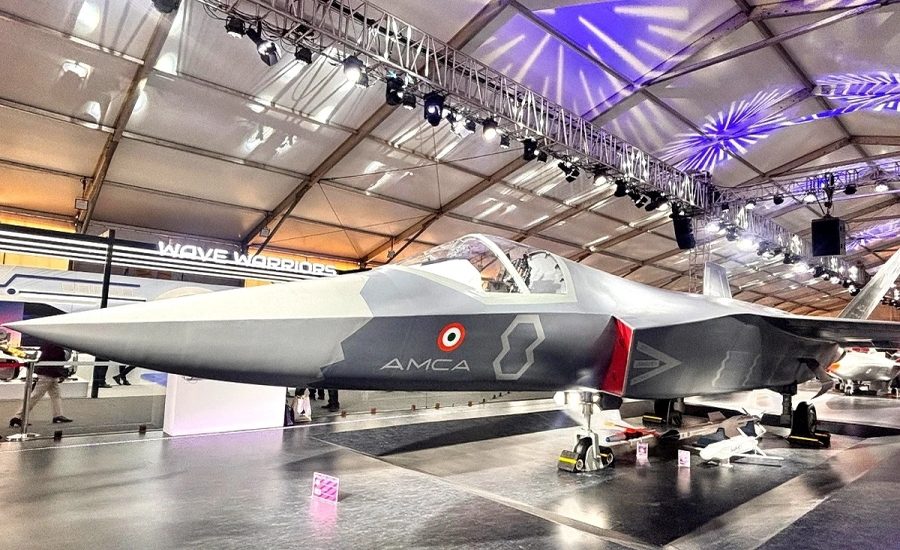
The AMCA project marks India’s first attempt at a completely indigenous fifth-generation stealth fighter jet. Key features of the aircraft include:
- Stealth Technology — extremely low radar visibility.
- Artificial Intelligence Systems — for enhanced operational efficiency.
- Long-Range Strike Capability — to strike targets deep inside enemy territory.
- Manned-Unmanned Teaming — piloted jets working alongside drones.
- Supercruise — sustained high-speed flight without afterburners.
- Advanced AESA Radar and Sensors — state-of-the-art avionics for modern warfare.
The AMCA is expected to become the backbone of the Indian Air Force (IAF), with initial induction slated for the mid-2030s. The first prototype is projected for 2026–2027, with a first flight around 2028–2029. Initial production could see 120 jets ordered, with potential for expansion.
Budget and Timeline
The estimated budget for developing prototypes is ₹15,000 crore. The project represents a significant investment in strengthening India’s defense capabilities and boosting private sector involvement in high-tech aerospace manufacturing.
Strategic Significance
The exclusion of HAL and the promotion of private firms marks a historic reform in India’s defense sector. Breaking HAL’s monopoly is intended to accelerate innovation, increase efficiency, and improve competition. Analysts say this move will strengthen India’s air power and enhance its ability to compete technologically with neighboring countries like China and Pakistan.
Should the AMCA programme succeed, India would join the select group of nations capable of designing and building indigenous fifth-generation fighter jets, a major milestone for national defense and aerospace self-reliance.
Market Reaction
Shares of HAL dropped sharply in response to the news, falling as much as 8 percent to intraday lows below ₹4,100. Investors expressed concerns over HAL missing out on what was considered a strategic and lucrative opportunity in the indigenous defense sector.
HAL has informed stock exchanges that it has yet to receive any formal communication from DRDO regarding the AMCA project. Meanwhile, private sector leaders are expected to spearhead the next phase of prototype development.
What’s Next
The next three to four months will see the final selection of the winning consortium based on commercial bids. Once selected, the companies, along with ADA, will move forward with prototype construction. India’s first indigenous fifth-generation stealth fighter jet is expected to be ready for the skies by the end of the decade.
About Hindustan Aeronautics Limited (HAL)
Hindustan Aeronautics Limited (HAL) is India’s premier aerospace and defence company, engaged in the design, development, manufacture, and maintenance of aircraft, helicopters, engines, and avionics. A Navratna PSU under the Ministry of Defence, HAL plays a critical role in strengthening India’s aerospace capabilities across both defence and civil aviation segments.