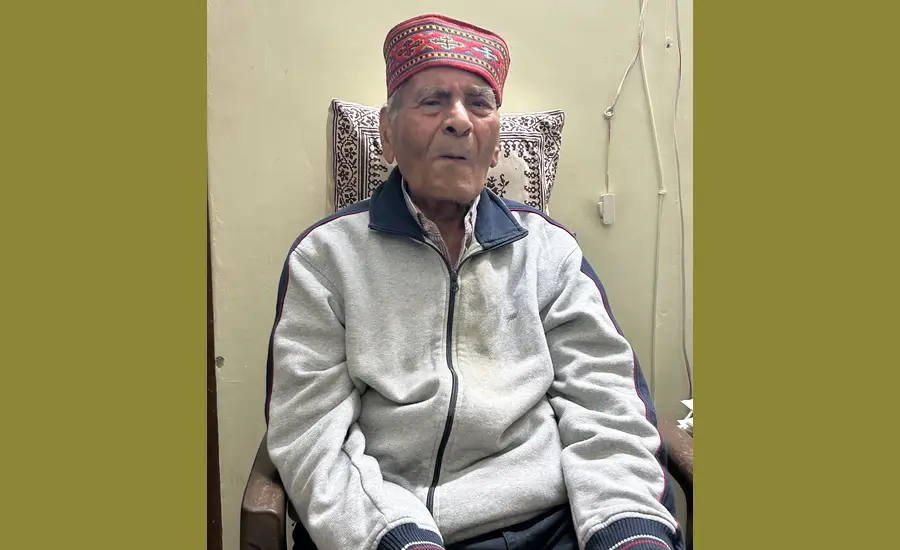
Bhopal: As he approaches his 100th birthday on March 5, former Madhya Pradesh Director General of Police Harivallabh Mohanlal Joshi represents a living chapter of India’s policing history. According to The Times of India, he is believed to be the last surviving officer of the inaugural 1948 batch of theIndian Police Service (IPS). Joshi’s life mirrors the evolution of law enforcement in independent India — from the dusty ravines of Chambal to the top ranks of the state police.
Even at nearly a century old, his memory remains strikingly precise. He recalls operations, weapons, terrain, informers, and tactical decisions as if they unfolded yesterday — not nearly six decades ago.
Nearly eight decades after taking the oath in independent India’s first IPS cohort, Joshi remains remarkably sharp and steady on his feet. At his residence, he walks with little support and feeds himself. A small whistle hangs around his neck to call someone in the house, but his voice still carries the authority of a man who once commanded battalions across the ravines.
The 1969 Turning Point in Chambal
“I joined Gwalior as DIG on May 13, 1969. My predecessor had some unsuccessful operations against the Jagmohan gang. I was concerned about the reason,” Joshi recalls.
An informer approached him with a personal motive — Jagmohan had allegedly molested his sister. Joshi took him into confidence and asked why earlier operations had failed.
The answer revealed a tactical loophole. Dacoits exploited the lack of coordination between the Superintendents of Police (SPs) of Bhind and Morena districts. When pressure mounted in Bhind, they slipped into Morena. When operations intensified in Morena, they returned to Bhind.
Joshi immediately closed the coordination gap. “I called for coordinated action, taking both SPs into confidence. The result was elimination of 17 dacoits, including Jagmohan,” he says.
Rewriting Anti-Dacoity Strategy
As DIG of the Gwalior Range — comprising seven districts severely affected by banditry — Joshi launched sustained anti-dacoity campaigns that transformed policing in the Chambal belt.
He strengthened Special Armed Force units by:
• Sanctioning Light Machine Guns (LMGs) at section level
• Introducing 2-inch mortars, Self-Loading Rifles (SLRs), and sniper rifles
• Improving mobility with cross-country troop carriers
• Intensifying night firing and ambush drills
• Expanding informer networks
• Instituting detailed post-operation debriefings
He also recruited Sahariya tribals for their deep knowledge of the ravines and reinforced village defence committees.
Joshi personally led the operation against dacoit Chota Nathu and was awarded the President’s Police and Fire Services Medal for gallantry, in addition to the Police Medal for Meritorious Service.
In three intense years, more than 300 dacoits were eliminated, over 500 arrested, and many surrendered.
The 1972 Mass Surrender
Yet, Joshi considers surrender — not encounters — as the greater achievement.
Sustained operational pressure combined with outreach efforts culminated in the historic 1972 surrender of more than 300 dacoits before socialist leader Jayaprakash Narayan in Jaura.
Joshi instructed officers against false encounters, advocated humane treatment for those willing to lay down arms, and pushed for development initiatives in the Chambal region. He later contributed to framing the MPDVPK Act, 1981, targeting those who harboured dacoits.
A Medal Delayed — and a Surprise
Recalling another episode, Joshi laughs. “Hundreds of gallantry medals recommended by the state for MP Police were lying in the national capital,” he says.
He approached the then Secretary to Home, K.F. Rustamji, and expressed concern that delays were demoralising personnel. It was during that conversation that he learned a President’s Medal had been kept pending for him as well.
From Village Rajasthan to the First IPS Batch
Born on March 5, 1926, in Ralawata village of the erstwhile princely state of Kishangarh in Rajasthan, Joshi completed his BA from Akola, studied at Allahabad University, and earned his MA in English from Morris College, Nagpur, in 1948.
During his student years, he worked with Lokmat and the monthly magazine Krishak, and briefly served as a lecturer before joining the IPS.
He was among the 39 officers of the first IPS batch in 1948 — the cohort that replaced the Imperial Police and laid the foundation of modern Indian policing.
National Assignments and Reforms
Beyond Chambal, Joshi handled counter-insurgency assignments in Nagaland and Manipur, commanded MP Police battalions in Jammu & Kashmir, and eventually retired as DGP of Madhya Pradesh in March 1984.
As DGP, he introduced several reforms:
• Ensured a minimum of three promotions for subordinates
• Instituted weekly public interaction sessions
• Upgraded police stations
• Improved traffic constable uniforms
• Strengthened welfare measures for personnel and families
Scholar in Uniform
Beyond his policing career, Joshi authored Geeta Chintan, a commentary on the Bhagavad Gita, and translated lectures of Swami Vivekananda delivered at the Police Academy in Mount Abu, published as Mahapurushon ki Jeevan Gathaye.
At 100, Harivallabh Mohanlal Joshi stands as a living bridge between colonial-era policing and modern Indian law enforcement — a man who fought in the ravines, shaped institutional reform, and witnessed the evolution of the Indian Police Service from its very first batch.