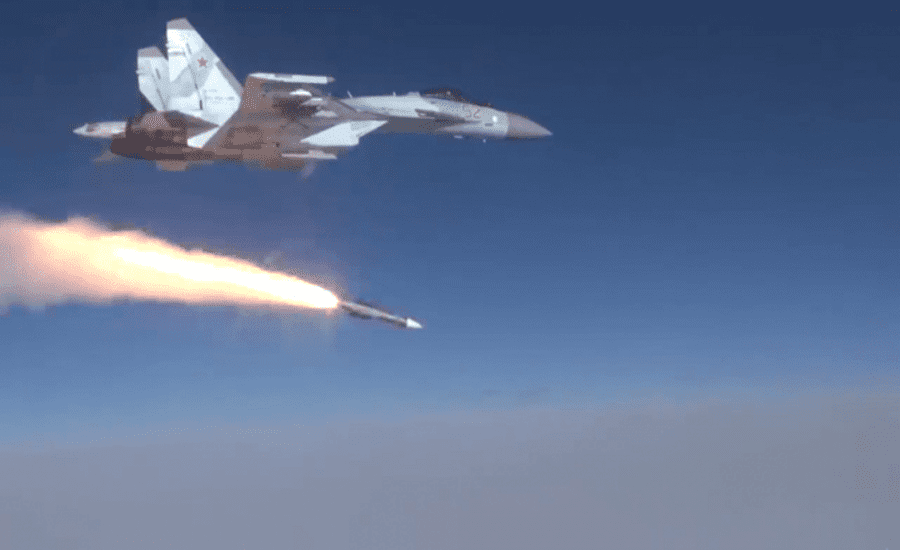
New Delhi: India is on the verge of a transformative leap in air combat capability as it evaluates the induction of the Russian R-37M long-range air-to-air missile (AAM)—a weapon widely regarded as the deadliest air-to-air missile in the world today.
Capable of reaching staggering speeds of 7,400 kmph (Mach 6+) and striking targets at ranges exceeding 300 km, the R-37M promises to fundamentally alter the balance of air power in the region.
If inducted into the Indian Air Force (IAF), the missile would significantly enhance beyond-visual-range (BVR) dominance, outpacing even iconic systems like the BrahMos in terminal velocity and redefining India’s aerial deterrence posture.
Background of R-37M missile India
Modern aerial warfare is increasingly decided before dogfights even begin. Advanced sensors, network-centric warfare, and ultra-long-range missiles now determine which air force controls the skies.
India’s current inventory includes capable BVR missiles such as R-77, Meteor, and the indigenous Astra Mk-1, with Astra Mk-2 and Mk-3 under development.
However, evolving regional threats—particularly the rapid modernization of the PLA Air Force (PLAAF) and Pakistan Air Force—have compelled India to explore game-changing interim solutions. The R-37M fits precisely into this strategic gap.
What Is the R-37M missile India?
The R-37M (NATO designation: AA-13 Axehead) is Russia’s most advanced operational air-to-air missile, designed to destroy high-value aerial assets from extreme distances.
Key Specifications of R-37M missile India
Speed: Up to Mach 6 (≈7,400 kmph)
Range: Over 300 km
Guidance: Inertial navigation with mid-course updates + active radar homing
Targets: AWACS, tanker aircraft, electronic warfare planes, fighters, cruise missiles
Warhead: High-explosive fragmentation
Launch Platforms: Su-30SM, Su-35, MiG-31BM
Its sheer speed and reach make evasion extremely difficult once a target is locked.
Why R-37M missile India Is Considered the World’s Deadliest AAM
Unlike conventional fighter-to-fighter missiles, the R-37M is built to decapitate the enemy’s aerial command structure.
1. Extreme Speed Advantage: At Mach 6, the missile drastically reduces reaction time, leaving little scope for countermeasures or evasive manoeuvres.
2. Ultra-Long Engagement Envelope: With a range exceeding 300 km, the missile allows pilots to engage targets well beyond enemy radar coverage, often before adversaries even detect the launch platform.
3. High-Value Target Neutralisation: The missile is optimized to destroy:
- AWACS aircraft
- Aerial refuelling tankers
- Electronic intelligence platforms
Eliminating these assets can collapse an enemy’s air operations within minutes.
Outpacing BrahMos: Understanding the Comparison
While BrahMos remains the world’s fastest operational cruise missile, its role is fundamentally different.
| Parameter | R-37M | BrahMos |
| Role | Air-to-Air | Surface strike |
| Speed | Mach 6 | Mach 2.8–3 |
| Target | Aircraft | Ships / ground |
| Combat Domain | Air superiority | Precision strike |
The comparison highlights terminal speed and reaction time, where the R-37M clearly surpasses BrahMos—making it lethal in air combat scenarios.
Integration with Su-30MKI: A Strategic Fit
Russia already deploys the R-37M on Su-30SM fighters, which are closely related to India’s Su-30MKI fleet—the backbone of the IAF.
- Minimal Integration Challenges
- Compatibility with N011M Bars radar
- Software upgrades rather than structural changes
- Existing Indo-Russian logistics synergy
Each Su-30MKI could carry two R-37M missiles under the fuselage, supplemented by Astra and R-77 missiles on wing pylons—creating a layered air-to-air strike package.
How R-37M Missile India Changes India’s Air Combat Doctrine
Pre-Emptive Air Denial: Enemy aircraft can be engaged before they reach launch positions, denying airspace outright.
AWACS & Tanker Kill Capability: By threatening force multipliers, India can paralyse enemy operations without mass dogfights.
Reduced Close-Combat Risk: With kills possible at extreme distances, pilots are less exposed to within-visual-range combat, improving survivability.
Bridging the Gap Until Astra Mk-3
India’s indigenous Astra Mk-3—powered by Solid Fuel Ducted Ramjet (SFDR)—is expected to offer ranges beyond 300 km, but full operational readiness is likely post-2030.
Until then, the R-37M provides:
- Immediate long-range lethality
- Operational experience with ultra-long-range engagements
- Tactical insight for future indigenous missile doctrine
Geopolitical and Strategic Implications of R-37M Missile India
Indo-Russian Defence Ties: The potential acquisition reinforces India-Russia defence cooperation at a time when global geopolitics remain fluid.
Regional Deterrence: The missile significantly counters:
- China’s PL-15
- Pakistan’s expanding BVR inventory
Air Superiority in Indo-Pacific: Enhanced reach enables India to project power across vast airspaces, particularly in high-altitude and maritime theatres.