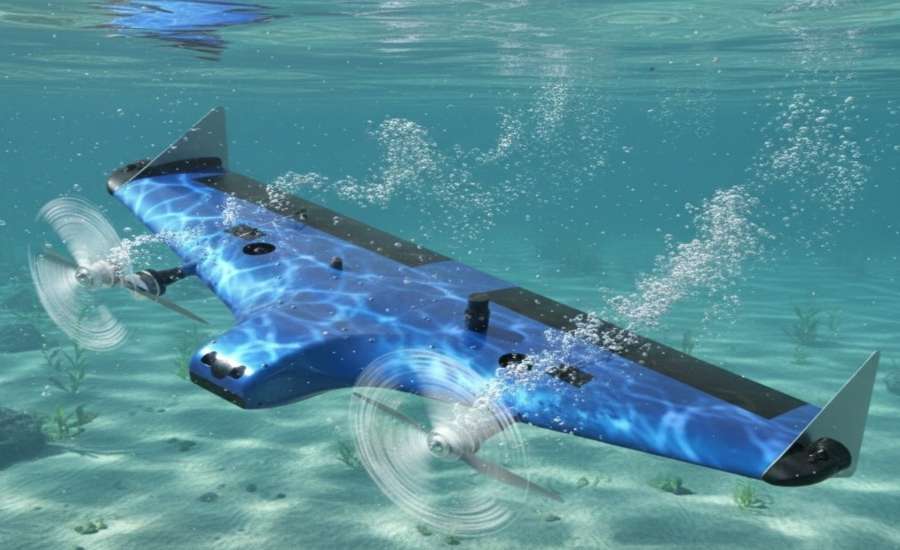
New Delhi: India’s first amphibious drone AVATAAR marks a significant milestone in the country’s defence and robotics innovation ecosystem.
Developed by Bengaluru-based startup AquaAirX Autonomous Systems, this next-generation drone can operate both in the air and underwater, making it a powerful multi-domain surveillance platform.
The amphibious drone AVATAAR is designed for intelligence gathering, coastal monitoring, and underwater inspection, helping security agencies and researchers monitor maritime environments more efficiently.
With its ability to seamlessly transition between air and water, the drone represents a major step forward in India’s indigenous drone technology and autonomous robotics capabilities.
What Is the Amphibious AVATAAR Drone?
AVATAAR stands for Amphibious Vehicle for Autonomous Tactical Aerial & Aquatic Reconnaissance. It is a surveillance-class amphibious drone designed to operate across both aerial and underwater environments without needing separate systems.
Unlike traditional drones that only fly, AVATAAR can dive underwater, navigate using sensors, and then return to the air, giving operators a complete picture of maritime conditions.
The system is built for intelligence, surveillance and reconnaissance (ISR) missions where both surface and sub-surface information are important.
Who Developed the AVATAAR Drone ?
The amphibious drone was created by AquaAirX Autonomous Systems, a Bengaluru-based deep-tech startup founded by engineers Gouthami T. S. and Jitendra Saini.
The company focuses on building AI-powered amphibious and underwater drones capable of seamless transitions between air and water environments.
AquaAirX aims to transform marine intelligence, inspection, and security operations using robotics, artificial intelligence, and cloud-based analytics.
Key Features of the AVATAAR Drone
Here are the key features of AVATAAR Drone;
1. Dual-Domain Operation
The biggest innovation of AVATAAR is its ability to operate both in the air and underwater, allowing surveillance across multiple environments in one mission.
2. Advanced Sensor Suite
The drone carries several advanced sensors to help it work effectively underwater and in the air.
These include:
- Imaging sonar
- Doppler Velocity Log (DVL) navigation
- Acoustic communication modem
- LED lights and cameras
- Ultra-Short Baseline (USBL) navigation system
These sensors help the drone navigate underwater and gather real-time data even in low-visibility conditions.
3. Autonomous Mission Capability
The system can operate with AI-assisted navigation and mission control software, enabling automated surveillance and inspection missions.
4. Seamless Air-Water Transition
The drone can transition between air and water environments in seconds thanks to its specialized propulsion and design architecture.
Uses of AVATAAR Drone
The AVATAAR amphibious drone has several important defence and maritime security applications:
Coastal surveillance: Security forces can monitor coastal areas and detect threats near harbours or strategic maritime zones.
Harbour and port security: The drone can detect suspicious underwater activity around ships, ports, or underwater infrastructure.
Search and rescue operations: It can locate missing vessels, aircraft debris, or survivors in both air and underwater environments.
Tactical reconnaissance missions: Military and coast guard teams can use it for intelligence gathering in complex maritime zones.
Civilian and Industrial Applications
Beyond defence, the amphibious drone can also be useful for many civilian sectors.
Environmental monitoring
Scientists can use it to monitor water quality, marine life, and ocean pollution.
Offshore infrastructure inspection
It can inspect underwater pipelines, oil platforms, cables, and dams.
Disaster response
In flood zones or maritime accidents, the drone can search underwater areas that are dangerous for divers.
Why Do India Need Amphibian Drone
India has been investing heavily in indigenous drone technologies and autonomous systems as part of its defence modernization strategy.
The development of AVATAAR shows that Indian startups are now capable of building advanced robotics systems that can compete globally.
This innovation also supports:
- Maritime security along India’s long coastline
- Defence technology self-reliance
- Growth of India’s deep-tech startup ecosystem
As threats increasingly emerge in complex environments such as coastal waters and underwater zones, amphibious drones could become a critical tool for national security agencies.
Read also: Explained: How India’s Integrated Air Defence Command Network Will Shape Future Wars