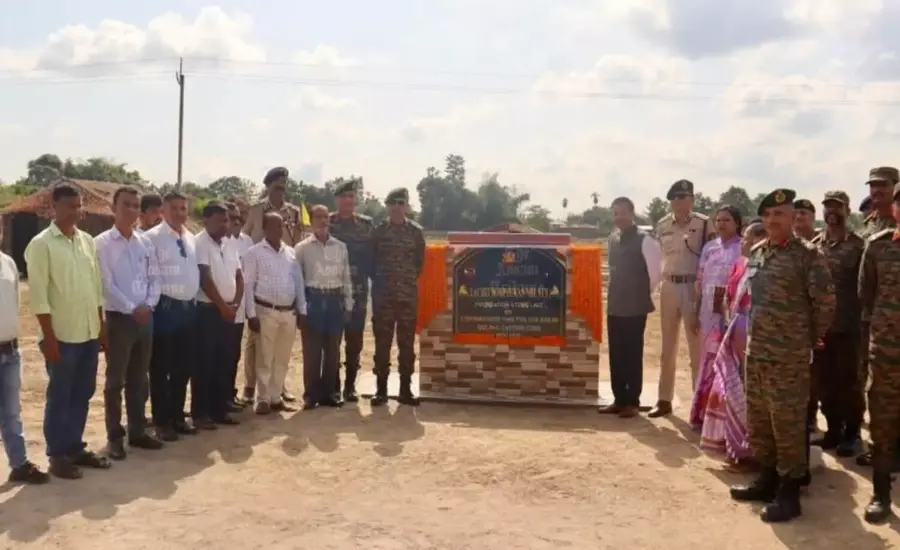
New Delhi: The government of India has taken decisive strategic action to reinforce one of its most sensitive and vital land links — the Siliguri Corridor — by establishing multiple new military bases along the stretch. The recently announced installations include a major station near Dhubri in Assam and forward bases near Kishanganj (Bihar) and Chopra (West Bengal).
With these additions, the narrow 22-kilometre (in its slimmest part) strip — often referred to as “the Chicken’s Neck” — linking India’s northeastern states to the mainland is being reshaped from a traditional vulnerability into a fortified strategic asset.
What is the Siliguri Corridor and It’s Importance
Geography and Strategic Significance: The Siliguri Corridor lies in northern West Bengal and is the only land connection between mainland India and its eight northeastern states: Arunachal Pradesh, Assam, Manipur, Meghalaya, Mizoram, Nagaland, Tripura, and Sikkim.
At its narrowest, the corridor is only about 20–22 km wide. It is bordered by Nepal to the west, Bhutan to the north, and Bangladesh to the south (and also lies near the tri-junction that touches China’s Chumbi Valley) — making it a highly sensitive geopolitical choke point.
Because almost all land trade, transport, and communication between the Northeast and mainland India traverse this strip — including highways, railways, oil pipelines, and communication networks — its importance to national integration, economic linkage, logistics, and national security cannot be overstated.
Historical Vulnerability: Since the partition in 1947 — when Bengal was divided into East and West — the creation of East Pakistan (now Bangladesh) left the newly independent India with a thin land corridor linking mainland India to its northeastern territories. That narrowness has long been recognized as both a strategic vulnerability and a geostrategic chokepoint in times of crisis.
Over the decades, strategic analysts have warned that any coordinated foreign hostility, political collusion, or infrastructure disruption along the Siliguri Corridor could sever the Northeast from the mainland — isolating more than 40 million people and cutting off critical supply lines.
Therefore, despite its crucial importance, India has persistently struggled with the “Chicken’s Neck” problem — balancing connectivity, infrastructure development, and defence readiness.
What’s New: The Military Build-up
According to the recent announcement, India has created:
- A major military station — Lachit Borphukan Military Station — near Dhubri in Assam.
- Forward operating bases at Kishanganj in Bihar, and Chopra in West Bengal.
These bases reportedly host rapid deployment forces, intelligence units, and elite para-special forces — configured for swift action, surveillance, and layered defence.
Notably, the base at Chopra is located less than a kilometre from the Bangladesh border — giving the Indian military a forward vantage point for monitoring and rapid response in a region long considered vulnerable.
From Vulnerability to Fortification
With overlapping coverage across these bases, the corridor’s defence architecture now includes:
- Deep surveillance and intelligence coverage into adjacent border zones.
- Rapid-mobilisation capabilities; the ability to deploy troops quickly across the corridor in the event of threats or escalation.
- Multi-layered defence posture, combining land forces (including adapted tanks for riverine/hilly terrain) with air defence, air-power assets, and missile systems — representing a shift from reactive deterrence to proactive dominance.
Why Now — The Catalysts Behind The Decision
Geopolitical Shifts in Neighbouring States: The latest military build-up is being seen as a direct response to shifting regional dynamics — particularly a changing political alignment in neighbouring Bangladesh. The recent replacement of the pro-India administration (led by Sheikh Hasina) with an interim government perceived as more aligned with China and Pakistan has raised serious security concerns in New Delhi.
Reports of Bangladesh seeking to acquire Chinese J-10C fighters — and collaborating on drone-manufacturing — along with offers of JF-17 Block C jets from Pakistan have reportedly intensified India’s need for securing its eastern flank.
Evolving Security Threats & Strategic Realignment: In recent years, the risks to the Siliguri Corridor have multiplied — from potential encirclement and infiltration along porous borders, to espionage, asymmetric threats, and attempts at cutting off the Northeast from the mainland during regional hostilities.
At the same time, India’s broader security and defense posture has undergone a shift — from reactive detention of threats to an assertive and proactive stance, preparing for two-front challenges and potential regional instability. This transformation necessitated not just rhetoric, but tangible reinforcements on ground.
Key Implications of Siliguri Corridor
- By fortifying the Siliguri Corridor, India strengthens its ability to maintain uninterrupted connectivity with the Northeast, safeguarding the region from becoming isolated during crises. This ensures logistic corridors remain open for civilians, trade, essential supplies, and military mobilisation.
- Moreover, when military installations are placed close to borders — yet with depth and overlapping coverage — the deterrence factor increases significantly, rendering hostile plans to sever the corridor far less feasible.
- The build-up sends a clear signal to neighboring countries, especially Bangladesh, China and Pakistan, about India’s seriousness in protecting sensitive corridors. It underscores that any aggression around Siliguri will be met with strong military readiness and will likely escalate rapidly. Analysts believe the message is plain: “This is no longer a soft vulnerability — it’s a hardened strategic asset.”
- Also, this may impact diplomatic dynamics: with India visibly reinforcing its eastern front, neighbouring states may reconsider alignment decisions, foreign military procurement plans, or cross-border cooperation in defence-related domains.
- With enhanced security, India may feel more confident investing in infrastructure — rail, road, pipelines — through the corridor, which would benefit economic integration of the Northeast, facilitate trade not only domestically but also with nearby countries (like Bhutan, Nepal), and deepen reach toward Southeast Asia under policies like the “Act East Policy.”
- Furthermore, with the corridor secure, there will be improved potential for tourism, regional development, and more stable socio-economic integration of the Northeast with mainland India.
Key Challenges & The Road Ahead
While fortification certainly improves security, the narrow geography and multilateral bordering (Nepal, Bhutan, Bangladesh, China proximity) mean vigilance must remain high. Threats can emerge not only in conventional military terms, but also through asymmetric warfare, infiltration, or hybrid tactics involving local proxies.
Sustained intelligence, regular patrols, coordination with border security agencies, and diplomatic engagement will be necessary to ensure the corridor remains secure without disrupting cross-border trade or harming local populations.
Additionally, there’s a need to complement this approach with infrastructure diversification — such as alternate routes, air/river connectivity, and redundancy — to reduce dependency on a single corridor. Several analysts have long suggested building alternate routes to avoid the “single-point-of-failure” problem.