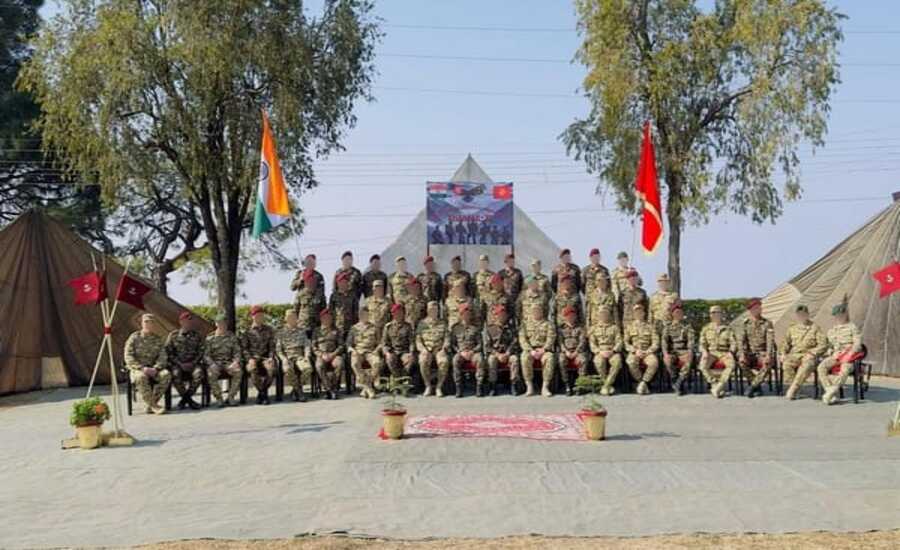
Misamari, Assam: The India–Kyrgyzstan joint military exercise KHANJAR officially began today at Misamari in Sonitpur district of Assam. Exercise KHANJAR-XIII is scheduled to run for 14 days, concluding on February 17.
The primary focus of this year’s edition is to enhance interoperability, urban warfare skills, and counter-terrorism coordination between the Special Forces of both nations under the United Nations mandate.
What Is Exercise KHANJAR?
Exercise KHANJAR is an annual military training exercise jointly conducted by India and the Kyrgyz Republic since 2011. The word Khanjar means dagger, symbolizing precision and joint military strength. It brings together elite troops to train on complex combat scenarios that include urban warfare, counter-terrorism operations, and specialised tactical drills.
Read also: Explained: Why India Is Acquiring 382.82 Acres in Assam for Tezpur Air Force Station
Each edition alternates between the two countries, reflecting deepening defence cooperation and sustained strategic engagement. The 12th edition took place in March 2025 in Kyrgyzstan, focusing on sniping, building interventions, mountain craft, and high-altitude combat training.
Where Is the 2026 Exercise KHANJAR Being Held?
This year’s KHANJAR-XIII exercise is being held at Misamari, a military training area in Assam. The venue offers diverse terrain suitable for urban warfare simulations and advanced military drills. Assam’s strategic location near international borders provides ideal ground for rigorous joint training exercises.
Focus Areas of the Training
Participating troops, including India’s elite Parachute Regiment (Special Forces) and Kyrgyzstan’s Scorpion Brigade, will undergo intensive training in these key areas:
- Urban warfare simulations — Tactical services for built-up areas including raids, close-quarters combat, and coordination under stress.
- Counter-terrorism drills — Practice in modern techniques required to deter and neutralise terror threats.
- Advanced weapons and tactics — Skills such as sniping, room intervention, complex building clearance, and rapid extraction.
- Mountain craft and endurance training — Preparedness for high-altitude deployment and survival operations.
These training modules are geared not just toward combat excellence but also towards strengthening joint planning, communication, and maneuver execution between the two nations.
Importance of Exercise KHANJAR
Joint military exercises like KHANJAR are not just tactical drills; they are strategic signals of cooperation and mutual trust. Here’s why Exercise KHANJAR carries importance:
- Strengthening defence ties — Deepens military cooperation and builds stronger bilateral relations between India and Kyrgyzstan.
- Shared learning and interoperability — Both forces learn from each other’s doctrine, technology, and field tactics.
- Facing global threats together — The exercises address modern security concerns like terrorism, insurgency, and regional instability.
- UN-mandated training relevance — Conducted under frameworks aligned with United Nations peacekeeping and conflict stability operations.
A Look Back at Previous Editions
Since its inception over a decade ago, Exercise KHANJAR has evolved into a key annual defence engagement. The previous (12th) edition was hosted in Kyrgyzstan’s Tokmok and featured joint training on urban warfare, counter-terrorism, and high-altitude operations. It also included cultural exchanges, strengthening military bonds and people-to-people understanding.
Both sides believe that this continuous cooperation uplifts strategic relations and enhances regional security frameworks.