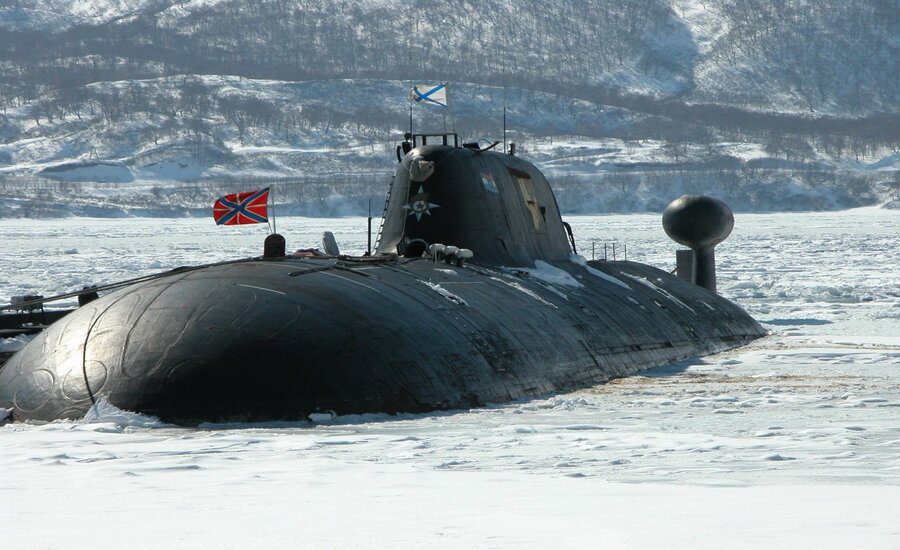
New Delhi: In a bold — and controversial — move, the Indian Navy is set to lease a 36-year-old Russian nuclear submarine, K-391 Bratsk, to be rechristened as INS Chakra III. The decision comes despite significant technical challenges, ageing hardware, and persistent diplomatic pressure from the United States.
The lease deal — reportedly worth around US$ 2 billion (₹18,000 crore) over a 10-year period — is aimed at fast-tracking India’s undersea warfare capabilities.
Supporters regard INS Chakra III as an “old but deadly” stopgap — a way to boost India’s naval strength quickly while domestic submarine programs mature. Critics question the wisdom of investing billions in a vessel long declared “beyond restoration.”
Historical Background of K-391 Bratsk or INS Chakra III
India’s partnership with Russia (and formerly the Soviet Union) in the domain of submarine leasing is long-standing. Decades ago, the Indian Navy had leased nuclear-powered submarines to train crews and gain operational experience under the sea.
The rationale was clear; building nuclear-powered submarines indigenously is complex, time-consuming, and expensive. Leasing offered a cost-effective interim solution, one that gave India access to advanced submarine technology without waiting for its own programs to fully mature.
The 2019 Lease Agreement of INS Chakra III
The current agreement traces its roots to a 2019 contract between India and Russia under which New Delhi would lease a Russian nuclear submarine. The vessel in question, as revealed later, is K-391 Bratsk.
Initially, there had been talks of delivery between 2025 and 2035, and even a higher contract value (some media reports suggested up to US$ 3 billion). However, that broader agreement was never delivered, and the plan stalled.
What Is K-391 Bratsk or INS Chakra III? — The Vessel’s Age, Condition, and History
Class & Origin: K-391 Bratsk belongs to the Shchuka-B class (NATO designation: Akula-class), a Soviet-era class of nuclear-powered attack submarines built from the mid-1980s onward. Bratsk was commissioned in 1989.
Decommissioning: The submarine was removed from active service in 1998. In 2003, it was sent to a repair center in Kamchatka.
Repair Attempts & Abandonment: Work stalled for years due to limited funds and inadequate repair infrastructure. By 2013, the submarine was transferred to a more competent ship-repair facility — the Zvezdochka Ship Repair Centre in Severodvinsk — but even there, progress remained minimal. Ultimately, by 2022, Russia declared the submarine beyond practical restoration.
Revival for India? Despite this bleak history, in early 2024 Moscow reportedly revived plans to refurbish and modernize Bratsk specifically for India under a new upgrade programme designated Project 09718.
The Upgrade Plan: Ambitions vs Engineering Reality
What India Wants: Vertical Launch Systems & Advanced Missiles: Under Project 09718, K-391 Bratsk is slated to be upgraded — not just restored. The plan reportedly involves installing vertical launch systems (VLS) to allow the submarine to fire advanced missiles such as the BrahMos missile (a joint India–Russia cruise missile) — or even newer Russian missiles like the Kalibr missile or the hypersonic Zircon missile.
This would be a transformative change: from a Cold-War-era attack submarine with torpedoes to a modern, missile-capable underwater strike platform.
The Engineering Challenge: From Torpedoes to VLS: But the original design of Shchuka-B submarines — including Bratsk — did not include VLS. Instead, the submarine carries eight torpedo tubes (four 533 mm, four 650 mm), which can launch torpedoes (like Type 65 and its variants) and certain cruise missiles compatible with torpedo tubes (e.g., Kalibr).
Installing vertical launch capability implies major structural redesign; retrofitting the hull, integrating new launch infrastructure, and accommodating the unique stresses of missile launches. That is likely why handover and delivery are slated for 2028 — giving time for the extensive refit.
Uncertainties Remain: What Weapons Can Bratsk Actually Carry?
It is unclear whether BrahMos (or Oniks-derived) missiles can be deployed from the refitted Bratsk; Russian reports mention Kalibr missiles for Shchuka-B upgrades, but not necessarily BrahMos.
While Kalibr missiles (and possibly Zircon) might be technically feasible after refit, the small warhead size of Zircon (around 100–150 kg) limits its effectiveness against larger warships.
Given the submarine’s age and long dormant period, bringing it back into operational condition — nuclear reactor systems, stealth capabilities, hull integrity — will likely be arduous and risky.
In essence, the upgrade plan is bold, but it rests on an engineering gamble: resurrecting an old submarine and expecting it to perform like a modern one.
Strategic and Geopolitical Rationale of INS Chakra III for India
- One of the main motivations behind leasing Bratsk is to fill a capability gap. The Indian Navy currently lacks a robust fleet of nuclear-powered attack submarines (SSNs), which are vital for undersea warfare — especially in a region where maritime competitors are expanding their reach. By leasing INS Chakra III, India can rapidly deploy an SSN — not a bespoke one built from scratch, but a proven platform (once refurbished) — saving years of waiting and resources.
- Leased nuclear submarines serve as training platforms: they allow Indian submarine crews to gain real operational experience in handling nuclear reactors, stealth operations, missile launches, deep-sea navigation, and more — crucial know-how for future indigenous submarines.
- Furthermore, having an operational SSN — even if leased — boosts India’s undersea deterrence posture, particularly relevant given growing Pakistani and Chinese maritime capabilities in the Indian Ocean region.
- At US$ 2 billion for a 10-year lease — even including refit costs — the option seems cost-effective compared to the financial and time costs of designing, building, and commissioning a new SSN from scratch. It gives India a quicker return on strategic investment.
Key Risks, Concerns & Diplomatic Headwinds of INS Chakra III
Aging Hardware: Bratsk was built in 1989 and has spent decades out of service. Even after refit, there are serious questions about hull integrity, reactor safety, and reliability under operational stress.
Engineering Challenges: Retrofitting VLS into a torpedo-tube design is not trivial; failure could lead to delays, cost overruns, or even project cancellation.
Limited Weapon Compatibility: There’s no guarantee that BrahMos or more advanced missiles will be deployable from the submarine. Even if Kalibr or Zircon are used, limitations in warhead size or performance remain.
Strategic Credibility — Perception vs Reality
An underperforming SSN could harm India’s strategic credibility. Leasing an old Russian submarine and claiming enhanced deterrence might not impress adversaries if the vessel fails to meet expectations.
Diplomatic Pressure — US & Sanctions Risk
The lease and upgrade deal comes under the purview of Countering America’s Adversaries Through Sanctions Act (CAATSA), which penalises countries acquiring major military hardware from Russia.
Although historically the United States has avoided sanctioning India in similar cases — possibly due to strategic tolerance or geopolitics — moving ahead with this lease may still strain Indo-US relations, especially at a time when India is trying to nurture deeper ties with the West.
Official Pushback and Public Messaging Confusion
The deal has already generated confusion. While several media outlets reported a fresh US$ 2 billion submarine purchase, the government later clarified that no new agreement had been signed; the lease merely stems from the existing 2019 contract, and delivery is now scheduled for 2028.
This discrepancy raises concerns about transparency, public communication, and the perceived legitimacy of the procurement process.
Broader Implications of INS Chakra III for India’s Naval Future
Bridge to Indigenous SSNs: INS Chakra III could serve as a bridge — giving time, experience, and tactical advantage until India’s own nuclear submarine programme matures.
Signalling Message to Regional Rivals: Leasing and modernising a nuclear submarine — even an older one — sends a strong strategic message to countries like China and Pakistan about India’s intent to project undersea power in the Indian Ocean.
Dependence on Russia Continues: The deal underscores that until India can reliably build and maintain indigenous SSNs, it remains dependent on Russia — with all the geopolitical baggage that entails.
Balancing Act Between East and West: With growing security ties to Western nations (including the US), the move reflects India’s careful balancing act — continuing traditional ties with Russia while engaging newer partners. But such balancing comes with growing diplomatic complexity.