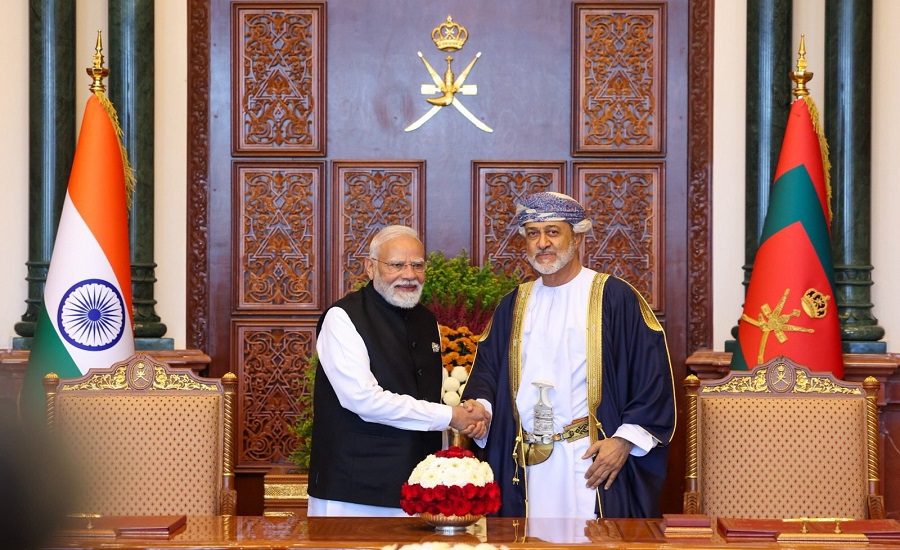
New Delhi: India and Oman on Thursday signed a landmark Comprehensive Economic Partnership Agreement (CEPA), marking a major step forward in strengthening their bilateral Strategic Partnership. The agreement was inked as Prime Minister Narendra Modi held extensive talks with Sultan Haitham bin Tarik in Muscat, focusing on deepening cooperation across multiple sectors.
High-Level Talks in Muscat
Prime Minister Modi, who arrived in Oman on Wednesday on the final leg of his three-nation tour, was received by Sultan Haitham at the Al Baraka Palace. During their meeting, both leaders discussed ways to further enhance the India–Oman Strategic Partnership, according to Ministry of External Affairs (MEA) spokesperson Randhir Jaiswal.
The discussions covered a wide range of areas, including defence and security, trade and investment, energy, agriculture, technology, emerging sectors, culture, and people-to-people exchanges. Regional and global developments of mutual interest were also part of the dialogue.
70 Years of Diplomatic Relations
The two leaders highlighted the significance of 70 years of diplomatic relations between India and Oman, describing it as a historic milestone that reflects the depth, trust, and continuity of ties between the two nations.
CEPA: A Milestone Agreement
Welcoming the signing of the CEPA, both sides termed it a milestone in bilateral relations that would significantly strengthen the strategic partnership. The agreement was signed by Union Commerce and Industry Minister Piyush Goyal and Oman’s Minister of Commerce, Industry and Investment Promotion, Qais bin Mohammed Al Yousef.
The pact is expected to improve market access, promote bilateral investments, and enhance cooperation across key sectors, while supporting trade diversification and supply chain resilience amid global economic changes.
Notably, this is Oman’s second free trade agreement with an individual country and its first such pact in nearly two decades.
Boost to Trade, Investment and Jobs
Prime Minister Modi said the CEPA would infuse new confidence and energy into India–Oman relations. Echoing this, the MEA described the agreement as the beginning of a “new chapter” in bilateral economic ties.
The agreement is expected to increase trade flows, attract investments, catalyse economic diversification, and generate employment in both countries. “For people, CEPA means more jobs, better market access for businesses, stronger supply chains and greater economic opportunities on both sides,” Jaiswal said.
India’s Expanding FTA Network
In recent years, India has signed several free trade agreements that are delivering benefits to farmers, traders and exporters. These include agreements with the UK (2025), EFTA (2024), Australia (2022), the UAE (2022) and Mauritius (2021). Officials said this growing network reflects India’s forward-looking trade strategy focused on resilience, diversification and mutually beneficial growth.
Strong Trade Linkages
Oman is India’s third-largest export destination among GCC countries. Bilateral trade between the two nations stood at about USD 10.5 billion in 2024–25, with Indian exports valued at USD 4 billion and imports at USD 6.54 billion.
India’s key imports from Oman include petroleum products and urea, accounting for over 70 per cent of total imports, along with polymers, pet coke, gypsum, chemicals, iron and steel, and unwrought aluminium. Major Indian exports to Oman include mineral fuels, chemicals, precious metals, iron and steel, cereals, ships, electrical machinery, tea, spices, apparel and food products.
Significance of the Visit
Prime Minister Modi is visiting Oman at the invitation of Sultan Haitham, marking his second visit to the Gulf nation. The visit is particularly significant as it coincides with the 70th anniversary of the establishment of diplomatic relations between India and Oman. The Prime Minister arrived in Muscat after completing visits to Ethiopia and Jordan as part of his three-nation tour.