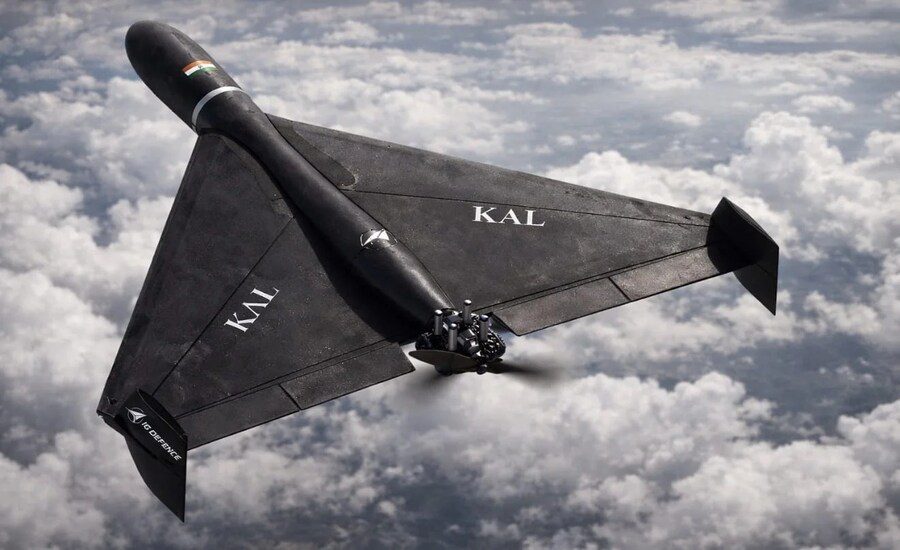
New Delhi: India has taken a significant step in strengthening its indigenous defence technology with the unveiling of Project KAL, a long-range strike drone being developed by IG Defence. The Project KAL drone is designed as a deep-penetration unmanned combat platform capable of carrying out precision strikes on strategic targets far beyond the frontline.
With a projected range of up to 1,000 kilometres and endurance of three to five hours, the Project KAL drone aims to enhance India’s long-range unmanned warfare capabilities. The initiative also aligns with the government’s broader Aatmanirbhar Bharat (self-reliant India) push in defence manufacturing and advanced military technologies.
What is Project KAL?
Project KAL is an indigenous long-range one-way strike drone being developed by the Indian defence technology company IG Defence.
The drone is designed to travel deep into contested territories, locate high-value targets and strike them with precision using an explosive payload.
According to initial information shared by the company, the project aims to develop a cost-effective unmanned strike platform that can operate far beyond frontline combat zones and carry out strategic missions without risking pilots.
The unveiling of the drone marks India’s entry into a category of long-range loitering strike systems that are increasingly shaping modern warfare.
Key Features of the Project KAL Drone
Here are the key features of Project KAL;
1. Long Operational Range
One of the most important capabilities of the Project KAL drone is its long operational reach.
- KAL Range: Up to 1,000 km
- Endurance: Around 3–5 hours
This allows the drone to travel deep into enemy territory and strike strategic targets with precision.
2. One-Way Strike Drone Design
The drone is designed as a one-way attack UAV, often referred to as a loitering munition.
In this concept:
- The drone carries an explosive payload.
- It travels to the target area.
- It identifies the target and crashes into it to destroy it.
This design is similar to modern strike drones used globally in recent conflicts.
3. Capability to Hit High-Value Targets
The Project KAL drone is expected to target critical military infrastructure such as:
- Radar installations
- Logistics hubs
- Strategic military facilities
- Other high-value operational assets
Such targets are essential for disrupting enemy command and supply networks during a conflict.
Why Does India Need Long-Range Strike Drones
In modern warfare, unmanned systems are becoming increasingly important.
Recent conflicts across the world have shown that long-range strike drones can:
- Penetrate deep into enemy territory
- Reduce risk to human pilots
- Conduct precision strikes at lower cost
- Overwhelm air defence systems when deployed in large numbers
Because they are relatively inexpensive compared to missiles or fighter jets, they can create a cost advantage during prolonged conflicts.
How Project KAL Supports India’s Defence Strategy
Project KAL fits into India’s broader strategy to strengthen domestic defence capabilities and reduce reliance on imported systems.
Key strategic benefits include:
1. Indigenous Defence Development: The project supports India’s Make-in-India and Aatmanirbhar Bharat initiatives in defence technology.
2. Enhanced Deep-Strike Capability: It gives India the ability to conduct long-range precision strikes without risking pilots.
3. Future Drone Warfare Readiness: With unmanned systems playing a major role in modern conflicts, the development of such drones prepares India for next-generation warfare scenarios.