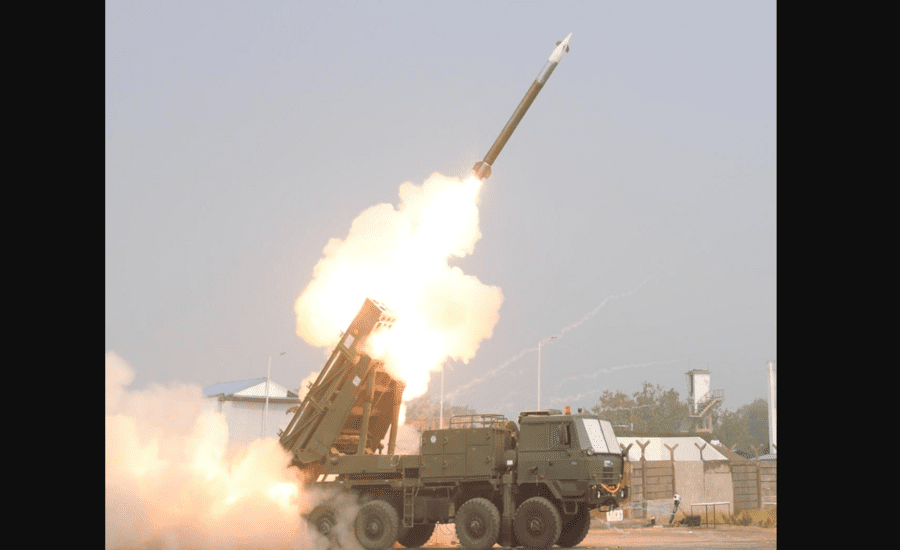
New Delhi: In a major stride for India’s defence industrial ecosystem and frontline artillery firepower, Larsen & Toubro (L&T) — one of India’s largest engineering and defence manufacturing conglomerates — has secured a key contract from the Indian Army to overhaul, upgrade and sustain the indigenous Pinaka Multi-Rocket Launcher System (MRLS).
The initiative is aimed at enhancing long-term operational readiness and combat effectiveness of rocket artillery units deployed along critical fronts.
This defence contract, awarded by the Corps of Electronics and Mechanical Engineers (EME) of the Indian Army, marks a significant pivot in the way the Army maintains and modernises ageing artillery assets.
What is the Importance of Indian Army–L&T Pinaka Upgrade Deal
The Pinaka MRLS is a cornerstone of India’s artillery strategy — designed and developed under the Defence Research and Development Organisation (DRDO) and manufactured domestically with major participation by L&T and Tata Advanced Systems.
Read also: Explained: What Are Solar-Powered Spy Drones and Why Is the Indian Army Deploying Them Now?
Unlike typical procurement deals that focus on acquiring new systems, this contract emphasizes sustenance, obsolescence management and capability enhancement of systems already in service.
This approach ensures that artillery assets remain technologically relevant and mission-ready in the long term.
Boosting Artillery Firepower & Operational Readiness
The Pinaka MRLS is an integral part of the Indian Army’s artillery deterrence capability — capable of delivering massive volumes of fire at short notice and crucial in area saturation and deep strike roles.
Earlier versions of the system delivered rocket salvos out to ranges of ~38 km, while more advanced guided variants now exceed ranges up to 120 km — significantly expanding tactical flexibility on the battlefield.
Maintaining such a crucial asset in operational condition with modern electronics and systems enhances readiness along India’s vast geostrategic fronts, including the Northern borders with China and Western frontier zones. Recent defence planning has prioritised artillery modernisation alongside futuristic capabilities such as long-range howitzers and drones, underscoring the Army’s evolving combat doctrine.
Major Highlights of the Indian Army–L&T Pinaka Upgrade Deal
- Replacement of obsolete electronics and systems with modern components
- Retrofit and modernisation of subsystems for enhanced reliability
- Structured, lifecycle-based maintenance framework versus older reactive repairs
- Sustained technical support from L&T’s defence engineering teams
This contractual framework signals a shift toward collaborative maintenance models between the Indian Army and private OEMs (Original Equipment Manufacturers), a trend expected to cascade into other Indian defence platforms as well.
Execution Strategy: Public-Private Collaboration
The execution of the Pinaka upgrade programme will follow a phased, collaborative model:
Phase 1 — Pilot Overhaul
L&T will jointly with the Army’s 510 Army Base Workshop (ABW) undertake a pilot overhaul of one Pinaka launcher and its associated Battery Command Post. This will test the upgrade procedures, interoperability and logistics workflow under real-world conditions.
Phase 2 — Main Execution
On successful completion of the pilot phase, the remaining Pinaka systems will be overhauled and upgraded by the Army’s technical units at 510 ABW, drawing on domain expertise from both Army personnel and L&T engineers.
L&T will continue to provide critical spares, technical oversight and quality assurance throughout the lifecycle.
This co-execution model not only enhances capacity within the Army’s own workshops but also deepens public-private synergy in defence sustainment — a key tenet of the government’s long-term strategy.