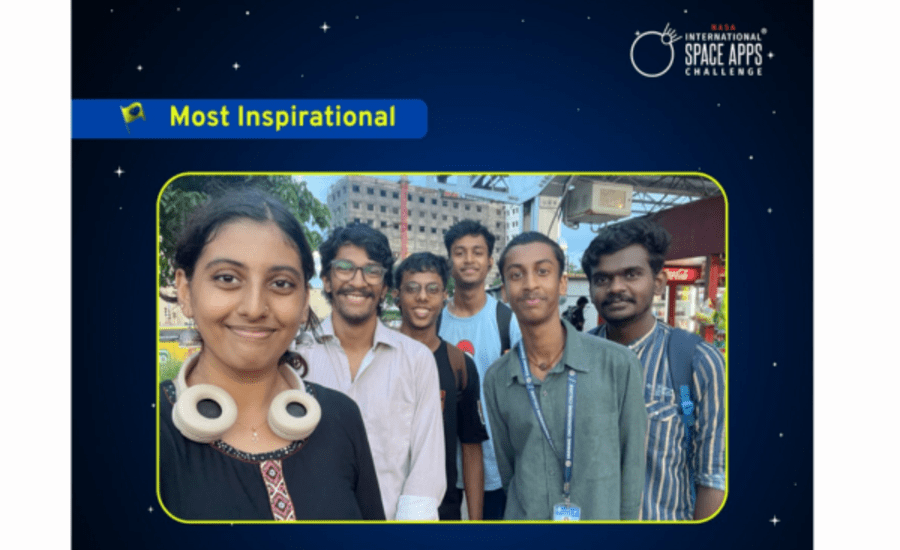
New Delhi; India has once again demonstrated its growing prowess in space technology and digital innovation as an Indian team’s satellite internet concept secured a top global honour at the NASA Space Apps Challenge 2025, one of the world’s largest and most prestigious innovation hackathons.
The Chennai-based team Photonics Odyssey emerged as a global winner, receiving the “Most Inspirational Award” for their forward-looking proposal aimed at expanding broadband connectivity across remote and underserved regions of India.
This achievement highlights India’s expanding footprint in global science, technology, engineering, and mathematics (STEM) innovation, particularly in the space and satellite communications domain.
What is NASA Space Apps Challenge 2025
The NASA International Space Apps Challenge is an annual global hackathon organised by NASA to encourage collaborative problem-solving using open-source data provided by space agencies.
Key Facts About the NASA Space Apps Challenge 2025 Edition
- Participation from over 114,000 innovators
- Events held across 500+ locations
- Representation from 167 countries and territories
- One of the largest collaborative STEM platforms globally
Since its launch in 2012, the challenge has grown into a powerful ecosystem fostering innovation, entrepreneurship, and real-world problem-solving using space science and technology.
The Winning Indian Concept: A Vision for Universal Connectivity
The award-winning proposal presented by Photonics Odyssey focuses on developing a sovereign, phased-array satellite internet infrastructure designed specifically for India’s geographical and demographic challenges.
Core Objectives of the Project
- Expand broadband access to remote and rural regions
- Reduce dependency on terrestrial internet infrastructure
- Improve resilience during natural disasters and emergencies
- Enable inclusive digital growth across India
According to estimates cited during the challenge, more than 700 million people in India still lack reliable broadband access, particularly in rural, hilly, tribal, and geographically isolated areas.
How the Satellite Internet System Works
The concept leverages phased-array satellite technology, which allows electronic beam steering without mechanical movement.
Read also: India’s Next Telecom Leap: TEC-IIT Bombay MoU to Drive 6G, Satellite & Open-RAN Innovations in India
This technology offers several advantages over conventional satellite systems:
- Faster signal acquisition
- Lower latency
- Higher reliability
- Better scalability for large populations
By deploying an indigenous satellite-based broadband network, the project envisions last-mile connectivity even in regions where fibre and mobile networks remain economically or geographically unviable.
NASA Space Apps Challenge 2025: Meet the Team Behind the Innovation
The winning team members, as acknowledged by NASA Space Apps 2025 include:
- Manish D. M.
- K. Prasanth G.
- Rajalingam N.
- Rashi M.
- Sakthika R.
Their interdisciplinary approach combined expertise in photonics, satellite communications, systems design, and problem-solving — a key factor behind their global recognition.
Global Recognition for Indian Innovation
NASA highlighted that Indian-American students and participants of Indian origin featured prominently among the winners, reflecting the strong global presence of Indian talent in cutting-edge technological innovation.
This recognition not only celebrates a single project but also symbolises India’s broader innovation ecosystem, which increasingly contributes solutions to global challenges.