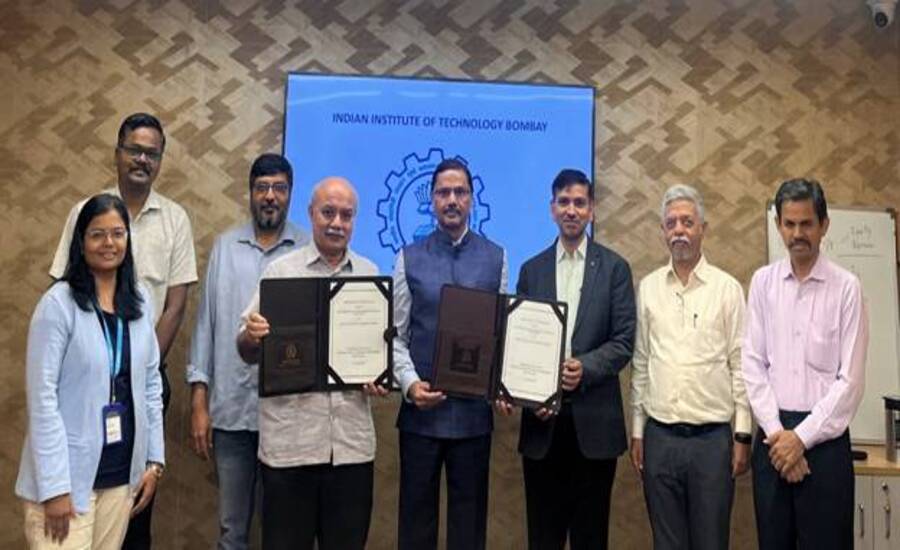
New Delhi: In a decisive move to bolster India’s leadership in next-generation telecommunications, the Telecommunication Engineering Centre (TEC) under the Department of Telecommunications, Ministry of Communications, has signed a pivotal Memorandum of Understanding (MoU) with the IIT Bombay.
The collaboration emphasises research, technical contributions, and standardisation activities with a keen focus on emerging domains such as 6G, artificial intelligence in networks, open interfaces and non-terrestrial satellite links.
Background of the Story
TEC serves as the technical arm of the DoT, tasked with formulating telecom standards, specifications, and conformity assessment for equipment and networks in India. Its role extends to representing India in global standardisation platforms such as the International Telecommunication Union-T sector (ITU-T) and similar forums.
Read also: Where Does India Stand In Using AI For Public Service & Delivery
On the other hand, IIT Bombay stands as a premier academic and research institute with strong credentials in communications, network-systems, AI and emerging technology. The MoU thus pairs regulatory/standardisation authority with academic research excellence.
Details of the MoU
The MoU was formalised recently between TEC and IIT Bombay, signalling the start of a structured collaboration to jointly undertake studies, technical contributions and standardisation efforts in telecom technologies.
Key areas of collaboration include:
- Research into future network architectures including 6G.
- AI-driven telecom networks and associated protocols and signalling.
- Satellite communications, non-terrestrial networks (NTNs), and integration with terrestrial systems.
- Open RAN (Radio Access Network) frameworks, open interfaces, network disaggregation.
- India-specific standards and test-frameworks to support indigenous telecom manufacturing and deployment.
- Strengthening India’s engagement and influence in global telecom standardisation bodies.
The TEC IIT Bombay MoU is not just a research tie-up—it’s a strategic step to accelerate India’s “Atmanirbhar Bharat” vision in telecom, reducing dependence on imports, and positioning India to actively shape global telecom standards.
Importance of TEC IIT Bombay MoU for India’s Telecom Ecosystem
Future-Ready Technology: With 5G already in rollout, India must gear up for 6G and next-gen networks. This partnership brings academia and standards bodies together to research enabling technologies in advance.
Global Influence: By contributing to standards for 6G, AI-networks, NTNs etc., India can shape how global telecom evolves — not just follow it.
Indigenous Innovation: Developing India-specific standards and test frameworks helps local manufacturers, avoids lock-in on foreign technology, and strengthens supply-chain resilience.
Satellite + Terrestrial Integration: As more networks involve satellite links, HAPS (High Altitude Platform Systems), non-terrestrial networks, the ability to integrate terrestrial + satellite is a strategic asset.
Open RAN Emphasis: Open-interfaces and disaggregated networks help diversify equipment vendors, reduce dependency and promote innovation in a competitive ecosystem.
Health & Safety Compliance: Research on signaling protocols, exposure (for example Specific Absorption Rate or SAR) frameworks and health impacts underscores that telecom growth must be safe, compliant and sustainable.
What to Watch For
- Joint research labs or centres of excellence set up under this MoU.
- Publication of India-specific standards or test frameworks emerging from this collaboration.
- India’s increased contribution or leadership in global standardisation bodies (3GPP, ITU-T, etc.).
- Product-and-equipment certification regimes aligned to this collaboration, enabling “Made in India” telecom gear.
- Advances in non-terrestrial networks (satellite + terrestrial) deployment in India with contribution from this partnership.
- Open RAN ecosystem maturation in India, driven by this joint R&D.