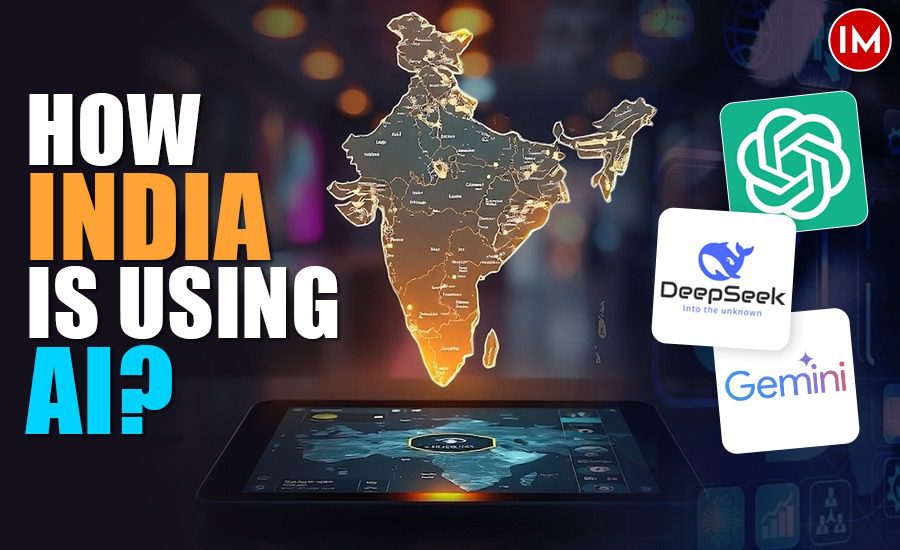
Frequent cyber attacks on government installations and incessant cyber frauds being played on innocent citizen through deep fakes and voice modulators notwithstanding, India is going ahead with its own AI (Artificial Intelligence) model. Today we are using AI in almost every sphere of public life, improving ease of doing business, transforming governance, enhancing efficiency, transparency, and public service delivery while raising important ethical and regulatory questions.
Speaker of House of Commons in Britain, Sir Linday Hoyle’s statement that British Parliament can benefit from India’s experiment of using AI in parliamentary practices, could be an eye opener for rest of the world. Indian Parliament uses AI in simultaneous translation of parliamentarian’s speeches in 22 languages. Let us have a glimpse of AI’s use in public life in the country and challenges it is facing on this front.
PUBLIC SERVICE DELIVERY
Today AI-powered chatbots like MyGov’s AI Assistant handle citizen queries, process grievances, and streamline applications for schemes like pensions, subsidies, and Aadhaar updates. Platforms like CPGRAMS (Centralized Public Grievance Redress and Monitoring System) use AI to categorize and prioritize complaints, reducing resolution times. AI also analyses data to predict service demands in different field like healthcare needs during monsoons and allocate resources proactively.
India is also using AI for crop yield prediction by using tools like IBM’s Watson and Microsoft’s AI for Earth to analyse weather, soil, and satellite data and to advise farmers on planting and pest control. AI cross-references land records and Aadhaar data to eliminate fraudulent subsidy claims, ensuring direct benefit transfers to farmers under PM-KISAN Scheme. Platforms like CropIn and Ninjacart are agri-tech startups using AI to connect farmers with markets and optimize supply chains.
During COVID-19, AI models tracked infection hotspots and predicted case surges. Apps like Aarogya Setu used AI for contact tracing. Startups like Niramai for breast cancer screening and Qure.ai for TB detection deploy AI to interpret X-rays and scans in rural areas with limited specialists. AI-driven health IDs and telemedicine platforms as part of National Digital Health Mission (NDHM) improve access to care in remote regions.
AI IN ADMINISTRATION
States like Delhi and Maharashtra have already been using AI to analyse crime patterns and deploy police resources effectively. Systems like AFRS (Automated Facial Recognition System) aid in identifying criminals and missing persons, though privacy concerns persist. It was due to use of AI by Mumbai police, the attacker of Bollywood actor Saif Ali Khan was identified and apprehended within 48 hours of the crime. Uttar Pradesh police too has used AI effectively in crowd control during 2025 Maha-Kumbh and in managing rapid response helpline like 108.
AI-powered drones and cameras have been monitoring sensitive India-China LAC, Indo-Myanmar and Indo-Pakistan borders for intrusions and to detect cross-border smuggling of cattle, drugs and weapons.
Cities like Bengaluru and Hyderabad use AI to optimize traffic signals and reduce congestion. AI models predict floods (e.g., Assam’s flood alerts) and earthquakes, enabling timely evacuations. That is the reason why states are able to reduce fatalities during catastrophe like cyclones and Tsunami.
FINANCIAL MODELS
The Income Tax Department uses AI to flag discrepancies in filings and curb tax evasion while Banks have been using AI to deciding loan applications. UPI platforms like Paytm, PhonePe too have been using AI to detect real-time payment frauds and money laundering. Startups like Lendingkart use alternative data like mobile usage, social media to assess creditworthiness for unbanked populations.
Platforms like DIKSHA and Byju’s use AI to tailor educational content to students’ learning paces. The National Skill Development Corporation (NSDC) employs AI to identify skill gaps and align training programs with job market demands.
RISKS INVOLED
Despite Digital Personal Data Protection Act, 2023 lack of robust data protection laws raises risks of misuse. Supreme Court’s order not to make Aadhar mandatory, the Aadhar number has become passport to almost all government services, igniting fears of its misuse by vested interests. Since lot of government services like PAN and bank accounts are linked to Aadhar, lot of people are being fleeced by fraudsters every day using data sourced from agencies using Aadhar information.
With only 45 per cent of India’s population – mostly from rural India – having internet access marginalized groups are largely from AI benefits thus creating an irreparable digital divide. There is also an apprehension that systems trained on skewed datasets may reinforce caste, gender, or regional disparities.
Automation in sectors like agriculture and manufacturing could worsen unemployment. India’s 80 per cent population is still working into these sectors thereby facing a grave danger of not landing a job and also losing a job to those who already one.
GOVT INITIATIVES TO PROMOTE AI
NITI Aayog released the National Strategy for Artificial Intelligence (NSAI) in June 2018 which highlighted the AI potential in boosting India’s annual growth rate by 1.3 percent by 2035. It also identified priority sectors for the deployment of AI with Government’s support Healthcare, Agriculture, Education, Smart Cities and Mobility.
NSAI also emphasized on four broad recommendations in supporting and nurturing an AI ecosystem in India – promotion of research, skilling and reskilling of the workforce, facilitating adoption of AI solutions; and the development of guidelines for ‘responsible AI’.
The government has launched a Rs 10,372 crore initiative in 2024 called IndiaAI Mission to build AI compute infrastructure, datasets, and startups. A supercomputing platform AIRAWAT (AI Research, Analytics, and Knowledge Assimilation Platform) too has been launched for public-sector AI innovation.
WAY AHEAD
The government needs to balance innovation with ethical safeguards to ensure AI accountability frameworks. We also need to developing AI tools in Indian languages to bridge linguistic gaps. India aims to position itself as a leader in AI for Good, exporting solutions to developing nations.
However, despite being the third largest economy and world’s most populous country, we are nowhere near being an AI-giant like USA or China. India needs to increase its AI pace to be the world leader in ethical AI ensuring at the same time that it is used only for the good of the people, not for harming them.
The Union Minister for IT, Mr Ashwini Vaishnav has announced that India is working to bring in its own AI Chatbot like ChatGPT or DeepSeek. The government is also significantly boosting its computing power by empanelling nearly double the initially planned Graphics Processing Units (GPUs) for AI development.
The country already has empanelled 18,693 GPUs, 12,896 Nvidia H100s and 1,480 Nvidia H200s, some of the most powerful GPUs available, he announced. Considering that DeepSeek was trained on just 2,000 GPUs that too imported by China three years ago, this is a robust configuration. But, training them into a Chatbot might still take some time.