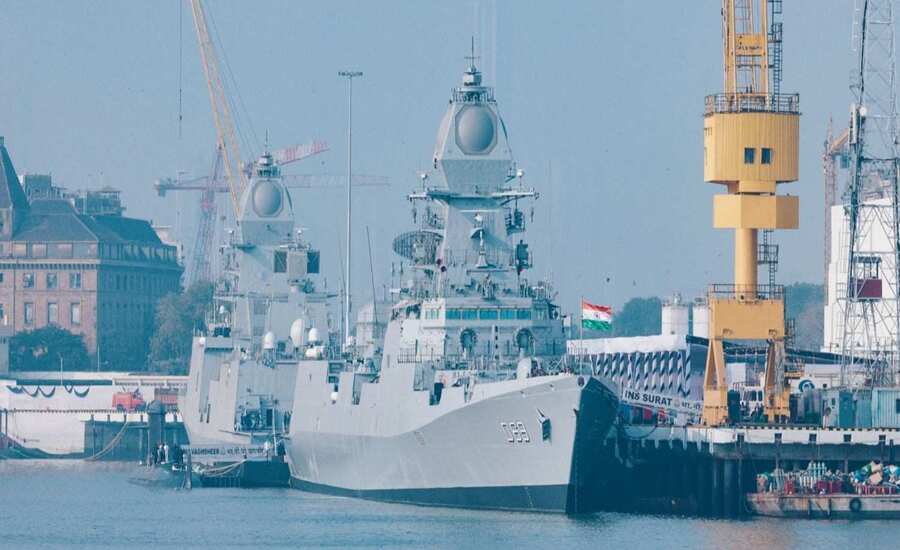
New Delhi: INS Surat AI-enabled warship has marked a major milestone in Indian defence history, entering active operational deployment during Operation Sindoor with artificial intelligence (AI)-driven systems in real combat.
This advanced destroyer’s performance demonstrates India’s leap from theoretical AI research to frontline application, enhancing decision-making speed and accuracy under live conditions in the Arabian Sea.
Background of INS Surat AI-enabled Warship
The Indian Navy’s latest destroyer, INS Surat, has become the first warship in Indian service designed with built-in support for AI and machine learning (ML) systems. Commissioned in January 2025, this stealth guided-missile destroyer integrates cutting-edge autonomous systems for surveillance, sensor fusion, threat evaluation, and real-time decision support.
Unlike traditional warships where data interpretation relies heavily on human operators, INS Surat’s AI platforms can filter large volumes of sensor inputs and recommend actionable options to commanders promptly. This shift boosts operational efficiency, especially in dynamic environments where swift decisions are vital.
Operational Debut of INS Surat AI-enabled Warship
In Operation Sindoor, conducted in the Arabian Sea, INS Surat deployed its AI capabilities in a dynamic naval theatre. Commanding Officer Captain Sandeep Shorey confirmed the vessel’s robust performance in surveillance coordination, threat identification, and tactical assessment—enhanced significantly by AI tools.
The ship’s AI systems processed sensor data from various sources, delivering precise and clear inputs to decision-makers. This proactive data integration allowed faster reaction times and higher situational awareness than previously possible.
Design and Indigenous Innovation
Built under Project 15B by Mazagon Dock Shipbuilders Limited with design input from the Navy Warship Design Bureau, INS Surat weighs around 7,400 tonnes and can reach speeds nearing 30 knots during extended missions.
Named after the historic port city of Surat in Gujarat, the destroyer reflects India’s emphasis on self-reliance in defence manufacturing, with roughly 75% indigenous components. These include not only conventional hardware but also AI-driven combat and navigation systems, aligning with the Make in India initiative.
What are the Features of INS Surat AI-enabled Warship
INS Surat’s prowess extends beyond AI. Its sophisticated weapons suite includes:
- BrahMos supersonic cruise missiles for precision strike capabilities.
- Barak-8 surface-to-air missiles for layered air defence.
- Advanced torpedoes and rocket launchers for underwater threats.
- Rapid-fire guns for close-range engagement.
- Twin helicopter bays extending reconnaissance and anti-submarine options.
These systems allow INS Surat to operate effectively across multiple domains—surface, air, and undersea—making it a versatile platform for modern naval warfare.
What is the Significance of INS Surat AI-enabled Warship
INS Surat’s operational success is a landmark for India’s military modernization. It reflects a broader strategic effort to integrate AI into combat assets rather than leaving it confined to trials or policy talk. The live use of AI in warfighting enhances combat readiness, threat response, and coordination under high-pressure scenarios.
This achievement reinforces India’s position as an emerging leader in the use of AI for national defence, showcasing how technological innovation and indigenous engineering can expand strategic influence in the Indian Ocean Region and beyond.