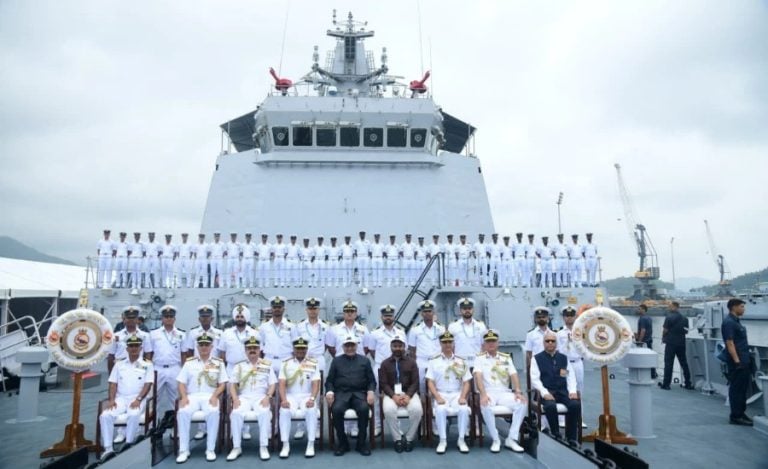
New Delhi: In a landmark development for India’s defence preparedness, the Indian Navy is poised to commission 19 warships in 2026 — the largest force accretion in a single year in its history.
This unprecedented expansion marks a significant milestone in India’s naval modernization plan, driven by advanced indigenous shipbuilding and strategic imperatives amid evolving regional security dynamics.
Details of Indian Navy Fleet Expansion
According to multiple defence reports, the Indian Navy will induct 19 warships throughout 2026, surpassing last year’s tally of 14 vessels.
This aggressive pace reflects both increased production capabilities at Indian shipyards and a concerted government push under strategic programs such as Aatmanirbhar Bharat (Self-Reliant India).
Of these additions, several frontline combatants — including advanced stealth frigates, support vessels, and auxiliary craft — will join the Navy’s fleet, significantly enhancing its operational reach in the Indian Ocean Region (IOR).
Indian Navy Fleet Expansion: Key Warship Inductions Driving Naval Power
Among the high-profile inclusions expected in 2026 are Project 17A Nilgiri-class multi-role stealth frigates such as INS Udaygiri, INS Taragiri, and INS Mahendragiri.
These ships are designed with reduced radar signatures, integrated sensor suites, and potent weapons systems capable of surface, anti-air, and anti-submarine warfare — critical capabilities for high-intensity operations at sea.
The Nilgiri-class frigate program is central to India’s indigenous naval shipbuilding strategy, with multiple units already under construction at major domestic shipyards like Mazagon Dock Shipbuilders Limited (MDL) and Garden Reach Shipbuilders & Engineers (GRSE).
In addition, the 2026 commissioning slate is scheduled to include specialized support ships, such as Nistar-class diving support vessels (DSVs).
These vessels play a crucial role in submarine rescue, deep-sea operations, and extended maritime support missions — an often-overlooked but vital component of blue-water naval strategy.
Importance of Indian Navy Fleet Expansion
This massive fleet augmentation comes amid shifting geopolitical currents in the Indo-Pacific, where regional actors are expanding their naval capabilities.
India’s naval planners have stressed the need to strengthen force projection and deterrence, particularly as maritime security challenges grow in the Indian Ocean and beyond.
Experts point out that sustained shipbuilding outputs — averaging one warship every six weeks — signal not just enhanced capability but also a strategic shift in how India approaches maritime security.
This tempo, expected to continue through 2026, underscores the Navy’s role as a cornerstone of national defence and regional stability.
Indigenous Shipbuilding — A Strategic Advantage
The extraordinary pace of commissioning is a direct reflection of India’s advancing indigenous shipbuilding ecosystem, which has steadily reduced reliance on foreign suppliers.
As India transitions from being a buyer to a builder of complex naval platforms, domestic shipyards have dramatically improved delivery timelines and technological competency.
Government initiatives such as the Aatmanirbhar Bharat defence manufacturing policy have been credited with boosting local production capabilities, incentivizing private sector participation, and securing vital supply chains for the Navy’s long-term procurement programs.
What are the Implications of Indian Navy Fleet Expansion
With these 19 new warships, the Indian Navy is not merely expanding its numbers — it is sharpening its blue-water combat edge.
A larger, technologically advanced fleet will enhance India’s ability to safeguard sea lanes, conduct high-end combat operations, and respond promptly to humanitarian or crisis situations across the Indian Ocean and farther afield.
This strategic buildup is expected to further elevate India’s status as a major maritime power, capable of operating alongside the world’s leading naval forces and contributing more robustly to regional security initiatives and multinational exercises.