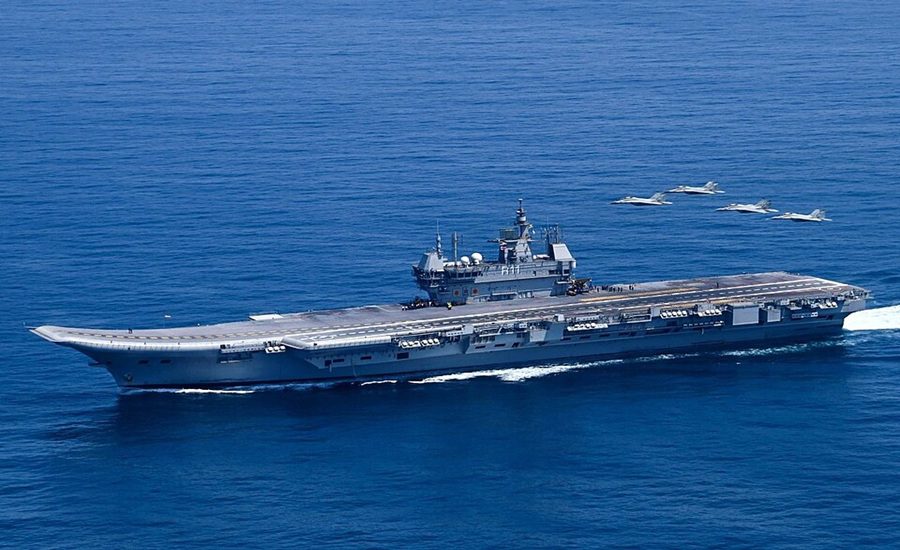
New Delhi: India’s indigenous aircraft carrier has achieved a historic milestone with 1000 successful arrested landings, also known as “traps.” This achievement highlights the growing strength of Indian naval aviation and the operational readiness of the .
The milestone was celebrated by naval personnel aboard the carrier and praised by senior commanders. These 1000 traps demonstrate the carrier’s ability to conduct continuous fighter jet operations—from early morning launches to late-night recoveries—showcasing the professionalism of pilots, deck crews, and the ship’s operational team.
What Does “INS Vikrant 1000 Traps” Mean in Naval Aviation
In aircraft carrier operations, a “trap” refers to a fighter jet landing on the carrier deck using an arrestor wire system.
Unlike normal runways, aircraft carriers have very short landing decks. To stop quickly, the aircraft catches a steel arresting cable with a hook under its tail.
Key points about arrested landings:
- Jets approach the deck at high speed.
- The tailhook catches one of several arrestor wires.
- The aircraft stops within a few seconds.
- If the hook misses the wires, the jet must take off again immediately.
Because this process is extremely demanding, every successful trap represents high skill and precise coordination between pilots and deck crews.
Role of INS Vikrant in India’s Naval Power
INS Vikrant is India’s first indigenously built aircraft carrier and one of the most complex warships ever built in the country.
Key facts:
- Commissioned in 2022
- Built by
- Displacement of about 45,000 tons
- Operates fighter jets like
- Supports helicopters for surveillance and rescue missions
The carrier allows India to project power across the Indian Ocean Region (IOR) and maintain maritime security.
Details of INS Vikrant 1000 Traps
The milestone was acknowledged by Rear Admiral Vivek Dahiya, who serves as Naval Member (NM) of the Flag Officer Commanding Western Fleet (FOCWF).
He congratulated Team Vikrant and all embarked squadrons for achieving the milestone safely.
The Western Naval Command—one of the most operationally active commands of the —is responsible for safeguarding India’s western maritime frontier.
The message emphasized that:
- The achievement reflects teamwork and operational discipline
- It demonstrates combat readiness of the carrier strike group
- It showcases the capability of Indian pilots to perform complex carrier operations
Importance of INS Vikrant 1000 Traps
Reaching 1000 arrested landings is not just a number—it reflects operational maturity.
1. Pilot Training and Skill
Carrier landings are among the most difficult maneuvers in aviation. Achieving 1000 safe traps indicates high training standards.
2. Aircraft Carrier Readiness
Regular flight operations prove that INS Vikrant can sustain combat missions at sea.
3. Strengthening Maritime Security
With growing strategic competition in the Indian Ocean, aircraft carriers provide India with long-range strike and surveillance capability.
4. Indigenous Defence Capability
The success of Vikrant highlights India’s growing self-reliance in defence manufacturing under indigenous shipbuilding programs.
Aircraft Operating From INS Vikrant
Currently, the main fighter jet operating from Vikrant is the .
Capabilities of MiG-29K:
- Carrier-based multirole fighter
- Capable of air superiority and strike missions
- Equipped with advanced radar and missile systems
- Designed for ski-jump take-off and arrested landing
Future carrier operations may also involve next-generation naval fighter aircraft, as India evaluates options for its expanding naval aviation fleet.
Growing Importance of Carrier Operations
Aircraft carriers like INS Vikrant allow a navy to operate air power far away from land bases.
Strategic benefits include:
- Rapid response to maritime threats
- Air cover for naval fleets
- Humanitarian assistance and disaster relief missions
- Protection of sea trade routes
For India, whose trade depends heavily on sea lanes, carriers are a critical strategic asset.