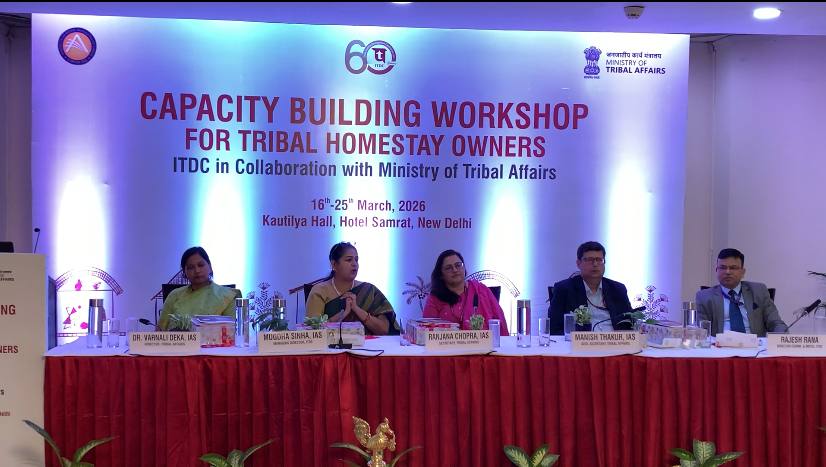
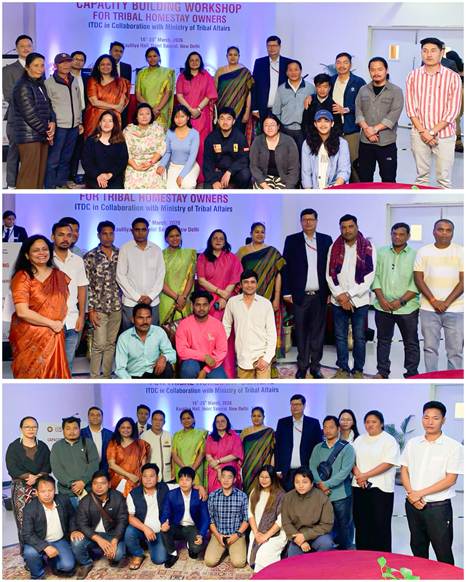
New Delhi: In a major push toward inclusive tourism and sustainable livelihood generation, India Tourism Development Corporation (ITDC), under the Ministry of Tourism, in collaboration with Ministry of Tribal Affairs inaugurated a Capacity Building Programme for Tribal Homestay Owners at Kautilya Hall of Hotel Samrat in New Delhi. The initiative seeks to strengthen community-based tourism by enhancing hospitality standards among tribal homestay operators and creating sustainable livelihood opportunities in tribal regions across India.
The programme marks an important intervention in the government’s broader effort to integrate tribal communities into India’s tourism economy by equipping homestay owners with practical hospitality skills, service standards, and operational knowledge. The first batch includes 40 participants from Arunachal Pradesh, Sikkim and Gujarat, who will undergo structured training conducted by IHM Ashok under ITDC for the Ministry of Tribal Affairs.
Senior Officials Attend Launch Ceremony
The inaugural ceremony was attended by senior officials from both ministries, including Ranjana Chopra, Secretary, Ministry of Tribal Affairs; Manish Thakur, Additional Secretary, Ministry of Tribal Affairs; Mugdha Sinha, Managing Director of ITDC; Varnali Deka, Director, Ministry of Tribal Affairs; and Rajesh Rana, Director (Commercial & Marketing), ITDC.
The presence of senior policymakers underscored the importance the government is attaching to tribal tourism as a vehicle for local development and employment generation.
‘Tribal Homestay – Operation & Development Manual 2026’ Released
A major highlight of the event was the release of a new publication prepared by IHM Ashok titled Tribal Homestay – Operation & Development Manual 2026.
The manual provides a structured operational framework for tribal homestay development and professional management. It has been designed as a practical guide for both aspiring and existing homestay owners and includes operational modules, service protocols, and hospitality practices tailored to tribal tourism contexts.
To ensure wider accessibility, the manual has been developed as a multilingual resource and translated into Hindi and Gujarati, allowing broader outreach among tribal communities.
Ministry of Tribal Affairs: Changing Tourist Preferences Favour Homestay Model
Speaking at the event, Secretary of the Ministry of Tribal Affairs Ranjana Chopra said the tourism landscape in India is witnessing a significant shift.
According to her, Indian travellers are increasingly choosing destinations that are less crowded, nature-oriented, and environmentally cleaner, while also preferring longer stays to experience local culture and surroundings more deeply.
She observed that India continues to face a shortage of hotel accommodation in many tourism zones, and the homestay model offers a practical and scalable solution.
She further noted that tribal regions, especially mountainous and ecologically rich areas, possess strong potential for tourism-led local economic transformation if basic hospitality principles are introduced systematically.
Homestays Can Transform Tribal Economies
Ranjana Chopra said the initiative can create meaningful livelihood opportunities for tribal households by allowing them to directly participate in tourism-linked economic activity.
She added that by building hospitality skills among tribal families, local economies can gradually develop around accommodation, food services, local guiding, handicrafts and nature-based tourism experiences.
Referring to ITDC’s institutional role, she said that as ITDC completes sixty years of service, this collaboration represents an important milestone in extending tourism infrastructure support to underserved communities.
She described the training programme as a “small seed” that can evolve into a sustainable livelihood model for tribal communities across India.
ITDC Targets Creation of Local Trainers Across States
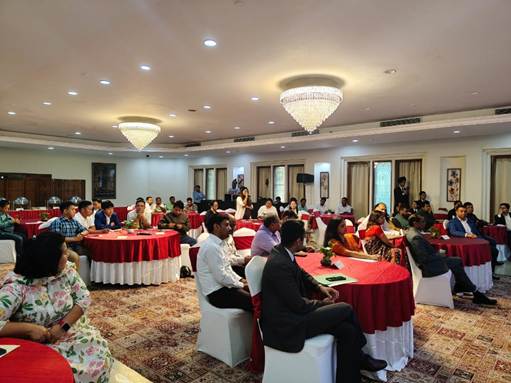
Addressing participants, ITDC Managing Director Mugdha Sinha said the tribal homestay movement is aligned with the Prime Minister’s broader vision of establishing one lakh homestays across India.
She said the immediate goal is to train 1,500 participants, but the long-term objective is larger: developing a network of trained individuals who can act as trainers of trainers within their own states.
This, she explained, would allow the model to scale rapidly and enable local communities to access hospitality training without depending on centralized institutions.
Inter-Ministerial Collaboration for Inclusive Tourism
Mugdha Sinha said the programme also reflects an effort to break institutional silos and build stronger inter-ministerial collaboration.
According to her, the partnership between the Ministry of Tribal Affairs, Ministry of Tourism and the Incredible Indiaplatform is intended to create a long-term ecosystem where tourism generates sustainable livelihoods while preserving local identity and traditions.
She emphasized that tribal tourism can only succeed when communities remain central to ownership and benefit-sharing.
Focus on Sustainable Development and Preservation of Tribal Traditions
Officials said the initiative has been designed not only as a tourism intervention but also as a sustainable development model.
The training seeks to ensure that tribal communities are able to offer high-quality visitor experiences while preserving their traditional lifestyles, architecture, food culture, and indigenous knowledge systems.
The programme is expected to support local entrepreneurship and generate new income streams without disrupting community structures.
About ITDC
India Tourism Development Corporation was incorporated in 1966 with the mandate of developing tourism infrastructure across India.
Over the decades, ITDC has expanded beyond hotel operations into sectors such as ticketing, tours and travel, event management, duty-free shopping, publicity and printing consultancy, engineering consultancy, sound and light shows, hospitality education, and skill development.
The corporation currently plays a wider role in tourism-linked institutional capacity building across sectors.